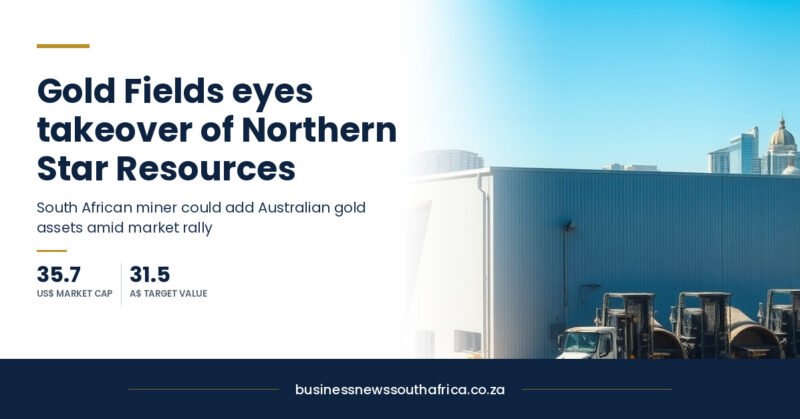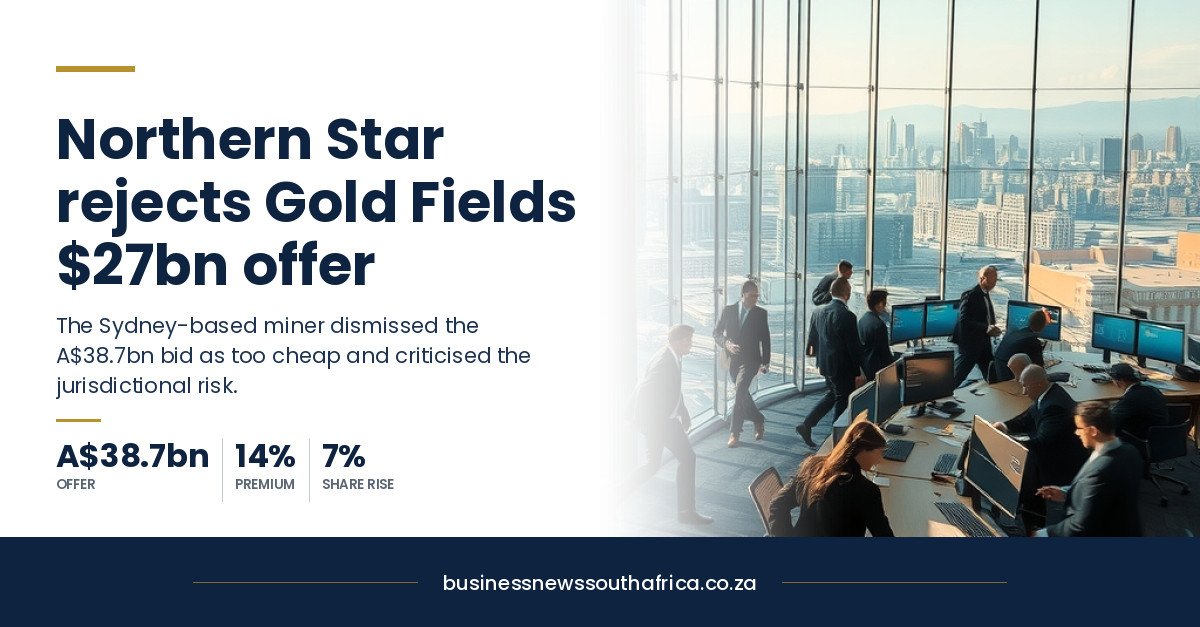
Johannesburg-based Gold Fields has been told no. Australia’s largest gold producer, Northern Star Resources, said on Monday that it had rejected an unsolicited takeover proposal from the South African miner worth A$38.7 billion (about $27.1 billion), calling the approach opportunistic and too cheap. The Gold Fields Northern Star deal would have created the world’s second-biggest gold producer after Newmont and one of the largest takeovers of an Australian company on record.
This morning we reported that Gold Fields had its eye on Northern Star. By the afternoon, the target had published its answer, and one line in it should interest every South African investor as much as the price does.
What Gold Fields offered
The proposal, received on 14 September, offered 0.3125 new Gold Fields shares plus A$7.25 in cash for every Northern Star share. At the time that was worth A$27.00 a share. Because most of the consideration is paper, its value moves with Gold Fields’ own share price, and by Friday’s close it had slipped to A$25.19, Northern Star said.
That works out to a premium of about 14% on Northern Star’s last closing price. Australian takeovers typically need a premium of at least 30% to succeed, which goes a long way to explaining the board’s answer. Northern Star’s shares still rose about 7% to A$23.67 on Monday afternoon, having touched A$24.46 in early trade, a sign the market now expects either a better offer or a sale process of some kind.
“Gold Fields has sought to acquire one of the world’s premier gold portfolios at a price that falls well short of what the Board considers to be its fundamental value and at a highly opportunistic time.”
Northern Star chair Michael Chaney
Northern Star also pointed to what it called onerous conditions attached to the approach, including a request for a period of “hard” exclusivity, and argued the offer arrived just ahead of growth catalysts such as the commissioning and ramp-up of its Fimiston mill, Capital Brief reported.
Why “jurisdictional risk” is the line South Africans should read twice
Among its reasons for rejection, Northern Star said the offer would have left its shareholders with significant exposure to Gold Fields stock, which it described as carrying a higher jurisdictional risk profile than Northern Star’s own asset base. In plain terms: being paid in the shares of a company headquartered in South Africa is, to this board, a discount in itself.
That is a striking thing to say about Gold Fields in particular. The company’s only South African mine is South Deep, south-west of Johannesburg, and by Gold Fields’ own account the combined group would have produced about 4.1 million ounces of gold a year, 80% of it from Australia, North America and Chile. Northern Star shareholders would have held 33% of the new company, which was to take a secondary listing on the Australian Securities Exchange.
The complaint, in other words, is less about where the gold comes from than about where the head office sits and where the company has its primary listing. For South African boards with global ambitions, it is a reminder that the country discount does not stay at home. It travels with the share certificate, and it shows up in the most concrete place possible: the price a target is willing to accept in your paper.
Gold Fields’ case, and who else has a say
Gold Fields said it had held a number of discussions with Northern Star over the past six months, with limited engagement, before tabling a proposal it believes offers compelling strategic and financial benefits for both sets of shareholders. It expects $4 billion to $5 billion in corporate, operational and portfolio synergies, and the two companies already sit side by side in Western Australia, including around Kalgoorlie, home of the Super Pit.
“The Company remains open to constructive dialogue and continues to seek engagement with the Northern Star Board,” Gold Fields said. Chief executive Mike Fraser is due to address investors at a gold conference in Colorado on Tuesday, his first public appearance since the rejection.
Gold Fields has done this before. Last year it grew its Australian footprint with the A$3.7 billion acquisition of Gold Road Resources, after raising its first offer.
The swing vote may be Elliott Investment Management. The activist investor, which says it now owns 6.2% of Northern Star, urged the company in June to run a strategic review that it said could end in a sale to a rival such as Gold Fields, and pressed for the change of chief executive that followed in July. “The Board has an obligation to engage with any serious buyer and fully evaluate the best path to deliver on that potential,” Elliott partner John Pike said on Monday.
Not every shareholder agrees. “This bid feels opportunistic and (we) would agree with the board in rejecting it,” John Ayoub, a portfolio manager at Wilson Asset Management, which holds Northern Star shares, told Reuters.
What happens next
A rejected first approach is the opening move in most large mining deals, not the end of them. Gold Fields can raise the cash component, which would also shrink the “jurisdictional risk” objection by reducing how much of the price is paid in its shares. It can wait for Elliott to keep pressing the board. Or it can walk away.
For JSE investors, the next numbers to watch are simple: whether Gold Fields’ share price holds up while it is seen as a bidder, and whether any improved offer leans more on cash. The second one will say a great deal about how much Gold Fields believes its own paper is being undervalued, and how much it is prepared to pay to prove the point.