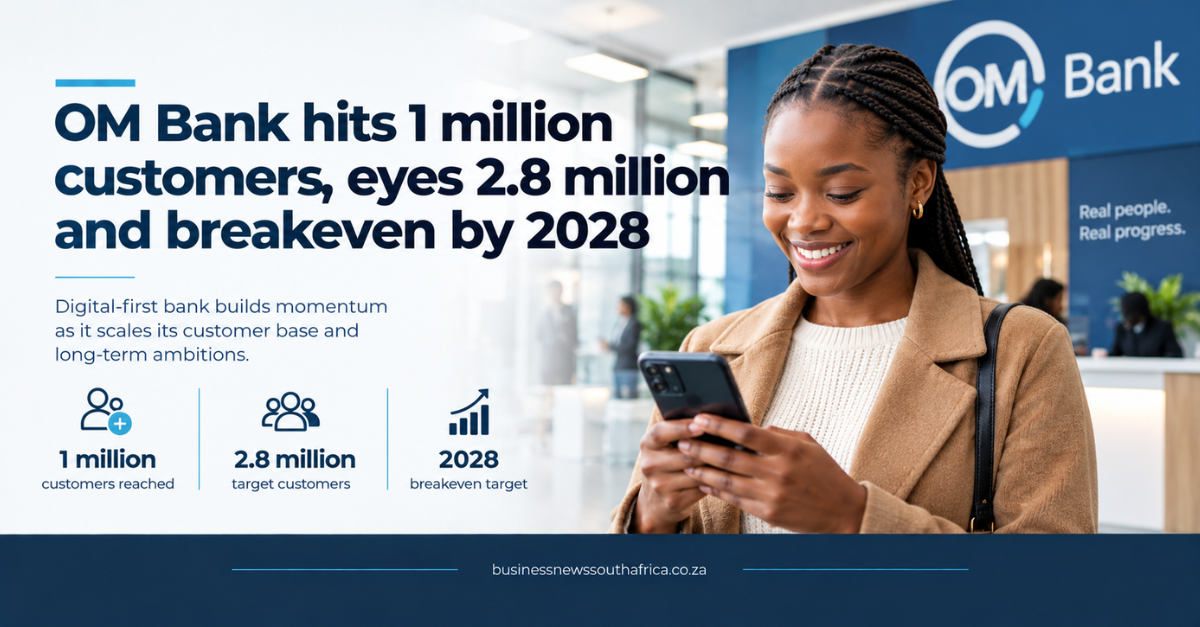
According to Moneyweb, OM Bank, a unit of Old Mutual, Africa’s largest insurer by assets, is positioning itself to take on the country’s entrenched banks and insurance players.
A “unit” is a separate business that operates under the umbrella of a larger company. In this case, Old Mutual has created a full-service bank that will compete with the traditional big-four banks, Standard Bank Group, FirstRand, Absa Group and Nedbank Group, as well as newer fintech lenders.
The market is already crowded. 81% of South Africans hold a bank account, and the big-four control about 83% of the R5.8 trillion of banking assets, according to S&P Global. Those banks are also expanding into insurance, offering car, home, credit and funeral cover. The convergence of banking and insurance is the reason OM Bank’s chief executive, Clarence Nethengwe, says the group felt “we had to get into banking ourselves”.
What OM Bank is betting on
Launched in August 2025, the bank has attracted roughly 4 500 new customers each day, reaching one million clients by September. Of those, 68% were already Old Mutual customers, while the remaining 32% are new to the group. Old Mutual spent R2 billion to set up the bank and injected a further R3.2 billion between 2025 and 2026. A further R2 billion is budgeted for 2027-28, when the lender expects to break even or turn a profit.
The bank’s strategy is to focus on earners with a monthly income of R15 000 to R50 000. It aims to grow its customer base to 2.8 million by 2028 and to mobilise deposits of up to R10 billion, largely by repurposing an existing insurance-savings product that already holds about R32 billion and adds roughly R1.5 billion each year.
“We expect to start paying dividends by 2032, potentially,” Nethengwe said, indicating a long-term view of profitability.
For small-business owners, the entry of a new bank could mean more choice in loan products and potentially lower rates, as competition intensifies. OM Bank’s focus on the middle-income segment suggests it may tailor products that are simpler than those offered by the big-four, which often bundle banking with insurance. That could be attractive for SMEs that need straightforward credit facilities without the extra insurance layers.
However, the uphill climb should not be underestimated. The big-four together are expected to post combined headline earnings, profit before tax and one-off items, of more than R139 billion by the end of 2026. Their scale gives them pricing power and extensive branch networks, which OM Bank will have to match with digital channels and a clear value proposition.
Fintech rivals are also in the mix. Sanlam, another major insurer, has secured approval to provide transactional banking services with digital lender GoTymebank by early 2027. Discovery, the country’s largest medical-insurance administrator, launched its own lender in 2019 and posted a full-year profit in the 12 months ended June. These players illustrate the broader trend of insurers moving into banking, a space that could become more fragmented but also more innovative.
For entrepreneurs weighing financing options, the key question is whether OM Bank’s products will be priced competitively enough to challenge the incumbents. If the bank can leverage Old Mutual’s existing customer base and its insurance-savings product to offer attractive deposit rates, it may carve out a niche. On the other hand, the bank’s profitability timeline, break-even by 2028 and dividends only by 2032, signals that it will need several years to achieve scale.
SMEs interested in exploring new funding sources can use the commercial funding suite tool to compare loan offers across providers, including emerging banks like OM Bank.
Overall, OM Bank’s entry adds another layer to an already competitive banking landscape. While the big-four remain dominant, the push by insurers and fintechs could create more tailored products for small businesses, provided the new entrants can sustain the capital and operational costs required to win market share.
Moneyweb reported that OM Bank is positioning itself to become the preferred lender in a key sector of South Africa’s economy, leveraging the insurer’s existing insurance-savings product that has accumulated roughly R32 billion and grows by about R1.5 billion each year. The bank’s plan to mobilise deposits of up to R10 billion by 2028 rests on repurposing that pool of funds, while its capital backing includes an initial R2 billion set-up spend and a further R3.2 billion injected between 2025 and 2026. A further R2 billion is earmarked for the 2027-28 period, aligning with the target to break even or turn a profit by the end of that window.
When a new bank launches in South Africa it must first obtain a banking licence from the Prudential Authority, demonstrate sufficient capital adequacy and meet liquidity requirements set out in the Basel III framework. The licence authorises the institution to accept deposits, extend credit and provide payment services, but it also obliges the bank to submit regular prudential returns and undergo supervisory inspections. Capital injections, such as the R2 billion and R3.2 billion that Old Mutual has provided, satisfy the minimum capital base and give regulators confidence that the bank can absorb losses while it builds a loan book.
For a South African business owner the entry of OM Bank matters because it adds a new source of financing that is not bundled with insurance cover, a common feature of the big-four banks. By targeting earners with monthly incomes between R15 000 and R50 000, the bank is likely to design loan products with simpler documentation and potentially lower interest spreads. Owners should monitor the bank’s deposit rates, which may be tied to the performance of the insurance-savings pool, and compare them against existing offers to gauge whether the competition translates into cheaper credit.
Looking ahead, entrepreneurs should keep an eye on the first-quarter-2027 rollout of Sanlam’s transactional banking service with GoTymebank, as that partnership will intensify competition in the digital-banking space. The big-four banks are projected to post combined headline earnings exceeding R139 billion by the end of 2026, giving them pricing power that could influence market rates. Any regulatory updates from the Prudential Authority regarding fintech collaborations or capital requirements will also shape how quickly OM Bank can scale its loan portfolio and deliver on its profitability timeline.