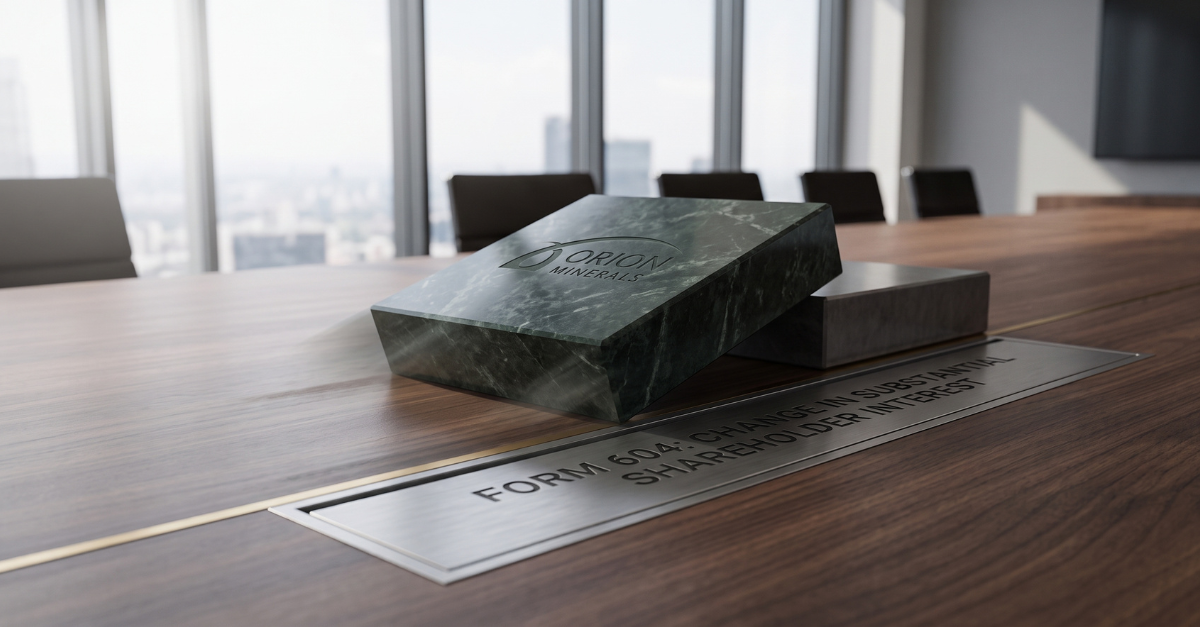
On 20 August 2026 Orion Minerals Limited lodged a Form 604 with the Johannesburg Stock Exchange. The form, which companies must submit when a person or entity holding at least five percent of voting rights changes their interest, was published by Moneyweb. The filing notes that a substantial holder has altered its shareholding, but the notice does not disclose the name of the holder, the size of the change or the exact date of the transaction.
For a small business owner or entrepreneur, the relevance of such a filing lies in what it can mean for the company’s governance and market perception. A substantial holder can influence board appointments, dividend policy and strategic direction. When that holder’s stake moves up or down, other investors often reassess the company’s risk profile, which can affect the share price and the cost of capital for future projects.
What is a Form 604?
A Form 604 is a regulatory requirement under the Companies Act and JSE listing rules. It forces any person who owns, or intends to own, five percent or more of a listed company’s voting rights to publicly announce the change. The purpose is to keep the market informed about who holds enough shares to sway decisions. The filing must state the holder’s name, the number of shares before and after the change, and the date the change took effect.
In Orion Minerals’ case, the public notice only confirms that a change has occurred. The company’s statement, as quoted in the Moneyweb brief, simply acknowledges the filing and says it will update its shareholder register accordingly. No comment was given on the reasons behind the move or its expected impact on the miner’s operations.
Orion Minerals is a gold exploration and development company focused on projects in the Witwatersrand basin. The firm has been seeking additional financing to advance its flagship Kraaipan project, a venture that requires substantial capital and, consequently, the support of large shareholders. A shift in a major holder’s stake could signal confidence in the project’s prospects, or conversely, a re-allocation of capital to other opportunities.
Recent trends in the South African mining sector show a modest increase in institutional ownership, as pension funds and foreign investors look for exposure to gold amid global inflation concerns. At the same time, some local mining houses have been trimming positions to free up cash for new acquisitions. Without the exact figures, it is impossible to place Orion’s filing within that broader pattern, but the mere existence of a change suggests the company is on the radar of investors with enough weight to trigger a Form 604.
For SME owners watching the mining space, the key takeaway is that large-shareholder movements can foreshadow strategic shifts. If a substantial holder is increasing its stake, it may be preparing to push for accelerated development or a potential merger. If the stake is being reduced, the company could face pressure to improve cash flow or consider asset sales. In either scenario, the market’s reaction can affect the cost of borrowing for the miner, which indirectly influences suppliers, contractors and service providers that operate in the sector.
Orion Minerals has not disclosed any immediate operational changes linked to the filing. The company’s last interim report, released in March 2026, showed a rise in exploration expenditure and a modest increase in gold reserves. Management highlighted the need for stable financing to sustain those activities. A change in a substantial holder’s interest could therefore be a piece of the financing puzzle, but the filing alone does not confirm any new funding arrangements.
Investors and analysts will now watch Orion’s share price for any movement that reflects market sentiment about the undisclosed change. The JSE’s daily trading data will reveal whether the filing prompted buying or selling pressure. For business owners who supply equipment or services to the mining sector, a volatile share price can translate into delayed payments or renegotiated contracts, underscoring why even a seemingly technical filing matters beyond the boardroom.