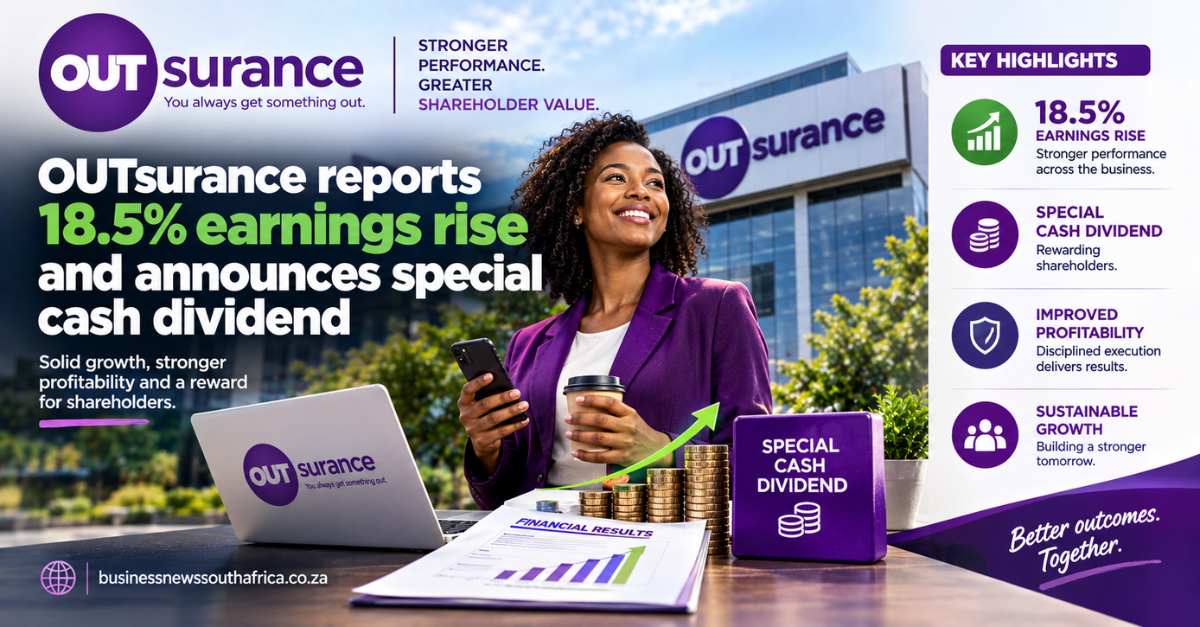
OUTsurance, the South African motor and short-term insurer, said its earnings grew 18.5% in the latest reporting period. The figure, taken from the company’s own release, reflects higher premium income and tighter cost control.
Marthinus Visser, the group chief executive officer, used a Moneyweb interview to outline three areas of focus. First, he spoke about a shift in the company’s international ventures. While he did not name specific markets, Visser indicated that the insurer is re-allocating resources toward regions where it sees better risk-adjusted returns. In plain terms, the move means the company will pull back from less profitable overseas operations and concentrate on areas that match its underwriting expertise.
Second, Visser announced a special cash dividend. A special cash dividend is a one-off payment to shareholders, separate from the regular dividend that is paid out each year. It is usually funded from excess cash or a specific profit event. The amount of the payout was not disclosed in the interview, so investors will need to wait for the formal announcement to know the exact figure.
Third, the CEO highlighted changes to corporate governance at board level. Corporate governance refers to the system of rules, practices and processes by which a company is directed and controlled. Adjustments to the board can affect strategic direction, risk oversight and the speed of decision-making. Visser said the new composition is intended to bring fresh perspectives and strengthen oversight, but he did not provide details on who is joining or leaving the board.
For small business owners who rely on OUTsurance for vehicle and property cover, the earnings boost could translate into more stable pricing and the ability of the insurer to honour claims even in a tight credit environment. The special cash dividend, while primarily of interest to shareholders, signals that the company has generated surplus cash, a sign of financial health that may reassure policyholders.
The broader market sees the insurer’s performance as a bellwether for the short-term insurance sector, which has been coping with higher claims costs and inflationary pressure. OUTsurance’s earnings growth contrasts with some peers that have reported flat or declining results, suggesting that its focus on cost efficiency and selective international exposure is paying off.
Analysts will be watching the upcoming detailed results for the exact dividend amount and the names of the new board members. Those details will determine whether the optimism expressed by Visser can be backed by concrete actions.
What a special dividend says that an ordinary one does not
A special dividend is a statement about capital rather than about profit, and the statement is a blunt one: the company has more money than it can currently use. That is not automatically good news or bad news, and reading it correctly means asking why the surplus exists in the first place.
An insurer accumulates capital for a specific reason. Regulators require it to hold enough to pay claims in a year far worse than the one it expects, so a portion of the balance sheet sits deliberately idle, sized against the risks the insurer has underwritten. When the business grows, that requirement grows with it and absorbs cash. When growth slows, or when the company steps back from a market, capital held against those risks is released and has nowhere particular to go.
That is why a special dividend and a retreat from underperforming operations tend to be announced in the same breath, as they are here. The payout is the mechanical consequence of the retreat. The question it raises for a shareholder is whether the company is returning money because it has genuinely run out of attractive places to deploy it, which is honest and much preferable to spending it badly, or because it has run out of ideas, which is a different proposition at the same price.
What it means for a policyholder rather than a shareholder
For a business owner whose interest in the insurer is a fleet policy rather than a share certificate, the relevant signal is not the dividend but the capital position behind it. An insurer with surplus capital is an insurer able to pay a large claim in a bad year without needing to raise money at short notice, which is the only promise an insurance policy actually makes.
The caution is that capital strength and pricing discipline are separate things. A well-capitalised insurer can still raise premiums, and an insurer reallocating away from unprofitable segments is by definition rethinking which risks it wants to carry. A policyholder in a segment the insurer is cooling on may discover that at renewal rather than in a results presentation.