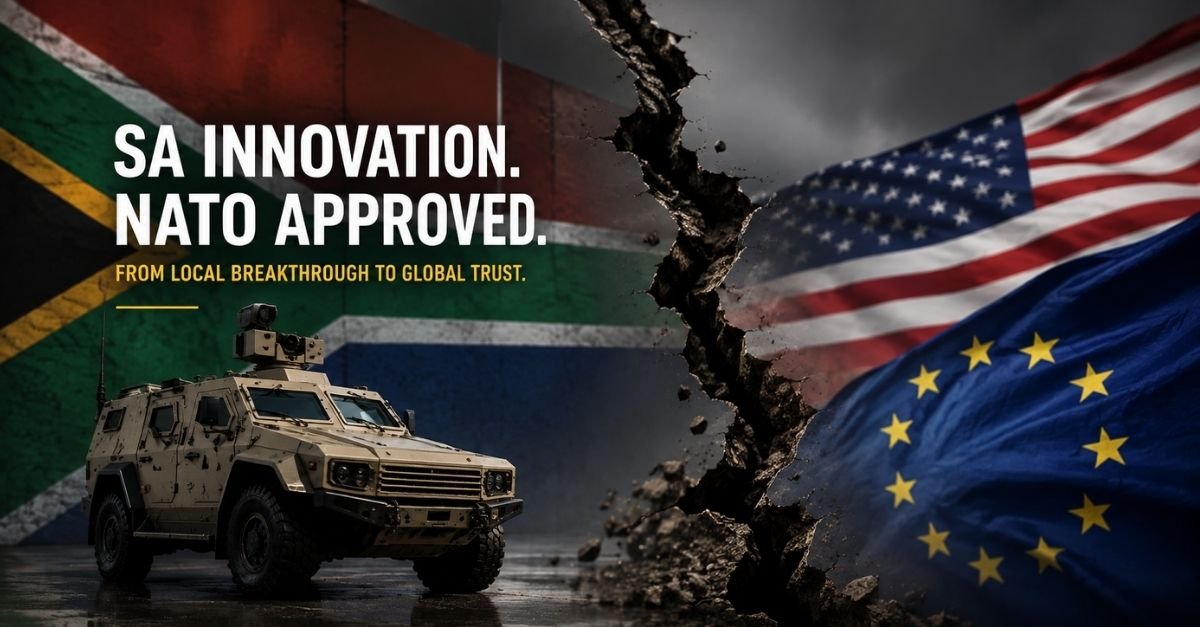
Two years ago, Paramount Group did not have a single customer inside NATO. Today, according to the private, South African-founded defence manufacturer, that market has “definitely opened up” — and the reason has less to do with anything Paramount changed than with a rift opening between the United States and its European allies over defence spending.
“There were no NATO markets two years ago,” Deon Grobler, who leads Paramount’s international vehicle business and product development, told Bloomberg. “That has definitely opened up. All of a sudden spending has changed completely out of Europe.” NATO member states, which historically bought almost exclusively from American and Western European suppliers, are now reaching out to a company whose traditional customer base ran through Africa, the Middle East and countries such as Jordan, Ecuador and Kazakhstan.
Why a rift between allies becomes a sales opportunity
The mechanism here is straightforward once it is spelled out. European NATO members have spent decades relying heavily on American defence contractors and, to a lesser extent, on each other, a structure built around the assumption that Washington remained a stable, engaged security partner. As that assumption has come under strain, European defence ministries have been actively diversifying their supplier base, both to reduce dependence on any single ally and to find equipment that can be delivered faster and cheaper than the backlog-choked order books of the traditional primes. Paramount, active in roughly 30 countries and privately held, with no government shareholding to complicate a sale, fits that diversification need almost by accident of timing.
The numbers back up the shift in direction. According to industry data compiled by DefenceWeb, South African defence exports reached R10.1 billion in 2025, nearly tripling the R3.6 billion recorded in 2024. Europe alone accounted for 42% of that total, ahead of the Middle East on 23% and Africa, long the industry’s traditional base, on 20%. Germany took delivery of a single munitions contract worth R3.3 billion for 73,586 rounds, while Turkey bought 35,000 rounds worth R676 million. Armoured vehicles made up just over R1 billion of the total, with more than 130 vehicles exported, and aircraft sales to the Democratic Republic of Congo, Mozambique and Iraq, likely including Paramount’s own Mwari light attack and surveillance aircraft, brought in close to R1.75 billion between them.
What Paramount is actually selling
The product at the centre of Paramount’s NATO push is the Mbombe family of mine-protected infantry vehicles: a four-wheel, 16-tonne variant capable of 140 km/h with an 800 km range, alongside six- and eight-wheel versions built for the same mine-resistant, ambush-protected role that Western militaries spent two decades relearning the value of in Iraq and Afghanistan. Alongside the vehicles sits a growing portfolio built for exactly the kind of conflict currently reshaping European threat assessments: the MAC OWL armoured vehicle, certified for use in Ukraine in June, the MAC Dead Fly interceptor drone, and the KATRAN uncrewed surface vessel.
Mathews Phosa, chairman of Paramount’s South African unit and a former ANC treasurer-general, framed the company’s model in terms that speak directly to industrial policy rather than just arms sales: “Our portable production model allows South African technology and intellectual property to be combined with local manufacturing and industrial partnerships in international markets.” In practice, that has meant setting up armoured vehicle manufacturing inside Ukraine itself through a partnership with Greek firm MAC HUB, running a separate armoured car line in the Czech Republic, and developing a light armoured multipurpose vehicle jointly with an Indian partner. The intellectual property stays South African even where the welding does not.
Why this matters beyond the defence sector
For a country whose export mix is dominated by mining commodities and vehicles built to someone else’s design under licence, a privately-held, South African-engineered product line winning contracts against European and American incumbents on its own technical merits is a genuinely unusual data point. It also carries a real, if narrower, opportunity for South African SMEs: Paramount’s “portable production model” depends on local manufacturing and industrial partnerships in the countries it exports to, but the design, engineering and systems-integration work behind that intellectual property still has to happen somewhere, and defence-adjacent local suppliers, in precision manufacturing, composites, electronics and systems software, are the ones positioned to benefit as that order book grows.
None of this is without risk. Export orders tied to a geopolitical rift can reverse as quickly as they opened if the underlying US-Europe relationship stabilises, and defence contracts of this size typically move through long, politically sensitive approval processes in the buying country that can stall or collapse without warning. For now, though, the direction of travel, an SA-founded manufacturer selling mine-protected vehicles and drones into markets that would not answer its calls two years ago, is a rare example of a distinctly South African industrial capability being pulled, not pushed, into the world’s most demanding procurement market.