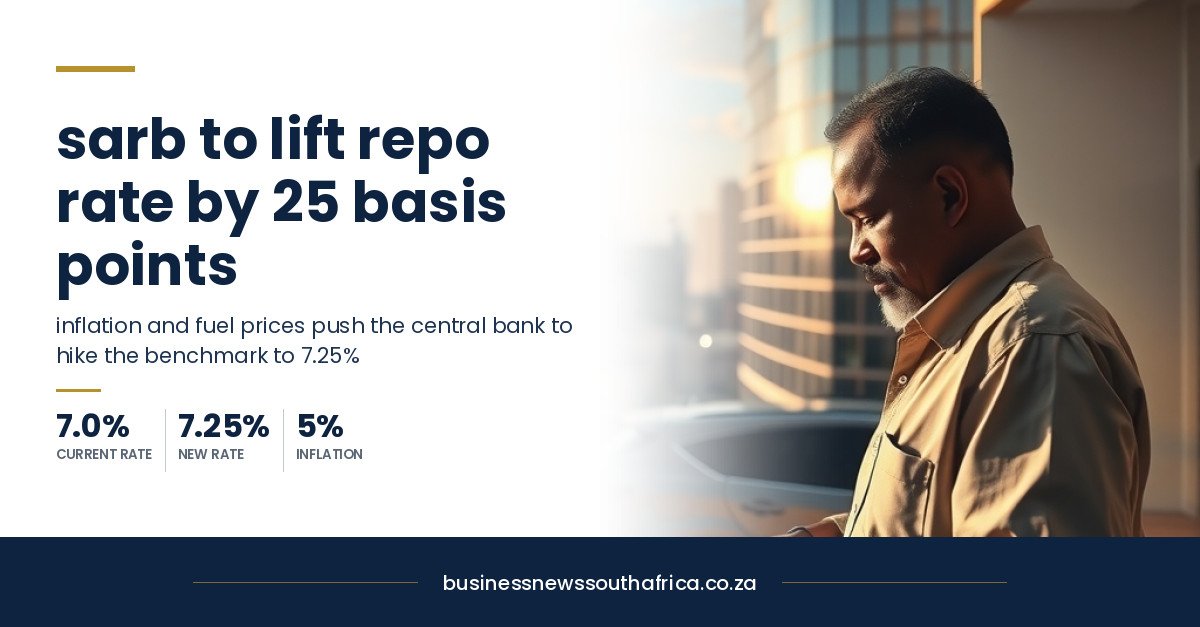
The South African Reserve Bank has raised its policy rate by 25 basis points to 7.25%, effective 25 September, taking the prime lending rate to 10.75%. The Monetary Policy Committee’s decision on Wednesday 23 September was unanimous, and it came in line with what most banks and economists had expected going into the meeting.
Governor Lesetja Kganyago tied the move to a fuel price shock that has intensified rather than faded. “We see upside risks to inflation,” he said, describing a decision taken amid high uncertainty while the committee stayed focused on its price stability mandate, Moneyweb reported.
Why the Reserve Bank moved now
Headline inflation was 4.4% in August, up from 4.3% in July and 140 basis points above the Reserve Bank’s 3% target. On its own that is not an alarming number. What worried the committee is the direction of travel: fuel prices have kept climbing, services inflation remains elevated, and inflation expectations are sitting at around 4%, well above the target the bank is trying to anchor.
The global picture adds to the pressure. Kganyago pointed to the conflict in the Middle East, disruption to oil supply and the war between Russia and Ukraine as forces pushing prices up, and noted that central banks elsewhere have also been raising rates. SAnews reported the Governor’s framing of the bank’s responsibility plainly: inflation must revert to 3% as the current shock fades, and the Reserve Bank intends to deliver that outcome. It projects inflation returning to target towards the end of 2027.
The trade-off is growth. The Reserve Bank cut its growth forecast for 2026 to 1.2% from 1.4%, and described the risks to growth as skewed to the downside. Raising rates into a slowing economy is a deliberate choice to protect the inflation target now rather than risk a longer, more expensive fight later if higher fuel costs feed through into wages and prices across the economy.
What the hike costs
Most South African loans are priced off prime, and banks move prime in step with the repo rate, so the change reaches borrowers almost immediately. On a R1 million, 20 year home loan at prime, the monthly repayment rises from about R9,984 to about R10,152, roughly R168 more a month. On a R1.5 million bond the increase is about R253 a month.
For businesses the effect lands first on variable rate debt: overdrafts, revolving credit and term loans linked to prime. A company carrying R500,000 on an overdraft priced at prime will pay about R104 more in interest each month. None of those numbers is dramatic on its own. The larger cost is what the hike signals: borrowing will not get cheaper in the near term, and planning that assumed rate cuts this year needs revisiting.
What business owners should do
The practical steps are the same ones that apply at the start of any hiking cycle. Check which facilities are linked to prime and model what a further increase would do to monthly cash flow, rather than only this one. For planned borrowing, compare fixed rate offers against variable pricing now, since fixed rates will already reflect expectations of where rates are heading. Businesses that sell on credit should also expect customers to pay more slowly as their own financing costs rise.
Consumers will feel the hike through bond, vehicle and credit card repayments at the same time as higher fuel prices, which squeezes discretionary spending. Retailers, hospitality businesses and anyone selling non-essential goods should plan for softer demand into the festive season rather than assume a normal year-end lift.
What to watch next
The committee’s next decision will depend on whether the fuel shock starts to unwind. The key data points are the monthly fuel price adjustments, the next inflation prints from Stats SA and the path of inflation expectations. A unanimous vote suggests the committee is united about the risks, and that it would be prepared to move again if inflation keeps rising.
For more on rates, markets and the economy, see our Markets & Finance coverage. The Reserve Bank publishes its full MPC statements on resbank.co.za.