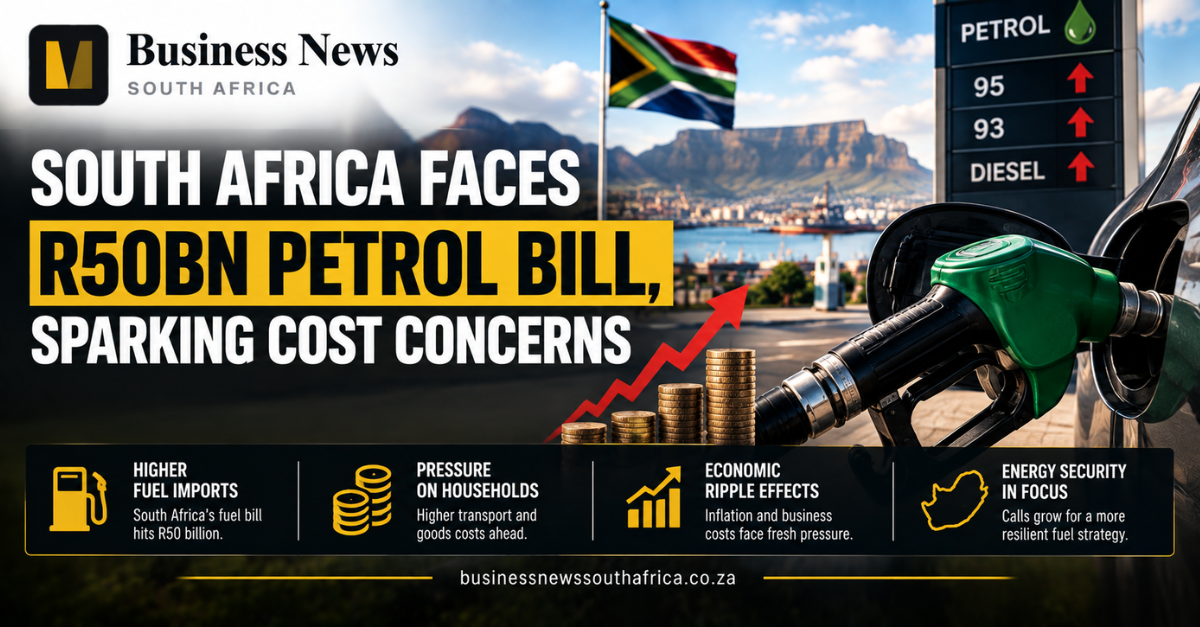
Picture a line of fuel trucks at a Durban terminal, engines humming, as a headline on a local automotive site flashes: R50 billion petrol bill headache for South Africa. The statement, published by TopAuto.co.za, offers a single, stark figure without explanation, a bill that, if accurate, would be a sizeable chunk of the national budget.
What exactly does a “petrol bill” refer to? In South African parlance it usually denotes the cost incurred by the state for imported refined petroleum, which is then subsidised or passed on to consumers through the retail price of gasoline. The term is a shorthand for the total invoice the Treasury pays to international refiners and the logistics chain that brings the product to local pumps.
According to the headline, the amount in question is R50 billion. To put that into perspective, the country’s annual fiscal budget runs in the vicinity of R1.5 trillion, meaning the fuel expense would represent roughly three per cent of total spending. For a country already juggling a high debt load and a volatile rand, that proportion is not negligible.
South Africa imports about 70 per cent of its refined petroleum, a dependency that makes the nation vulnerable to global price swings. When crude oil prices jump, the import bill can swell quickly, especially if the rand weakens against the dollar. The headline therefore hints at a confluence of rising commodity prices and a depreciating currency, a familiar story for many South African businesses.
Why should an SME owner care about a headline that sounds more like a line item on a government spreadsheet than a daily operational cost? The link is simple: fuel is a key input for transport, delivery and logistics. An increase in the government’s cost of petrol often translates into higher fuel taxes or reduced subsidies, which in turn push up the price per litre at the pump. For a small retailer or a regional distributor, a R0.20-R0.30 rise per litre can add up to thousands of rand a month, eroding profit margins that are already thin.
In the broader economy, higher fuel costs tend to feed into inflation. The Consumer Price Index (CPI) includes a transport component, and when that component climbs, the Reserve Bank may feel compelled to tighten monetary policy. For a small business owner, tighter policy usually means higher interest rates on loans, which can stall expansion plans or make working capital more expensive.
The headline also raises a question about fiscal policy. If the Treasury is shouldering a R50 billion fuel invoice, the question is whether that cost is being absorbed through the general fund, passed on to consumers, or covered by targeted subsidies for certain sectors. The answer is not provided in the source, and without a breakdown it is difficult to gauge the immediate impact on any particular industry.
What is clear, however, is that the cost of fuel is a recurring headache for South Africa. In 2023 the country spent close to R40 billion on petroleum imports, and analysts have warned that the figure could climb if global oil prices remain elevated. The current headline suggests that the upward trend may have accelerated, perhaps driven by geopolitical tensions or supply chain disruptions that have pushed benchmark crude prices above US$80 a barrel.
For entrepreneurs, the practical takeaway is to keep a close eye on fuel price trends and to consider hedging strategies where possible. Some larger firms use forward contracts to lock in a price for a portion of their fuel needs, thereby shielding themselves from sudden spikes. Smaller firms may not have the scale to negotiate such deals, but they can still mitigate risk by reviewing delivery routes, consolidating shipments, or exploring alternative fuels such as biodiesel where infrastructure permits.
In the meantime, policymakers will need to balance the fiscal burden of a large import bill against the economic pain of higher pump prices. Options on the table typically include adjusting fuel levies, providing temporary subsidies for essential transport services, or encouraging local refining capacity, a sector that has struggled with under-utilisation for years.
Until more details emerge about the composition of the R50 billion figure, the headline remains a warning sign rather than a definitive forecast. For the South African small-business owner, it is a reminder that fuel costs are a variable that can shift the bottom line overnight, and that staying informed is the first line of defence.