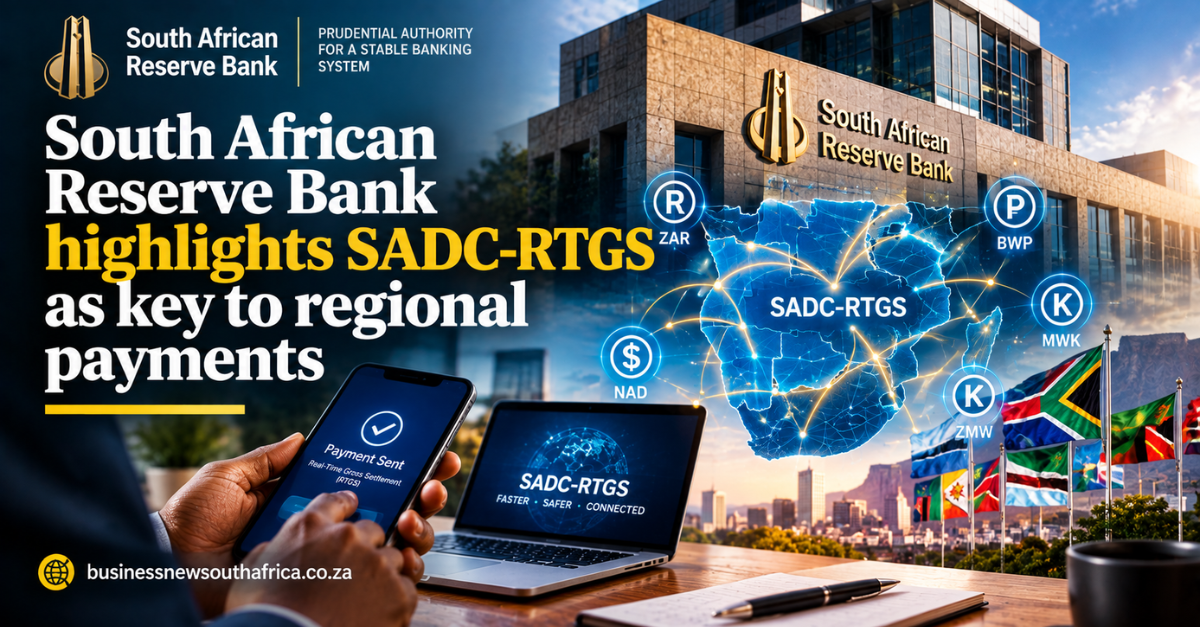
When you press play on Moneyweb’s “The Business of Africa” podcast, the first voice you hear is that of Arif Ishmael, head of the National Payment System Department at the South African Reserve Bank. He opens by describing the Southern African Development Community Real-Time Gross Settlement system, SADC-RTGS, as the backbone of the region’s financial network.
For a small-to-medium enterprise that ships goods from Johannesburg to Lusaka, the speed and cost of moving money across borders can be the difference between profit and loss. Ishmael’s remarks matter because the system links the central banks of 16 SADC members, allowing payments to settle in real time rather than days later. If the platform lives up to its promise, businesses could see faster cash flow and lower fees, which directly affect their bottom line.
The promise of smoother payments sits against a backdrop of long-standing fragmentation. The first attempts at African integration date back to the 1959 Sanniquellie meeting, where Liberia, Ghana and Guinea debated whether a political federation or a looser technical cooperation was the way forward. Those early debates eventually produced the Organisation of African Unity in 1963 and, later, the Abuja Treaty of 1991, which set out a legal framework for an African Economic Community.
Decades later the continent still struggles with high trade costs. The World Bank Group’s Integrating Africa report estimates that trade finance demand in Africa leaves a gap of about $100 billion each year. It also finds that transport costs in sub-Saharan Africa are more than 50 percent higher than in East Asia and the Pacific, largely because under-developed infrastructure accounts for over 40 percent of those costs. Intra-African trade is under 16 percent, with most flows concentrated in a few regional hubs.
Some countries are already tackling the bottlenecks that make cross-border trade expensive. Rwanda’s customs digitalisation has cut average border dwell time by more than 40 percent. Kenya’s warehouse receipt system and cargo-tracking technology have improved traceability and reduced losses in agricultural trade. Ethiopia’s electronic single-window platform now handles procedures for more than 20 agencies involved in trade clearance. These steps show that digital tools can shave time and money off the trade chain.
Why cross-border payments matter
In the podcast, Ishmael argues that the SADC-RTGS system is the financial counterpart to those customs and logistics reforms. By settling payments instantly, the platform could reduce the need for costly correspondent-bank arrangements and lower the risk of settlement delays. He notes that the system was designed specifically to support regional economic integration, and that its reach across 16 countries gives it a unique scale.
However, the benefits are not guaranteed. The Reserve Bank’s description of the system as the “backbone” of the region’s financial system is a claim that has yet to be verified by independent data on cost savings or transaction volumes. Small businesses will need to see concrete evidence that fees are lower and that the platform is reliable before they can shift significant cash flows onto it.
What remains unclear is how quickly the SADC-RTGS can expand its services to cover more transaction types, such as retail-level payments or mobile money transfers that dominate many African markets. The system currently focuses on inter-bank settlements, so SMEs that rely on smaller payment providers may still face a layer of intermediaries.
For now, the podcast serves as a reminder that financial integration is a piece of the larger puzzle of African trade. If the SADC-RTGS can deliver on its promise, businesses that operate across borders could enjoy faster cash conversion cycles and reduced foreign-exchange risk, advantages that matter in a continent where moving a container from Addis Ababa to Djibouti can cost $2 000, more than shipping the same container to China.
Until the Reserve Bank publishes performance data, the system’s impact will remain a hypothesis. SMEs watching the development should keep an eye on any announced fee structures, settlement speed metrics and the rollout of new services that bring the platform closer to the end-user.