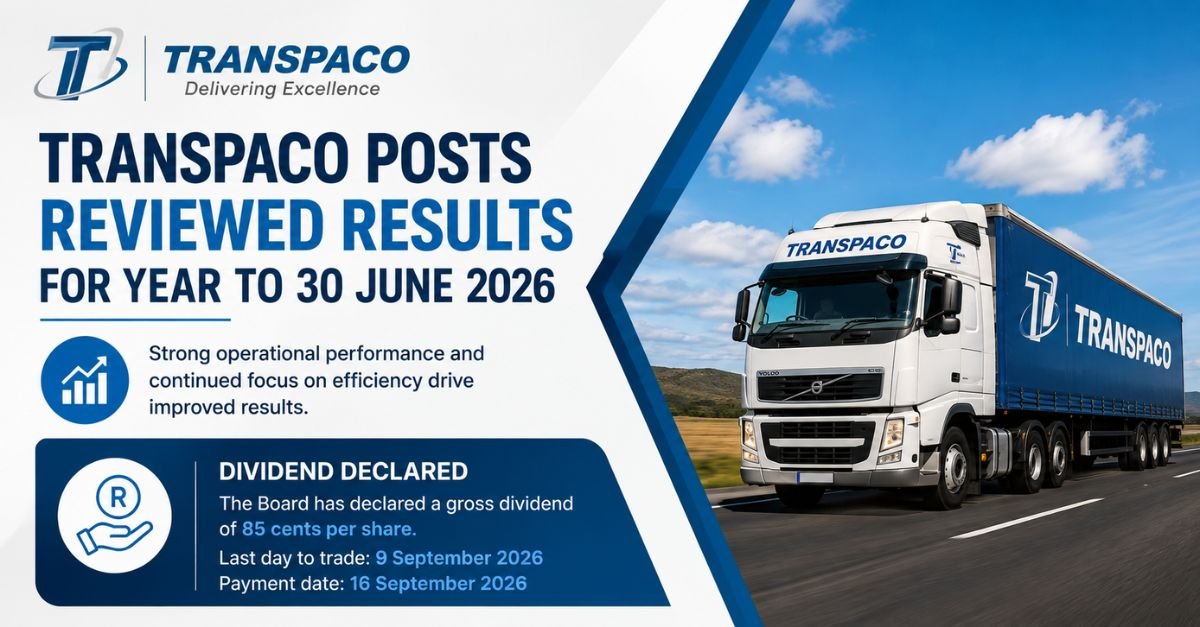
Transpaco has told the market it made enough money to pay shareholders something, though exactly how much remains, for now, the company’s own business. According to a short-form announcement posted via Moneyweb, Transpaco Limited released reviewed condensed consolidated results for the financial year ended 30 June 2026 and declared a dividend, describing the figures as reviewed, meaning examined by management but not yet audited by an independent accountant.
Condensed consolidated results give investors an early glimpse of group performance, profit, revenue and cash flow combined across all subsidiaries, ahead of the fuller audited statements still to come. The dividend itself was confirmed without the exact amount per share disclosed in this initial release.
Why a dividend, even an unspecified one, is worth noting
For shareholders, declaring a dividend at all signals the board believes the company holds sufficient cash after covering operating costs, a genuinely meaningful signal in the transport and logistics sector specifically, where cash flow gets squeezed by rising fuel prices, load-shedding-related delays and fluctuating freight rates all at once. A payout here suggests Transpaco expects earnings resilient enough to absorb those pressures rather than needing to conserve every available rand.
Because the numbers remain under review rather than audited, investors should treat this announcement as provisional. Management may still adjust revenue or expense items before the final audited statements land, which means the dividend amount and underlying profitability both stay genuinely uncertain until that fuller picture arrives.
South Africa’s logistics industry has been coping with high diesel costs, tighter capacity on road networks, and the lingering operational effects of load shedding on warehouse operations, a combination that rewards companies able to keep trucks moving and delivery schedules reliable even when the macro environment turns tough. Transpaco, running its own fleet alongside freight-forwarding services, has historically positioned itself as a mid-size player nimble enough to out-manoeuvre larger carriers on exactly those margins. Many logistics firms in this environment have been investing in fuel-efficient vehicles and digital tracking platforms to offset rising costs, and while this particular announcement does not detail Transpaco’s own capital spending, the dividend itself suggests the board is confident cash generation can support both shareholder returns and continued investment simultaneously.
Investors should watch the forthcoming audited annual report for the actual profit, revenue and cash-flow figures, along with the exact dividend per share and the payout ratio, the share of profit actually distributed, both of which will determine whether this payout looks sustainable or optimistic in hindsight. For small business owners who rely on transport services generally, the announcement is at minimum a hint that Transpaco intends to stay financially stable, which tends to translate into reliable service levels for the businesses depending on it.
Mid-size logistics operators occupy a genuinely precarious spot in South Africa’s freight sector, too small to command the buying power larger carriers get on fuel and vehicle financing, yet often more flexible and responsive than the giants when a client needs a route or schedule no big fleet wants to bother with. A dividend declared in this environment is a small vote of confidence not just in Transpaco specifically but in the idea that a well-run mid-size operator can still turn a genuine profit despite every cost pressure the sector is facing at once. South African logistics clients, from retailers to manufacturers, tend to reward exactly this kind of demonstrated financial stability with longer contracts, since a freight partner that might not survive a bad year is a genuine operational risk worth avoiding regardless of how competitive its rates look today. The full audited numbers, once released, will show whether that confidence was well placed or simply optimistic timing ahead of a harder year still to come.