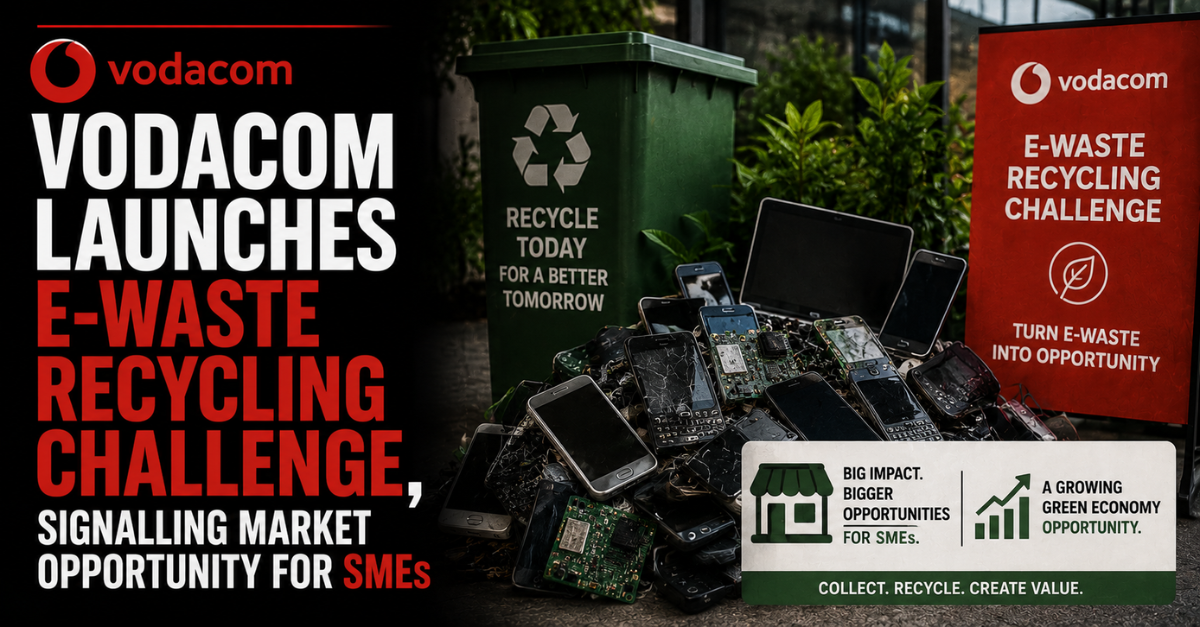
According to a wire report on Infrastructurenews.co.za, Vodacom has rolled out a challenge aimed at encouraging responsible electronic waste (e-waste) recycling across South Africa. The company says the response shows the public is ready to embrace proper disposal of discarded phones, tablets and other devices.
Electronic waste refers to items such as mobile phones, computers, and household appliances that have reached the end of their useful life. Improper handling of e-waste can release hazardous substances like lead, mercury and cadmium into the environment, while also wasting valuable materials such as copper, gold and rare earths.
Why the challenge matters for small businesses
For owners of small enterprises, the challenge points to a growing market niche. Collecting used devices, refurbishing them for resale or extracting recoverable components are activities that can be undertaken with modest capital and a handful of staff. In a country where the mobile penetration rate exceeds 90 per cent, the volume of obsolete handsets is substantial, creating a steady supply of material for recycling firms.
South Africa currently generates an estimated 1.5 million tonnes of e-waste each year, according to the Department of Environment, Forestry and Fisheries. The National Environmental Management: Waste Act requires producers to take responsibility for the end-of-life handling of their products, but compliance remains uneven. A challenge that raises public awareness can help bridge the gap between regulation and practice, giving SMEs a clearer pathway to operate within the law.
The economics of a “waste” stream that is actually an ore body
It helps to reframe what is physically happening when a handset is recycled properly, because the economics only make sense once the material is understood correctly. A tonne of discarded mobile phones contains a meaningfully higher concentration of gold than a tonne of ore mined from a typical gold-bearing rock formation, a comparison the electronics recycling industry has cited for years to make the point that “urban mining” is not a marketing phrase but a genuine resource economics argument. The same applies at smaller scale to the copper in charging cables and the rare-earth elements in phone speakers and vibration motors. A recycler is not disposing of rubbish; they are running a low-grade, high-volume extraction operation, and the profitability depends on collection volume and processing efficiency rather than on the value of any single device.
Vodacom’s challenge also serves as a form of market signalling. When a major telecom publicly backs a recycling drive, it can encourage other large players, from handset manufacturers to retail chains, to adopt similar programmes. That, in turn, expands the network of collection points and creates a more predictable flow of e-waste for small recyclers.
From a financial perspective, the value of recoverable metals in a single smartphone can range from a few rand to several dozen rand, depending on the device’s age and condition. While the margins are modest, the cumulative effect across thousands of units can be significant for a well-run operation, which is exactly why collection volume, not per-unit value, is the metric that determines whether a small e-waste business survives its first year.
However, the challenge also highlights a risk: the need for proper certification and compliance. The South African Waste Management Association (SAWMA) maintains a register of licensed e-waste recyclers. SMEs entering the space must secure the appropriate licences, invest in safe handling equipment and train staff on hazardous material protocols. Failure to do so can result in fines or loss of business credibility, and an unlicensed operator competing on price against a compliant one is, in effect, competing unfairly by skipping the safety costs the law requires.
For entrepreneurs weighing the decision, the key question is whether the anticipated volume of collected devices will cover the upfront costs of equipment, licensing and marketing. The Vodacom challenge suggests a favourable public attitude, but each business will need to conduct its own cost-benefit analysis.
In the broader economic picture, the push for responsible e-waste handling aligns with South Africa’s circular-economy ambitions. By turning discarded electronics into a resource stream, the country can reduce reliance on imported raw materials and lower the environmental footprint of its growing digital economy. While the Vodacom initiative is still in its early stages, the signal it sends is clear: there is a market appetite for responsible e-waste solutions, and small firms that can meet the regulatory and operational demands stand to benefit.