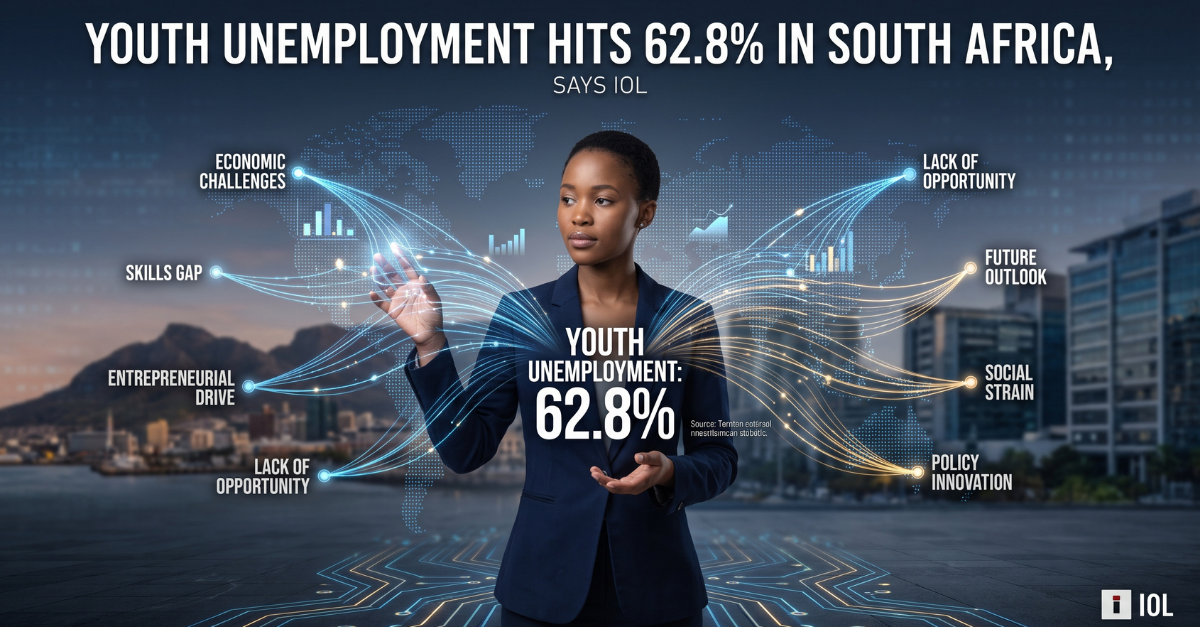
The IOL reported that 62.8% of young South Africans cannot find work. The figure refers to the unemployment rate, the share of the labour force that is without a job and actively looking for one, for people aged roughly 15 to 34.
For owners of small and medium enterprises, the number is more than a statistic. It signals a shrinking pool of potential employees and a market where many households have little disposable income. When a large share of the youth is idle, consumer demand for non-essential goods and services can stall, putting pressure on cash-flow for retailers, hospitality venues and other small-scale operators.
Why the rate is so high
South Africa‘s youth unemployment has hovered around the 60% mark for several years, according to publicly available labour force surveys. The problem is rooted in a mix of factors: a mismatch between the skills taught in schools and those needed by employers, limited entry-level positions in a tight job market, and a slowdown in sectors that traditionally absorb large numbers of first-time workers, such as manufacturing and retail.
In addition, the economy has been coping with persistent load-shedding, higher interest rates and a volatile rand. Those macro pressures tend to hit low-skill, low-wage jobs first, leaving young people with fewer openings to start their careers.
The “narrow” versus “expanded” definition problem
One detail worth flagging for anyone reading unemployment statistics closely: South Africa publishes two different unemployment rates each quarter, a narrow definition that only counts people who are actively searching for work, and an expanded definition that also includes discouraged work-seekers, people who want a job but have stopped actively looking, often because they see little point after repeated rejection. Youth unemployment figures reported using the expanded definition are typically several percentage points higher than the narrow rate for the same age group, so the specific 62.8% figure cited here should be read alongside which definition IOL’s report is actually using, since the gap between the two measures is itself a signal of how many young people have simply given up searching rather than found work.
What it means for SMEs
Small businesses often rely on a steady flow of junior staff to handle routine tasks while senior employees focus on growth. With a large share of the youth unemployed, finding workers with the right mix of basic competence and willingness to learn can become more difficult, forcing owners to raise wages or invest in on-the-job training.
At the same time, the lack of income among a big segment of the population reduces demand for products that are not essential. A clothing boutique in Johannesburg, for example, may see fewer footfalls as young shoppers cut back on discretionary spending. Likewise, a café in Cape Town could see lower weekday sales if nearby students are not earning wages.
Government response and the road ahead
The government has launched programmes such as the Youth Employment Service, which aims to place young people in short-term work experiences, and the National Youth Development Agency, which funds skills development. These initiatives are designed to bridge the gap between education and employment, but their impact is still being measured.
For SME owners, the key takeaway is to watch how these programmes evolve. If they succeed in creating a pipeline of semi-skilled workers, businesses may find a new source of labour at lower cost. Until then, owners may need to consider alternative strategies: automating routine tasks, partnering with training providers, or focusing on niche markets that are less sensitive to broad consumer spending trends.
In short, the 62.8% figure is a warning sign. It highlights a structural challenge that reaches beyond the job market and touches the everyday realities of small-business cash-flow, hiring, and growth planning, whichever precise definition of unemployment produced the number in the first place.