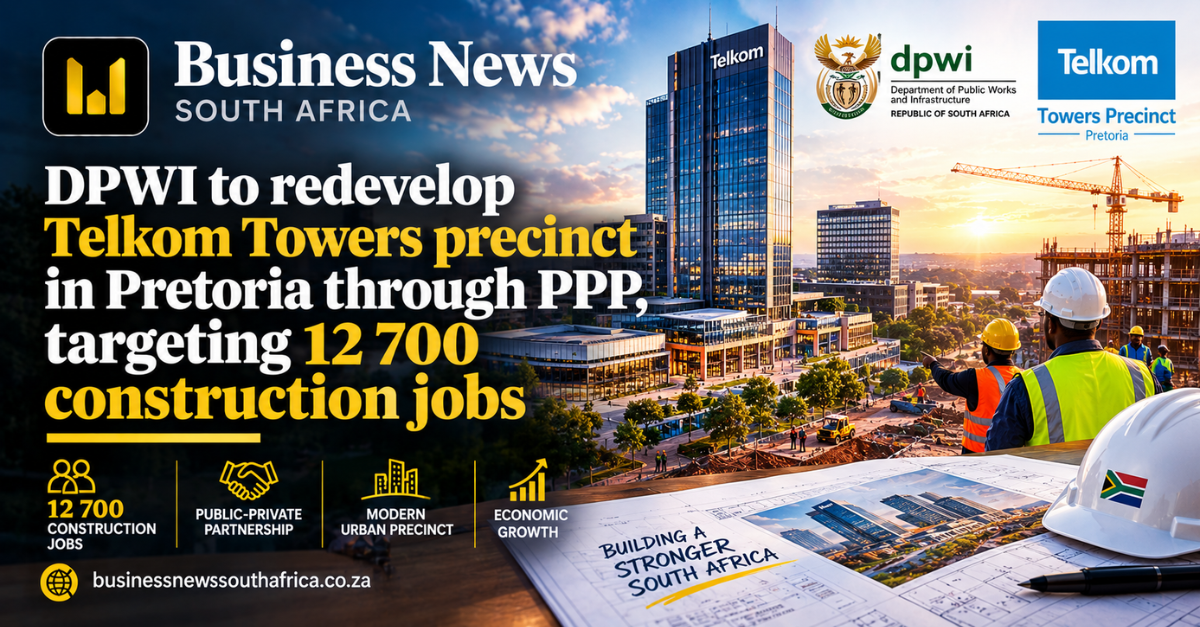
In the heart of Pretoria’s central business district, the once-glamorous Telkom Towers stand largely empty, their concrete façades bearing the scars of vandalism. On Thursday, Minister of Public Works and Infrastructure Dean Macpherson announced a plan to turn that decay into a catalyst for urban renewal.
The Department of Public Works and Infrastructure (DPWI) intends to spend roughly R4.56 billion to refurbish the Telkom Towers precinct and two neighbouring government buildings, Public Works House (PWH) and the Central Government Offices (CGO). The money will not come from the state treasury; instead, the project will be delivered through a public-private partnership (PPP). In a PPP, private investors fund, rebuild and manage the assets, then hand them back to the state after an agreed period, earning returns from lease payments made by government departments.
Macpherson said the Telkom Towers component alone will cost between R1.8 billion and R2.2 billion and will generate about 5 300 construction jobs. The PWH block, which houses the DPWI head office, is slated for a R2.2 billion overhaul, creating roughly 5 700 jobs. The CGO building will require about R560 million and will add another 1 600 jobs. Combined, the three projects will unlock 212 000 m² of gross leasable area, space the state can rent out to generate income.
Why the PPP model matters for local contractors
For small and medium-size construction firms, the PPP approach opens a rare window to compete for large-scale government work. Unlike traditional tenders where the state shoulders most of the risk, a PPP places the financial and operational risk with the private partner, but also promises a steady stream of lease income once the buildings are operational. Macpherson noted that private-sector appetite for the project is “immense”, suggesting that firms with the right technical and financial capacity could secure a foothold in a high-profile redevelopment.
The DPWI will formalise the process by issuing a request for information (RFI) next week, in collaboration with the Infrastructure Finance and Implementation Support Agency (Ifisa). The RFI will test interest not only in the Telkom Towers base project but also in a broader precinct-scale approach that could incorporate additional government-owned assets. Responses will feed into a request for qualification (RFQ) stage, where Ifisa will shortlist companies capable of handling the complex work. Those that qualify will then receive a request for proposals (RFP) to actually carry out the rehabilitation, operate the facilities and, eventually, transfer them back to the state.
Minister of Finance Enoch Godongwana launched the Ifisa programme office at the South Africa Investment Conference earlier this year. Ifisa’s mandate is to mobilise private finance and technical expertise at scale, accelerating infrastructure delivery across the country. By routing the Telkom Towers project through Ifisa, the DPWI aims to ensure that private investors have a clear, government-backed framework for participation.
The broader goal, according to Macpherson, is to pull government departments back into the Pretoria CBD, reducing reliance on costly private-sector leases elsewhere. By consolidating departments in newly refurbished, state-owned buildings, the government hopes to save money that can be redirected to service delivery. The plan also aligns with the Tshwane Inner City Regeneration Programme, a municipal effort to revive the city centre’s economic vibrancy.
While the timeline for completion remains undefined, the first step, the RFI, will be published within days. The DPWI expects the RFI to clarify the project’s scope, after which the RFQ and RFP stages will follow. Macpherson cautioned that the exact costs the government will bear are still being worked out, but the overall structure is designed to limit public-sector exposure while still delivering a substantial public asset.
For SMEs in construction, engineering, property management and related services, the upcoming RFI represents a concrete opportunity to engage with a high-visibility government project. Success will depend on demonstrating both technical capability and financial resilience, qualities that the PPP model explicitly tests before any contracts are awarded.