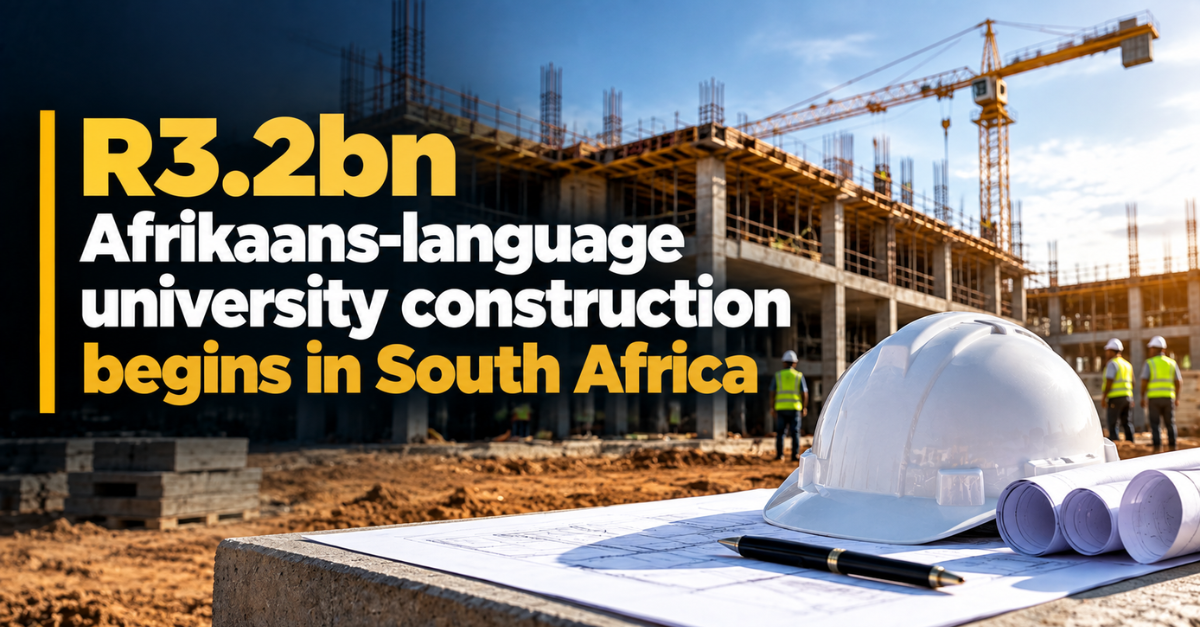
Steel girders rise against the sky at a sprawling site outside Pretoria, the sound of cranes punctuating the early morning air. The skeleton of what will become South Africa‘s first fully Afrikaans-language university is taking shape, a visual reminder that a R3.2bn (three-point-two-billion rand) project is now under way.
According to a report on businesstech.co.za, the university is being built at an estimated cost of R3.2bn. The figure translates to roughly US$170 million at current exchange rates, a sum that places the development among the largest public-sector construction projects in recent years.
For prospective students who prefer instruction in Afrikaans, the new campus promises a dedicated environment that mirrors the language-specific offerings already available at a handful of existing institutions. It also creates a clear market for construction firms, suppliers of building materials, and service providers who will be needed throughout the build phase and later for campus operations.
The term “Afrikaans-language university” refers to a higher-education institution where the primary medium of instruction is Afrikaans, South Africa’s third most spoken language after Zulu and Xhosa. While Afrikaans is used at several universities, this will be the first stand-alone institution built solely for that purpose.
South Africa’s higher-education landscape currently includes 26 public universities, many of which offer programmes in multiple languages. The decision to fund a dedicated Afrikaans university reflects ongoing debates about language equity, cultural preservation, and the role of state funding in supporting minority-language education. The government has previously allocated funds to expand university capacity, but this is the first time a single-language campus has received a budget of this magnitude.
From a financial perspective, the R3.2bn investment will flow through a mix of national treasury allocations, provincial contributions, and possibly private-sector partnerships. For local contractors, the project offers a steady stream of work that could help offset the slowdown caused by recent load-shedding and supply-chain disruptions. However, the scale of the spend also raises questions about opportunity cost, whether the same funds might have been directed to existing universities that need upgrades or to other pressing social priorities.
Stakeholders are watching the development closely. Prospective students see a chance to study in their mother tongue without travelling far from home. Community leaders view the campus as a cultural anchor that could boost regional identity and attract related businesses, such as bookstores, cafés, and student housing. Meanwhile, fiscal watchdogs will likely scrutinise the project’s budgeting and procurement processes to ensure transparency.
What remains unclear are the timelines for completion and the exact range of programmes that will be offered. The university’s governing board has not released a detailed academic roadmap, and the construction schedule has not been publicly confirmed. As the steel framework rises, the next phases, roofing, interior fit-out, and technology installation, will determine when the first cohort of students can enrol.
In the meantime, the sight of the half-finished towers serves as a concrete reminder that language, education, and economics intersect in very visible ways. Whether the R3.2bn spend will deliver the promised benefits will become evident only when the doors finally open.
Private higher education has expanded steadily in South Africa over the past decade, as demand for university places has consistently outstripped the capacity of public institutions, with language specific campuses often drawing on a dedicated base of alumni and community donors to fund large capital projects. The Department of Higher Education and Training’s own sector data carries further detail. For related coverage, see this site’s Property coverage.
Construction projects of this size in the higher education sector typically unfold over several years, with campus infrastructure, student housing and academic facilities phased in as funding and enrolment allow, rather than delivered all at once.