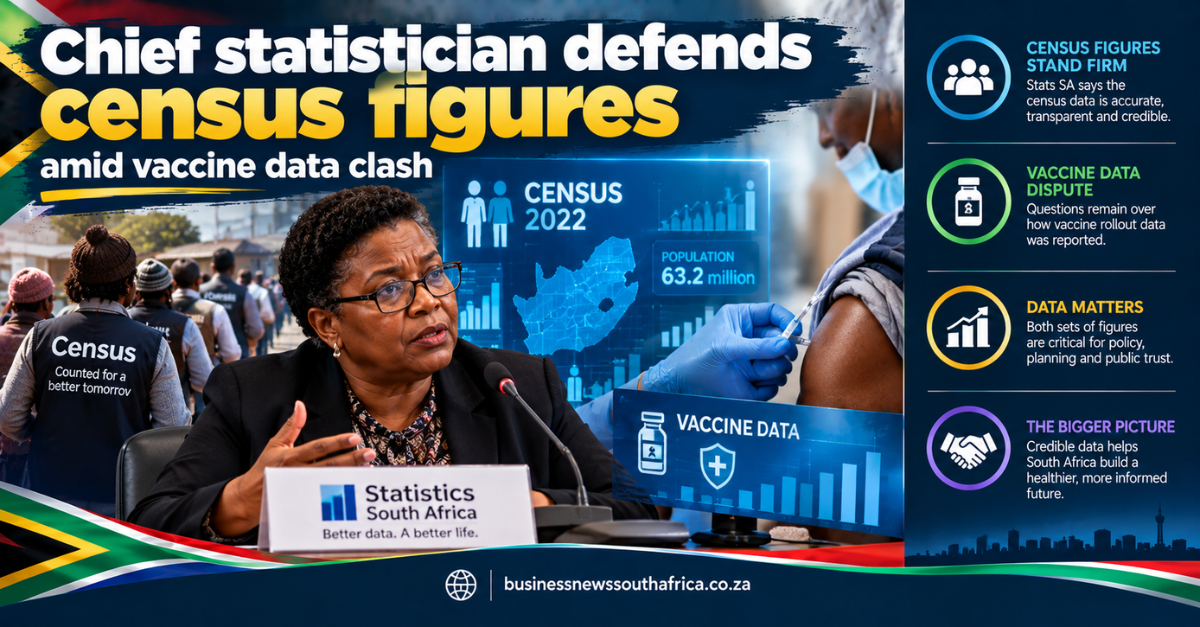
At a press briefing in Pretoria, the chief statistician of Statistics South Africa insisted that the country’s most recent census figures remain reliable, even as the health department questions the data used to calculate immunisation rates.
The census, a ten-yearly count of every resident, provides the baseline for a range of public-policy decisions, from school planning to health-service delivery. In this context, immunisation data, the record of who has received vaccines, is often cross-checked against census demographics to estimate coverage gaps.
According to the statistician, the methodology applied in the latest census follows internationally recognised standards, including household surveys, satellite mapping and post-enumeration checks. The claim is that any perceived shortfall in vaccine-coverage figures stems from reporting delays in the health sector, not from the population count itself.
Health officials have raised concerns that the census may have under-counted certain urban informal settlements, which could skew the denominator used in calculating immunisation percentages. The statistician countered that the census employed targeted outreach teams and digital verification tools to reach those areas, and that the resulting data have been validated by independent auditors.
For businesses that rely on demographic insight, such as private clinics, pharmaceutical distributors and health-tech start-ups, the dispute matters. Accurate population data underpins market sizing, location decisions and risk assessments. If the census numbers were to be revised, it could ripple through investment forecasts and procurement plans.
The broader picture reflects a recurring tension in South Africa: the need for high-quality data to guide public-health interventions versus the operational challenges of gathering that data in a diverse and mobile population. Recent years have seen similar debates over unemployment statistics and education enrolment figures, each prompting calls for stronger data-governance frameworks.
While the statistician’s defence rests on documented procedures, the health department has signalled it will conduct its own audit of the immunisation reporting chain. The outcome of that audit could shape future collaborations between Statistics South Africa and the Department of Health, and may influence how private sector players plan their services.
At present, no changes to the census data have been announced, and the statistician reaffirmed the government’s commitment to transparency and continuous improvement of data collection methods.
Why a census and administrative health data can genuinely disagree
A national census and a health department’s own immunisation records are built from two entirely different methods, and a mismatch between them does not automatically mean either one is wrong. A census counts people directly, or estimates undercounted populations statistically, on a fixed reference date every ten years. Immunisation coverage estimates, by contrast, divide vaccine doses administered by an assumed population denominator that is usually a projection forward from the last census, which means the two figures can drift apart for years simply because the projection has not been updated, not because either the counting or the vaccinating was done incorrectly.
Statistics South Africa is the body legally responsible for the country’s official population figures, which is precisely why the census methodology gets defended publicly when another department’s numbers appear to disagree with it: a change to the acknowledged population baseline has knock-on effects across every other piece of government statistics built on top of it, from school planning to municipal budgets. The practical stakes for a business reader are indirect but real: government funding formulas, provincial equitable-share allocations and infrastructure planning all lean on the same population baseline, so a sustained, credible challenge to the census figures would eventually ripple into exactly the kind of public spending decisions that shape municipal service delivery for the businesses operating in a given area. For related coverage of a different demographic release from Stats SA this month, see this site’s report on South Africa’s falling birth rate.