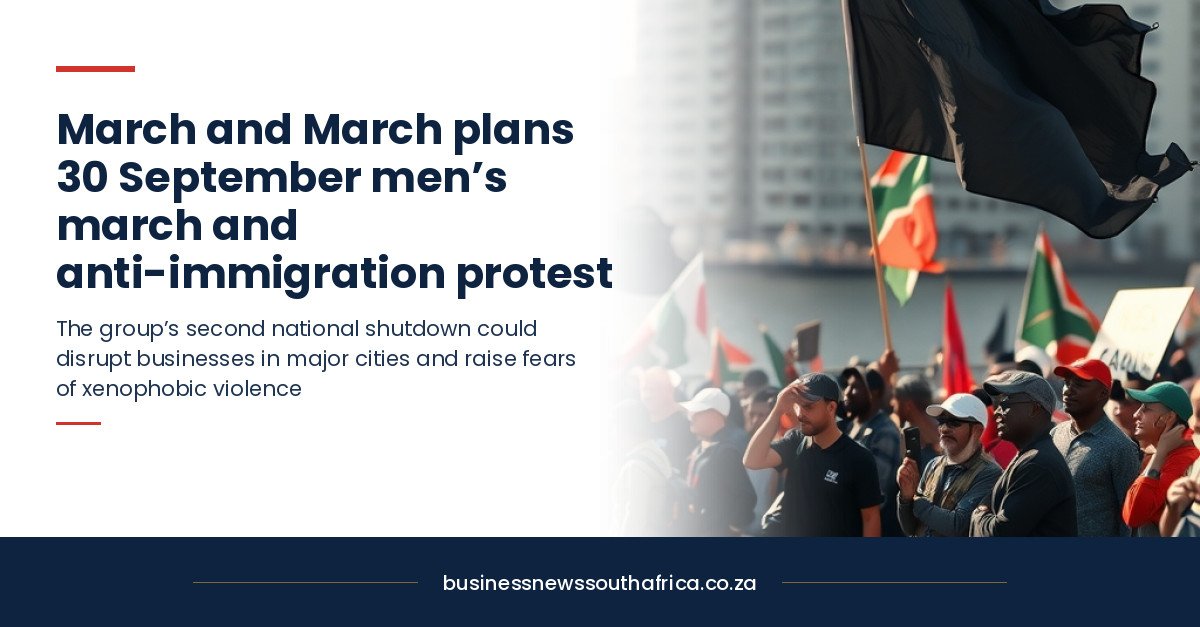
March and March is holding another national day of mass protest against illegal immigration on Wednesday, 30 September 2026, mirroring the national shutdown the group organised for 30 June. After the June protests it warned it would launch further mass action within three months.
This time the group has added the recent murders of 12 women to its calls to action, so 30 September is also billed as a “Men’s March against GBV and Crime”. “We call upon all South African men to take to the streets across the country to speak in one voice and claim our society back from criminals,” the group said. Marches are planned in Pretoria, Johannesburg, Durban, Cape Town and other major cities, according to BusinessTech.
BusinessTech described the new deadline as arbitrary and not supported by any official government channels, and said it has reignited fears of xenophobic violence against foreign workers. Demonstrations against immigrants have taken place on a near-weekly basis since the June protests, some of them violent. Earlier March and March action in Durban led to clashes between supporters and foreign nationals camped on Che Guevara Road, Briefly reported.
The South African Police Service (SAPS) has said the new date will not change its approach. It will continue normal policing operations, with its focus on maintaining law and order and responding to incidents as they occur.
## Who March and March are and what they want
The movement has campaigned against illegal immigration since early 2025 and is led by Jacinta Ngobese-Zuma. Ahead of 30 June, it set out demands that included the deportation of undocumented foreign nationals, stricter border controls and a government declaration of a state of emergency on illegal immigration, according to IOL. Ngobese-Zuma has rejected the charge of xenophobia. “We don’t have enough schools, hospitals and buildings, but we find ourselves having to carry the burden for all of Africa,” she said, as quoted by Briefly.
Before 30 June she also disputed the “shutdown” label. “Nobody even said this whole thing is a shutdown, but for some reason the government is making everyone nervous,” she said. Labour federations Cosatu, Fedusa, Saftu and Nactu confirmed that the action was not called by recognised unions and carried no legal strike protection, IOL reported.
## What happened on 30 June
Ahead of the June date, acting Police Minister Firoz Cachalia announced a R600 million police operation with deployment across all nine provinces. “Our message is clear, everyone has the constitutional right to protest peacefully and within the confines of the law,” he said. “However, criminality, intimidation, violence, the destruction of property and any attempt to undermine public safety will not be tolerated.”
Of the R600 million allocated to peacekeeping operations on the day, only R306 million was spent. The mass disruption that had been feared did not materialise, but there was damage. At least one death was linked to the protests, there were more than 900 arrests, and businesses lost millions of rands, largely restricted to the township economy.
## The president’s response
President Cyril Ramaphosa used his weekly letter to the nation to call for calm and unity, addressing both the tension around foreigners and the rise in gender-based violence. “We cannot allow violence against women to define who we are,” he wrote, adding that “the abuse, rape and killing of women is a stain on our national conscience.” On migration, he said the country refuses to be “defined by xenophobia and intolerance”, and stressed that migration must take place within the law. The full letter is on the government website.
## Township traders carried the June losses
Because the June losses fell mainly on the township economy, spaza shops and other township traders have the most to weigh up on the day. Most business insurance covers only defined perils, so anyone concerned about looting or damage should check their own policy wording for civil-unrest cover beforehand. Our business insurance guide explains what standard SME policies cover, and the Regulatory & Policy section carries any official guidance that follows.