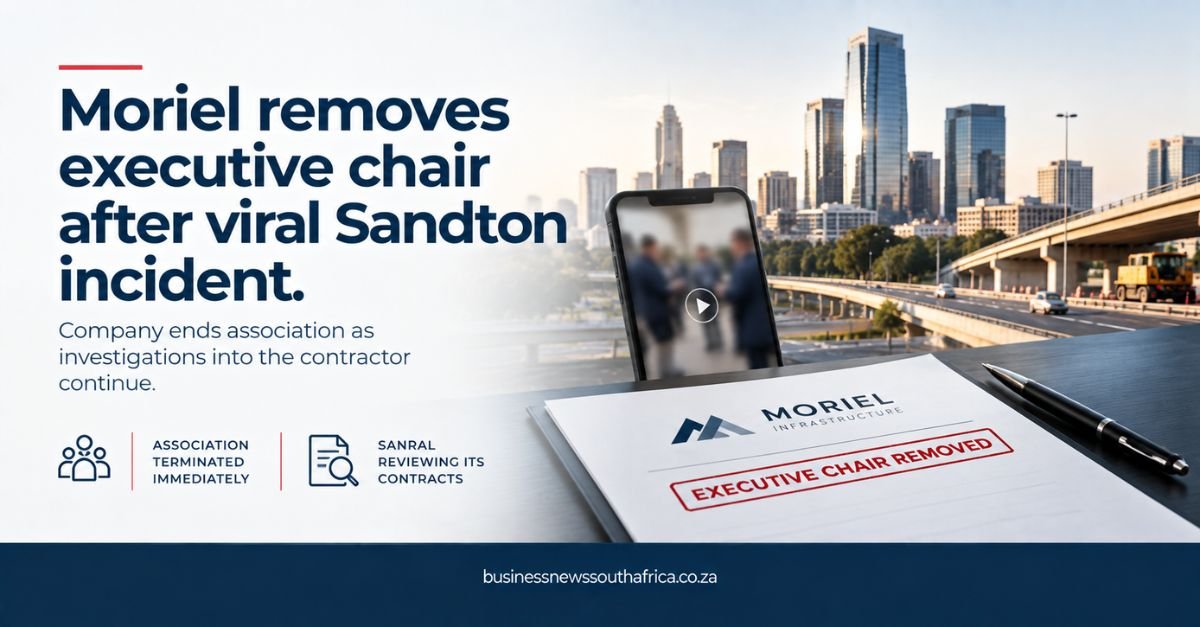
A video from a Sandton eatery shows Lawrence Mudzinganyama, the executive chairman of Moriel Infrastructure Group, pointing at two women and saying, “I’ll murder you now, and walk.” He also claimed the restaurant owner worked for him and threatened to “put a bullet in all of you.” The clip spread quickly on social media, drawing public outrage.
Within hours, Moriel Infrastructure published a statement saying the board had decided to terminate its association with Mudzinganyama with immediate effect. The company said he will no longer represent, speak for, or act on its behalf in any capacity. The statement described the behaviour in the video as inconsistent with the organisation’s values.
The fallout reached beyond the restaurant. The South African National Roads Agency (SANRAL) confirmed it has two contracts with Moriel Infrastructure on the N1 and N2 national roads. SANRAL’s acting CEO, Lehlohonolo Memeza, said the agency will investigate the projects at the request of Transport Minister Barbara Creecy, including whether the contracts were lawfully awarded and are being fulfilled.
Vlamo, the five-star restaurant where the incident occurred, issued an Instagram statement distancing itself from Mudzinganyama and confirming it reported the matter to the South African Police Service on 19 September. A case number was issued and the venue said security would be increased to protect patrons.
What this means for businesses
For companies of any size, the episode underscores the importance of aligning senior leadership behaviour with corporate values. Boards may need to act swiftly when a leader’s conduct threatens reputation or legal standing, especially when public contracts are involved. Small and medium enterprises can use this as a reminder to review governance structures and have clear policies for dealing with misconduct. The compliance document generator can help draft such policies.
While Moriel faces scrutiny over its road contracts, the incident also highlights how quickly a personal lapse can become a corporate crisis in the age of viral video. Companies should monitor social media risks and be prepared to respond decisively to protect brand integrity.
What comes next for the company
The South African National Roads Agency’s involvement matters because Moriel Infrastructure has held road-construction and maintenance contracts with the agency, meaning the company’s public standing and its ability to win or retain government tenders can be directly affected by how quickly and visibly it distances itself from an executive’s conduct. Companies that hold public infrastructure contracts face a higher bar on governance and public conduct than purely private-sector firms, since procurement processes typically include a fit-for-purpose or good-standing assessment of key individuals associated with a bidding company.
For businesses more broadly, the episode is a reminder that an executive’s personal conduct, captured on video and circulated on social media, can create commercial consequences within hours rather than the weeks a formal disciplinary or governance process might otherwise take. Boards increasingly face pressure to act immediately on reputational risk of this kind, ahead of, not instead of, any internal investigation or formal process that follows.
Neither Moriel Infrastructure nor Mudzinganyama has indicated whether any legal consequences will follow the video’s circulation, and the women named in the footage have not publicly commented as of publication.
The incident adds to a broader pattern of South African companies facing sudden reputational crises driven by viral social media footage, where the speed of public reaction now regularly outpaces a company’s own formal internal processes, forcing boards to weigh immediate public distancing against the risk of appearing to prejudge an outcome before any investigation concludes.
Businesses that rely on public-sector contracts should treat this as a live case study in how quickly a single individual’s conduct can put an entire company’s standing at risk.