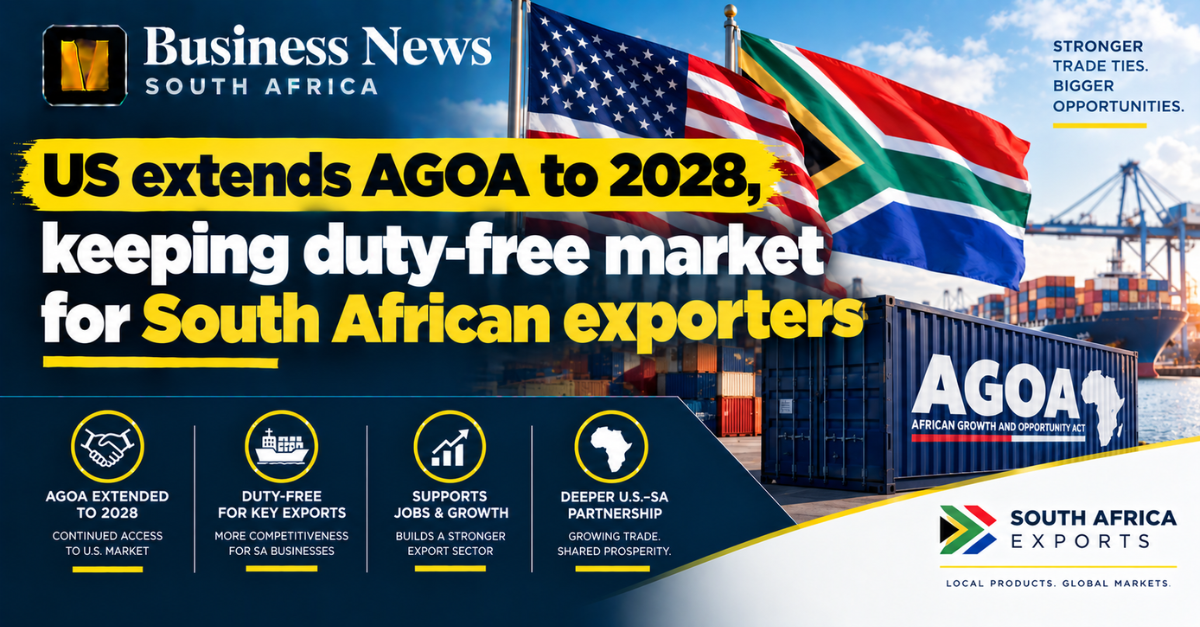
In a quiet move that will matter most to South African firms that ship goods to the United States, the African Growth and Opportunity Act (AGOA), a trade law that grants duty-free access to the US market, has been extended until the end of 2028. The extension was announced after the law lapsed in September 2025 and was retroactively prolonged to the end of 2026, before receiving a further two-year boost.
Oxford Economics analyst Jervin Naidoo told CapeTalk that the extension is a win for both sides. “The US needs South Africa in AGOA as much as South Africa wants to remain, as part of receiving preferential access to the US market,” he said. Naidoo’s assessment is a claim by the analyst; the government’s official statement on the extension has not been published.
For South African exporters, the numbers are tangible. Roughly 22% of the country’s exports to the United States qualify for duty-free treatment under AGOA, and estimates suggest that about half a million jobs depend on the programme. Those figures come from industry surveys and are widely quoted, but they have not been independently verified for this article.
The timing of the extension is not accidental. China recently rolled out a zero-tariff preference scheme for several African nations, including South Africa, that runs from 1 May 2026 to 30 April 2028. Naidoo argues that the US move is “more of a counter because China has opened up its market completely to African countries.” He adds that the same pressure applies to other AGOA-eligible nations such as Tanzania, Kenya and Nigeria, all of which have growing Chinese interests.
While the extension offers a short-term safety net, Naidoo describes it as a “mild reprieve”. South African businesses had hoped for a longer horizon, a 15-year extension was floated in previous negotiations, to give them confidence for strategic investment. “It’s not enough time to make long-term strategic decisions,” he said.
Trade Union Solidarity, a labour federation, warned that any exclusion of South Africa from AGOA would have “devastating” effects on key sectors, especially automotive and agriculture, and would threaten thousands of specialised jobs. The union’s statement is a claim reflecting its position; no official exclusion has been proposed.
Relations between the United States and South Africa have been strained in recent years. In 2025, two US bills were introduced that sought to remove South Africa from AGOA, citing concerns over the country’s lack of explicit laws blocking imports made with slave labour. The US also floated a 12.5% tariff on South African goods, a move that would have eroded the price advantage that duty-free status provides.
For the SME owner who relies on US customers, whether in textiles, wine, or specialised components, the extension means that current contracts can continue without the added cost of tariffs, but the two-year window forces a rapid reassessment of supply chains. Companies may need to diversify markets, negotiate longer contracts now, or lobby for a further extension before the 2028 deadline.
In the broader picture, the AGOA extension underscores how trade policy can be used as a geopolitical lever. The United States is seeking to keep African trade flowing through its ports rather than ceding market share to China’s zero-tariff scheme. South Africa, meanwhile, must balance the short-term benefits of duty-free access against the longer-term risk of over-reliance on a single market.
As the 2028 deadline approaches, the real test for South African exporters will be whether they can turn the “mild reprieve” into a stepping stone for deeper market penetration, or whether they will be forced to look elsewhere when the agreement finally expires.
What a preference programme actually asks of an exporter
Duty free access sounds like the absence of paperwork. It is closer to the opposite. A preference programme is a conditional arrangement, and the conditions sit on both the country and the individual consignment.
At country level these schemes are unilateral rather than negotiated bargains. The granting country writes the eligibility criteria, reviews them periodically, and can suspend a beneficiary without the other side having agreed to anything. That is what makes the arrangement politically useful to the grantor and structurally fragile for the beneficiary: the terms can change through a domestic process in another country, on a timetable nobody here controls.
At consignment level the binding constraint is rules of origin. Duty free treatment attaches to goods that genuinely originate in the beneficiary country, which means an exporter has to prove that raw materials sourced elsewhere were substantially transformed locally rather than merely repackaged. The test varies by product, and it usually turns on either a change in tariff classification or a minimum share of local value. For a manufacturer with an imported component in the bill of materials, that calculation is the whole difference between paying a tariff and not paying one, and getting it wrong is expensive in a way that shows up long after the goods have shipped.
The administrative load is the part smaller exporters underestimate. Origin has to be documented, records retained, and the calculation defensible to a customs authority that may query it years later. Larger firms carry that overhead comfortably. It is a real barrier for a first time exporter, and part of why preference programmes are used more heavily by established exporters than by the new entrants they are often justified by.
Why the length of an extension matters more than the fact of one
A short renewal keeps existing trade flowing and does very little for investment, and the reason is arithmetic rather than sentiment. Committing capital to a production line, a packhouse or a cold chain built around one market means recovering that cost over a period usually measured in many years. A guarantee that expires well inside the payback period does not support the decision, so firms keep serving the market with capacity they already have and decline to build more.
That is the practical difference between a programme that sustains trade and one that grows it, and it explains why exporters lobby for long renewals rather than frequent short ones. The rational response to a short window is to treat the market as valuable but temporary: serve existing contracts, avoid single market dependence in new capacity, and develop an alternative destination in parallel rather than after the deadline arrives.