When a small retailer in Johannesburg prepares to launch a new line of portable power stations, the biggest hurdle is often convincing customers that the product lives up to its promises. In a market where many buyers research online before they spend, a single positive review can tip the scales.
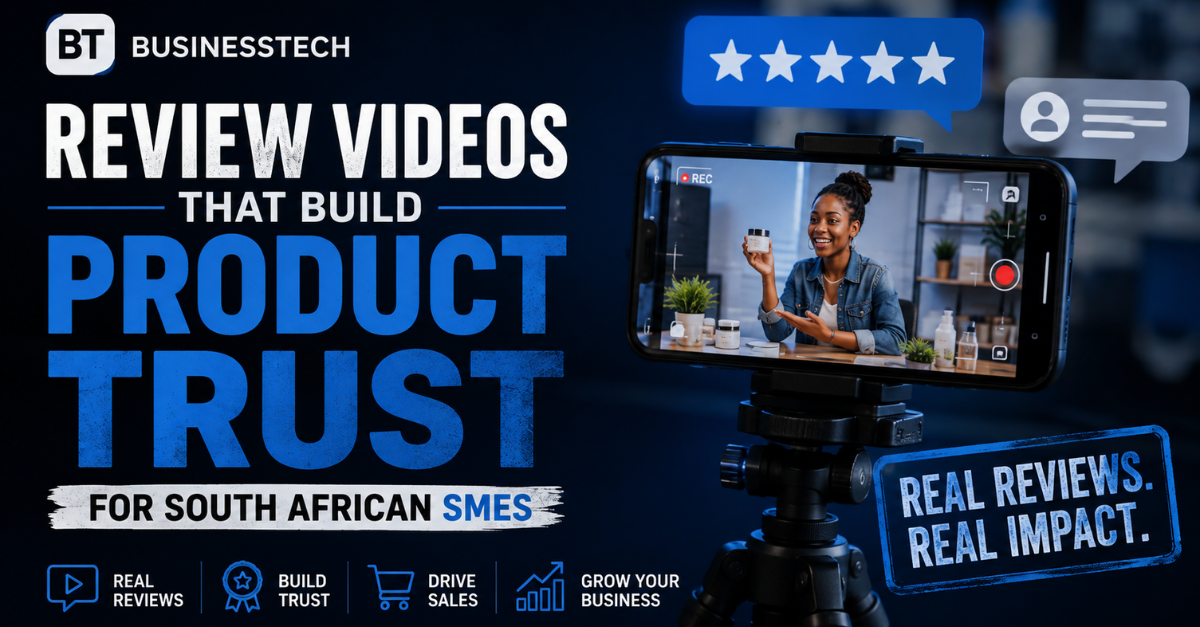
According to BusinessTech, a review video produced by its team can provide that decisive proof. The company describes the offering as a “review video”, a short film that shows the product in use, highlights key features and shares the reviewer’s real-world experience. BusinessTech says the videos are published on YouTube, shared across its social media channels and accompanied by a written review on its website.
The claim is supported by figures from the 2025 Digital Marketing Report, which found that 77% of South African customers use reviews and online articles to research products they are interested in buying, and 73% trust those reviews the most when making a purchase decision. Those numbers suggest that a well-produced review could reach a large portion of the buying public and carry weight in their decision-making.
What the service includes
BusinessTech’s package consists of three parts. First, a video is filmed and edited to showcase the product’s strengths and performance. Second, the video is uploaded to YouTube and promoted on BusinessTech’s social media accounts, giving it exposure beyond the client’s own followers. Third, a written article summarising the review is posted on the BusinessTech website, linking back to the video and providing SEO benefits that help the product appear in search results.
For many South African small and medium enterprises, creating professional video content in-house is costly and time-consuming. Outsourcing to a specialist that already works with a range of products, from smartphones and laptops to trading platforms, can shorten the time to market and ensure a consistent quality level.
However, the service is not without considerations. The cost of a custom video will vary depending on the product’s complexity and the level of promotion required. SMEs also need to ensure that the reviewer’s perspective aligns with their brand values, as the credibility of the video rests on perceived authenticity.
In the broader digital landscape, video consumption in South Africa has been on the rise, with mobile data becoming more affordable and platforms like YouTube seeing higher engagement. At the same time, e-commerce sales continue to grow, driven in part by consumers who prefer to see a product in action before buying. In that environment, a review video can serve as both a marketing tool and a trust-building asset.
BusinessTech’s claim that its review videos are the “best choice” remains a company statement until independent comparisons are made. SMEs interested in the service should compare it with other options, such as influencer partnerships or user-generated content, to determine which approach delivers the best return on investment for their specific market.
Video’s growing weight in South African retail marketing
The shift toward video-led product marketing has accelerated across South African retail generally, not only for the categories BusinessTech names. Falling mobile data prices and rising smartphone penetration have made video a realistic format for smaller businesses to both produce and distribute, where a decade ago the cost of professional filming alone would have put it out of reach for most SMEs. Platforms like YouTube, Instagram and TikTok have also changed how South African consumers research big-ticket purchases, increasingly watching a product demonstrated in real use before comparing prices, a behaviour that traditional static product photography or written specifications cannot fully replicate.
For a small business owner, the practical trade-off BusinessTech’s offer represents is outsourcing versus building an in-house capability. A third-party review video can move faster and carries an existing audience, but it also means ceding control over how the product is framed to a reviewer whose credibility depends on being seen as independent. Businesses weighing this option typically look at whether the reviewer’s existing audience already overlaps with their target customer, since exposure without relevance rarely converts into sales regardless of production quality.