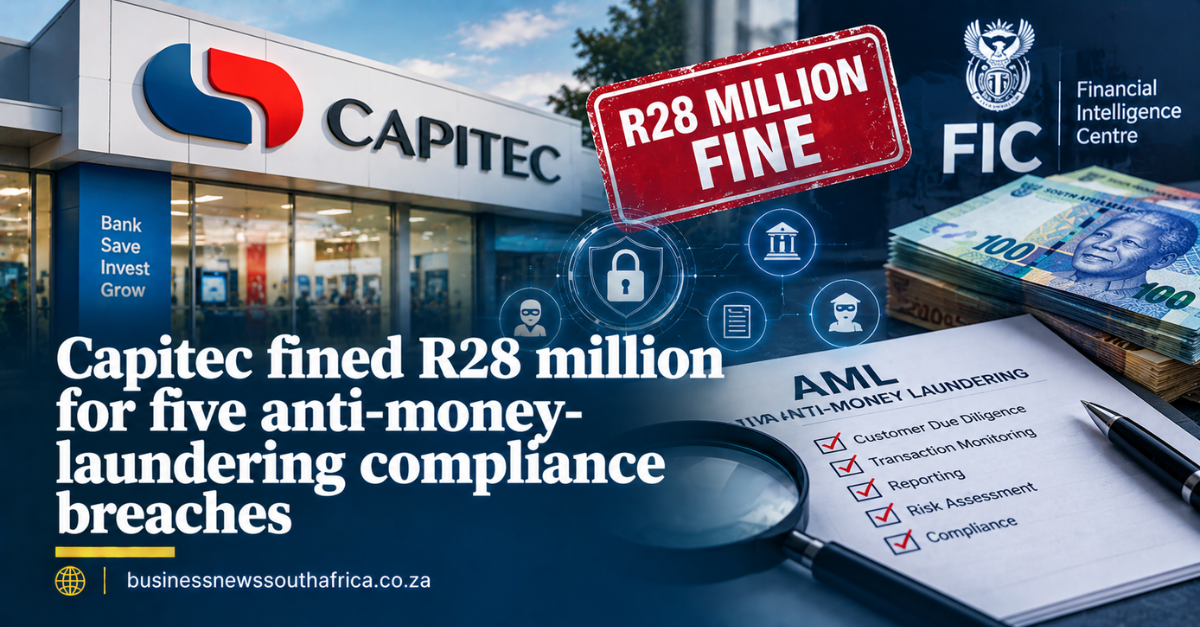
When the Prudential Authority (PA) handed Capitec Bank a written notice in early October, the headline was stark: a total penalty of R28 million for breaching South Africa’s anti-money-laundering rules. For a bank that markets itself on low-cost, high-speed accounts, the fine is a reminder that the price of non-compliance can be measured in millions rather than minutes.
The PA said the amount is split into five separate penalties. The largest, R10 million, relates to inadequate customer due diligence, the basic check that a bank must perform to verify who a client is and assess the risk of money-laundering. A further R5 million was imposed for insufficient enhanced due diligence, which means the bank did not carry out the extra checks required for customers or transactions that carry a higher risk. Another R5 million penalty covers inadequate ongoing due diligence, meaning Capitec failed to keep customer information and risk assessments up to date. A fourth penalty of R3 million targets shortcomings in employee training, and the final R5 million addresses broader weaknesses in the bank’s compliance framework.
Not all of the R28 million is payable straight away. The PA conditionally suspended R5.5 million of the total for 36 months from 13 October 2025. In practice, this means the bank does not have to pay that portion unless it repeats the same breaches within the suspension period. The suspended amounts are R3 million from the first penalty, R1 million from the second, R1 million from the third and R500,000 from the fifth.
For small-business owners and other Capitec customers, the fines could have indirect effects. Compliance programmes are expensive, they require technology, staff time and external advice. When a bank is forced to spend more on those fronts, it may look for ways to recoup costs, for example by adjusting fees on certain accounts or tightening credit criteria. While Capitec has not announced any price changes, the risk of higher costs is a realistic scenario for any institution under regulatory pressure.
The PA’s findings point to specific gaps. The bank did not obtain senior-management approval for its anti-money-laundering name-screening and payment-screening manuals before they were used. It also could not show documented, approved processes for reporting terrorist property, nor could it prove that policies, procedures, standards and controls for terrorist-financing and financial-sanctions reporting were in place. Those are the kinds of controls that help a bank spot suspicious activity before it becomes a problem.
South Africa’s Financial Intelligence Centre Act (FIC Act) obliges all accountable institutions, banks, insurers and similar entities, to put in place robust systems for identifying customers, monitoring transactions and reporting suspicious activity. The PA is the regulator tasked with supervising compliance in the banking sector. Over the past few years, the regulator has stepped up inspections, reflecting a global trend of tighter scrutiny on money-laundering and terrorist-financing risks.
Capitec said it has cooperated fully with the PA and is already taking steps to fix the identified weaknesses. The bank’s statement noted that it is updating its customer-due-diligence processes, rolling out additional training for staff and revising its risk-management documentation. Those remedial actions are typical after a regulator’s inspection, but the real test will be whether the changes stand up to a future audit.
For entrepreneurs watching the story, the key takeaway is that regulatory compliance is not a back-office issue that can be ignored. Even a bank that serves millions of low-value accounts can be hit with multi-million-rand penalties if its controls are found lacking. The ripple effect may be felt in higher fees, tighter loan conditions or slower onboarding for new customers, all factors that can influence a small business’s cash flow.
Going forward, the industry will be watching how Capitec implements the PA’s remediation plan and whether the suspended portion of the fine remains untouched. If the bank avoids repeat breaches, the R5.5 million stays on hold. A repeat could trigger immediate payment, adding pressure on the bank’s bottom line and potentially prompting further regulatory action.