In a typical South African retail outlet, shelves can look full while the back-room inventory is being siphoned off by thieves, counterfeit importers and extortionists. That hidden loss is part of what the Consumer Goods Council of South Africa (CGCSA) calls the illicit economy, illegal activities that generate revenue but evade tax, safety standards and regulation.
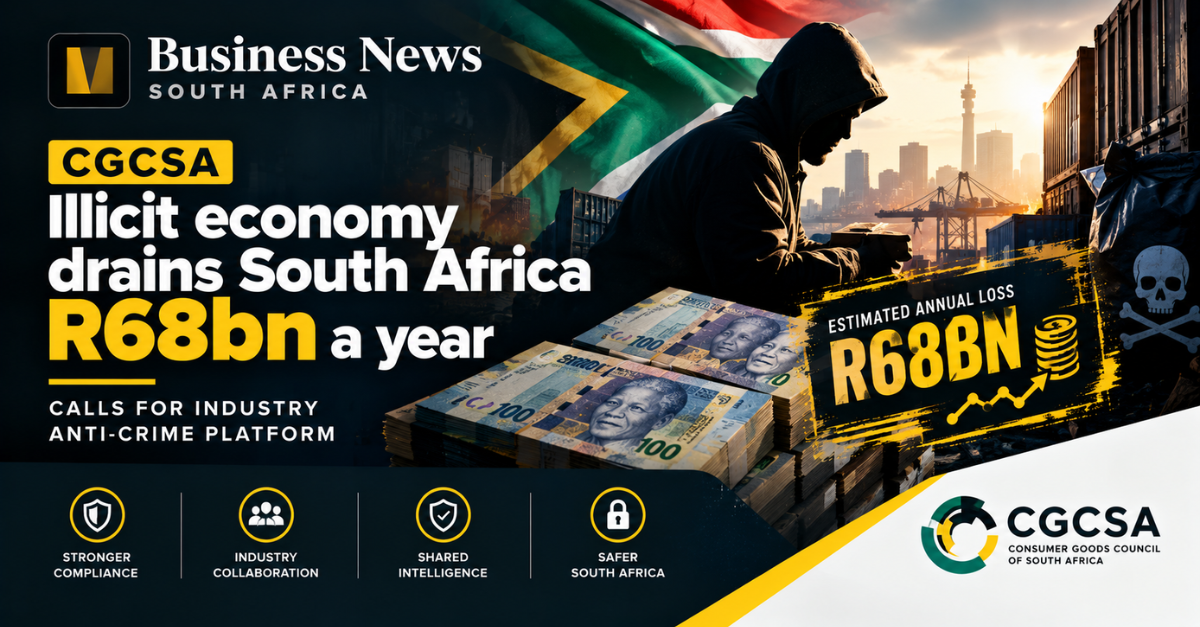
CGCSA chief executive Zinhle Tyikwe told reporters that the illicit economy is costing the country roughly R68 billion each year. The figure comes from the council’s own research across eleven key sectors. “Every rand diverted into the illicit economy is a rand that cannot be invested in economic growth, job creation or public services,” Tyikwe said.
The council defines the illicit economy as everything from the importation of knock-off goods to the theft and resale of legitimate products. For retailers, that means higher security costs, lost stock, and a competitive disadvantage for honest businesses trying to grow.
Tyikwe said the problem has moved beyond a public-safety issue and now threatens South Africa’s economic competitiveness. She urged the creation of an industry anti-crime platform, a coordinated body that would bring together business, government, law enforcement and civil society to focus on prevention, disruption, enforcement and measurable outcomes.
The proposed platform would build on the work of Business Against Crime South Africa (BACSA), a non-profit founded in 1996 to foster public-private collaboration on crime. Tyikwe noted that previous joint efforts between BACSA and the CGCSA have shown that coordinated action can deliver results.
Independent research commissioned by the CGCSA estimates the illicit economy’s cost at R68 billion, but a separate study titled “Shadow State Rising” by Frans Cronje Private Clients puts the figure closer to R84.6 billion, about 1 % of gross domestic product and 3.9 % of total government revenue. That study found the bulk of the losses concentrated in tobacco, illegal mining and alcohol, sectors that together account for roughly 90 % of illegal activity.
The study also recommends a task force that would include the South African Revenue Service (SARS), the National Prosecuting Authority (NPA) and the South African Police Service (SAPS), alongside private-sector observers and advisers. Such a body would aim to recover lost revenue, reduce the tax burden on compliant businesses and restore confidence in public institutions.
What remains unverified is how quickly an anti-crime platform could be set up, how it would be funded and what concrete metrics would be used to gauge success. The council’s statements are claims about the potential impact of collaboration; independent confirmation of any future reductions in illicit activity will depend on the platform’s design and execution.
For small and medium-size retailers, even a modest recovery of the estimated losses could translate into lower operating costs, more stable pricing for consumers and a healthier environment for new entrants. In a market where margins are already thin, cutting the shadow cost could be the difference between expansion and stagnation.
Why two credible estimates of the same problem can differ by R16.6bn
The gap between CGCSA’s R68 billion figure and the R84.6 billion estimate from the separate Shadow State Rising study is not necessarily a sign that one of them is wrong; illicit-economy estimates are built by extrapolating from sector-specific data, seized-goods volumes, tax-gap analysis, industry surveys, that vary in coverage and methodology, and different studies frequently draw their sector boundaries differently, one may include informal cross-border trade that the other treats as a separate category, for instance. What both figures agree on matters more than the exact total: tobacco, illegal mining and alcohol dominate the losses, a concentration that suggests targeted enforcement in three sectors, rather than an economy-wide crackdown, could capture most of the available recovery.
For compliant retailers specifically, the illicit economy’s cost is not simply the lost tax revenue government cites, it is a direct competitive disadvantage: a shop selling smuggled or counterfeit goods alongside its legitimate stock can undercut a fully compliant competitor on price precisely because it is not carrying the same tax, safety-certification and import-duty costs, meaning every rand of the R68 billion CGCSA cites is also, from a competing retailer’s point of view, business that a law-abiding store lost to an illegally undercut price.
The Consumer Goods Council of South Africa’s own research is the primary source for the illicit trade figures cited here.