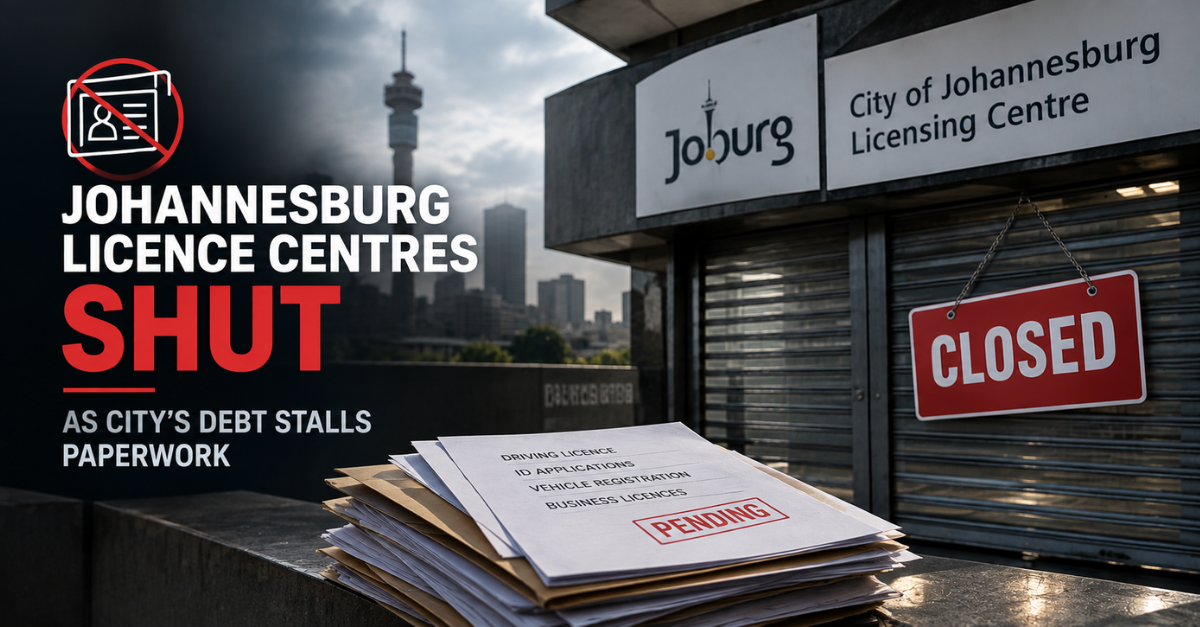
At the Johannesburg driving licence testing centres, the usual hum of printers and the shuffle of paperwork has been replaced by locked doors and long queues of frustrated motorists. The problem is not a sudden glitch; it is the result of a year-long failure to pay licensing agency fees that the city owes to the Gauteng Department of Roads and Transport.
The city’s withholding of those fees has forced the province to ration the special face-value paper used for official licences and registration documents. At the same time, the City of Johannesburg let its own supply contracts for ordinary A4 paper and printer toner lapse without tendering a replacement. The combined effect is a severe shortage of the basic consumables needed to process renewals, new licences and other driving documents.
Why it matters to small businesses
For a taxi operator, a delivery driver or a small logistics firm, a valid licence is a non-negotiable requirement. Without it, a driver cannot legally operate a vehicle, meaning lost income, missed deliveries and the risk of fines. The current backlog means a driver may have to take a day off work to stand in a queue that can stretch for hours, or risk operating with an expired licence in the hope of leniency that is not guaranteed.
Julius Kleynhans, Executive Manager for Local Government at the Organisation Undoing Tax Abuse (OUTA), told 702 Drive that the situation reflects “long-standing systemic failures rather than a sudden breakdown”. He explained that municipalities are subject to regular oversight, audit reports and reporting requirements to provincial governments, meaning the warning signs should have been visible for some time.
“This hasn’t happened overnight. I think this is a systemic issue that we’re starting to see unfolding. Unfortunately, it’s the innocent people, the motorists, that’s bearing the brunt of it,” Kleynhans said. He added that the officials and political structures responsible for the failures remain in place, limiting the chances of a quick fix.
The city’s poor financial position is another obstacle. Kleynhans warned that it could take years to put Johannesburg on a sustainable financial footing, especially as funds are being shuffled between competing obligations. “I cannot see that we’re going to get out of this soon. We’re still holding on to the old methods and ways of applying for licences, people queuing up at stations, and it’s just inefficient,” he said.
While some alternative licensing facilities may be technically open, many cannot process applications because they lack ink or the specialised paper. Kleynhans described the scene as “laughable” for a city that is the economic hub of the country.
For small business owners, the impact is two-fold. First, the direct cost of lost productivity when drivers are stuck in queues. Second, the indirect cost of uncertainty, suppliers and customers may hesitate to engage with a business that cannot guarantee a driver’s legal status. In a sector where margins are already thin, any additional delay can tip the balance.
What can be done? Kleynhans argues that the underlying causes, unpaid fees, expired contracts and poor procurement planning, need to be addressed before any temporary workaround will help. He called for accountability, saying that “heads must roll” if the same officials continue to oversee the process without delivering results.
In the meantime, motorists are advised to check the status of their nearest centre before making the trip, and to allow extra time for any visit. Some provincial offices have hinted at limited leniency for expired licences, but that is not a reliable safety net.
The Johannesburg case is a reminder that intergovernmental debt (money owed between different levels of government) can have very real, everyday consequences. When a city fails to meet its financial obligations, the ripple effects can reach the driver who simply wants to renew a licence, and the small business that depends on that driver to keep the wheels turning.