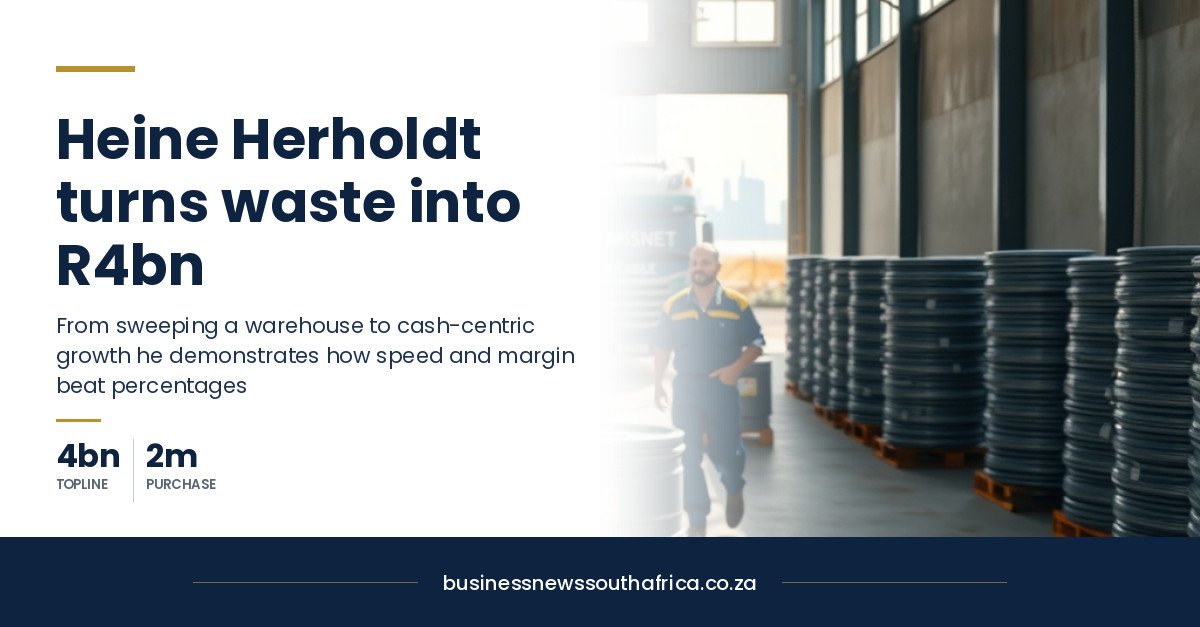
Heine Herholdt started in his father’s electrical wholesale business in blue overalls with a broom, on less than minimum wage. Today his company does “well over 4 billion rand in topline”, as Vusi Thembekwayo put it when he introduced him on the VT podcast. The lessons Herholdt drew from getting there are about cash, not percentages.
From the warehouse floor to the buying desk
Herholdt, chief executive of Herholdt’s Group, grew up outside Bloemfontein. He enrolled at the University of the Free State to study accounting, then told his father during his first year that he was wasting his time and his father’s money (20:11). The deal on offer was blunt: come and work in the business, for less than minimum wage, and pay rent at home.
The first job was sweeping the warehouse. “When I started working there I was getting 1,600 and I was paying 800 rent,” he said (21:38), a step backwards from the R2,000 a month he had earned working holidays. The point, he said, is that anyone running a business needs to understand every part of it, starting at the bottom.
How did one cable order triple the business?
His breakthrough came on the buying side. The business was selling cable but buying it one drum at a time. Herholdt asked a supplier for a price on 20 drums, got the cost down from R28 a metre to R20, and wrote out the order himself. The buyer, he recalled, was horrified: at the usual price, 20 drums of 500 metres would have cost R2.8 million. Herholdt had paid R2 million.
He then phoned every customer with a special deal. The market price was around R30 to R32 a metre; he offered R26 “and literally offloaded all 20 drums within a week” (29:03). The R2 million came back as about R2.6 million, in a business that had been turning over about R1 million a month. “You just tripled,” Thembekwayo said. “Tripled the revenue,” Herholdt agreed.
The lesson he took from it shaped the company. The traditional approach in the trade, he said, was percentage-based: buy something for R10, add 30% and sell it. In a cable business moving R100,000 items, what matters is the cash each sale returns, and the stock turn that lets you do it again. That is where Herholdt credits Robert Kiyosaki, and in particular two ideas from him, OPM and OPT: other people’s money and other people’s time (41:03). Financing lines buy the stock; a fast turn repays them.
Why is slow stock a liability, not an asset?
The cash cycle is unforgiving for an importer. Herholdt described it plainly: you pay upfront, wait about four weeks for manufacturing and another four for shipping, and then “you wait for Transnet for another week or two” before the stock reaches you (40:25). About ten weeks pass between the money leaving and the product arriving, which is why he watches his warehouse as closely as his balance sheet.
“When you walk through your warehouse and you check dust this thick lying on something, that’s not an asset.”
Heine Herholdt, at 45:52
That view was tested hard in the solar market. At the peak, Herholdt’s Group had 40 containers of inverters land, already paid for, when it was the biggest in distribution. About two weeks later the supplier cut its price by more than 50% (43:33). Competitors importing one container at a time got the new price immediately. Herholdt was sitting on 40, and so were many of his customers.
He took the loss at once, a “50% shave”, and told his customers to clear their shelves quickly too, rather than hold stock that was no longer worth what the balance sheet said.
“If you have to take a hit, the first hit is the best hit to take.”
Heine Herholdt, at 44:50
The cash that came back went into new stock at the new price, sold at a profit and turned again. As Herholdt described the logic of a falling market: if nobody wants the item at 120, take 20, “because 20 is better than nothing”, then turn the 20 into 25, the 25 into 30.
How does Herholdt pick and test his team?
On hiring he is unusually clear. “I don’t want somebody that can do the job. I want somebody who has got manners,” he said (57:01), adding that he can teach someone a job, but he cannot teach manners and respect.
He is also testing whether his leadership team can run the business without him. At the time of the recording he had told his team he was “resigning virtually” for two months: they would make every decision themselves, and at the end he would tell them how good or how bad a job they had done (52:34).
The scale they are now running is considerable. Herholdt said the group has nine branches and moves about 500 megawatts of solar panels a year, along with inverters and battery storage (41:45). He frames the mission in the widest terms.
“I’d be satisfied whether I’m the supplier or not, the day that when I look out the plane and all I can see is just solar panels on every single roof, which means that every single South African has got access to clean green energy.”
Heine Herholdt, at 1:11:51
What this means for South African businesses
For a South African owner, Herholdt’s story carries three practical lessons. First, measure deals by the rand margin and the speed of the turn, not only the percentage: a thinner margin on a much larger, faster-moving order can transform cash flow, as his 20 drums did. Second, treat ageing stock as a cost that grows every week you hold it. Taking the loss early freed cash that could be reinvested at the new price, while competitors who waited kept paying for stock nobody wanted.
Third, plan for the whole cycle, including the port. A roughly ten-week gap between paying a supplier and receiving the goods, a week or two of it waiting on Transnet, has to be funded, which is why Herholdt pairs financing lines with a relentless focus on stock turn.
He also had a message for business owners frustrated with the country: “We shouldn’t feel about our country and the people in this country the way that we feel about the politicians that are running it” (1:20:51). Coming from someone who has built a national business in South Africa, the point is that the market is bigger than the headlines about the people running the state.
How this article was produced
This article is based on How Heine Herholdt Built His Multi Billion Business Empire, a video featuring Heine Herholdt (CEO of Herholdt's Group), published on the Vusi Thembekwayo YouTube channel on 29 August 2026. Quotes are taken word for word from the video’s transcript (filler words such as “um” removed) and link to the moment they were said. Views expressed are the speaker’s own; analysis of what it means for South African businesses is Business News South Africa’s.