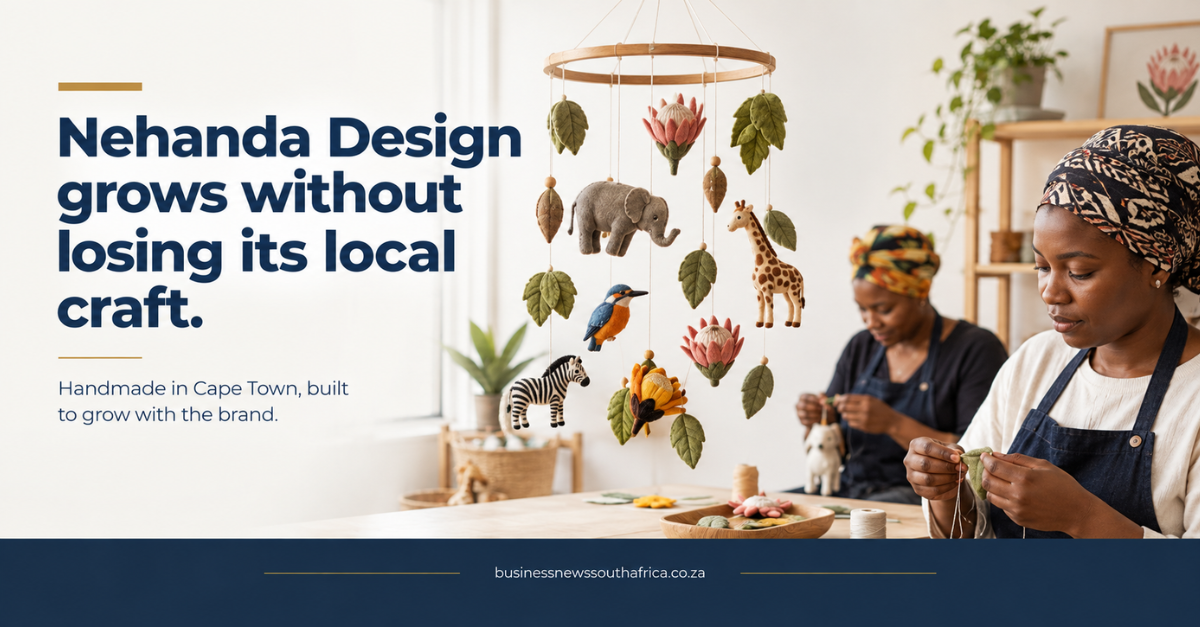
According to a press release on Bizcommunity, Nehanda Design is growing its range of handcrafted mobiles and décor while deliberately keeping production in South Africa.
Founder Magan, who studied Industrial Design, says the brand started with one-person commissions and now works with a network of home-based artisans, many of them women. The challenge, she explains, is to decide when a hand-made detail adds real value and when it slows the business down.
One example is a King Protea mobile that originally featured an intricate hand-embroidered pattern. When a second artisan was trained to copy the stitch, the piece took considerably longer to finish. Magan replaced the embroidery with a painted motif, cutting production time while keeping the item hand-crafted. She describes the change as a “better-looking product” that is also more commercially viable.
That kind of optimisation is not a one-off project. Magan says the team reviews processes weekly, treating the balance between craft and efficiency as a constant “balancing act”. The approach reflects a broader belief that local sourcing can reduce material travel distances, sometimes offering a larger environmental benefit than imported goods marketed as “organic” or “sustainable”.
For small South African craft businesses, building a reliable local supply chain is costly. Skilled labour commands a premium, and consistency becomes crucial as orders rise. Nehanda Design’s answer has been gradual growth and close relationships with its artisans, allowing the brand to experiment with new materials and designs without losing control over quality.
Customer interaction is another pillar of the model. Buyers can visit the studio, meet the makers, and contact Magan directly via email, WhatsApp or phone. In an era where many retailers rely on AI chatbots, Magan argues that this human-to-human touch “makes a huge difference” for shoppers seeking a personal connection.
Wholesale partnerships have helped extend the brand’s reach, but Magan is selective about retail allies. She favours independent stores that understand handcrafted products and actively promote South African design. Past experiences, such as losing a partnership with TFG, have sharpened her focus on choosing partners that share the brand’s story-driven ethos.
The brand’s positioning around keepsake-style pieces also taps into a growing consumer conversation about waste, fast consumption and the desire for lasting, meaningful objects. By keeping production local, Nehando Design can respond quickly to market shifts and maintain the narrative that each purchase supports a specific community of makers.
For other small creative enterprises, Nehanda Design’s journey illustrates that scaling does not have to mean abandoning craftsmanship. It requires a willingness to test processes, invest in people, and communicate the story behind each product. Entrepreneurs looking to grow a locally-made brand might consider using the commercial funding suite to explore financing options that align with sustainable, labour-intensive models.