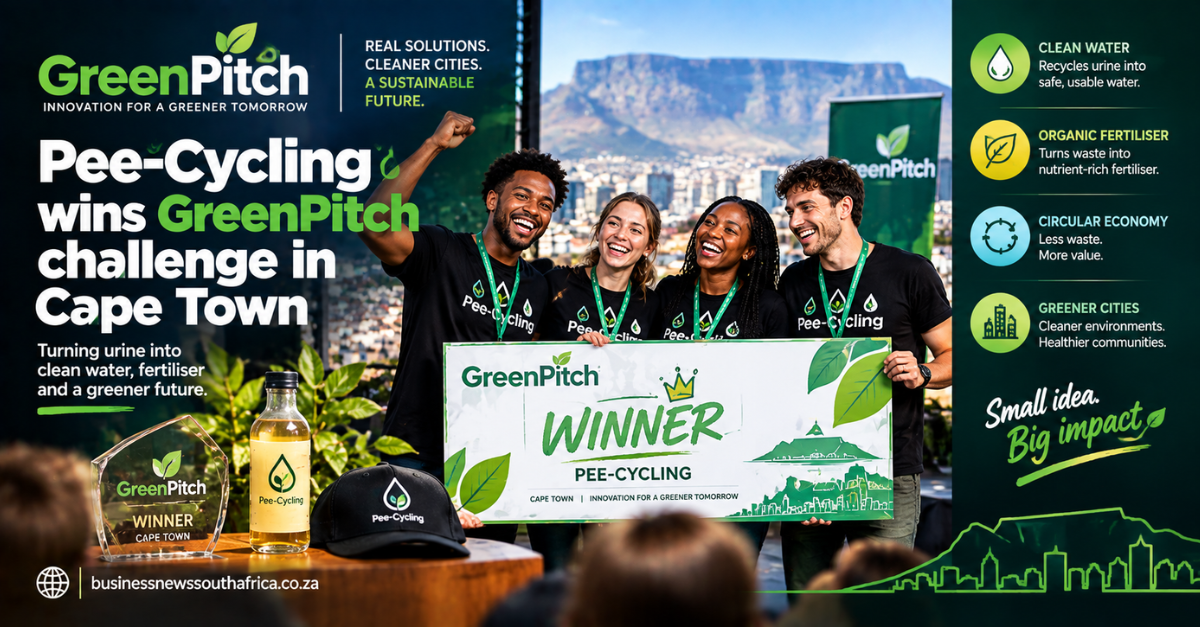
Engineering News reported that Pee-Cycling took top honours in Cape Town’s GreenPitch challenge. The win puts the urine-to-fertiliser startup in front of potential investors, municipal water managers and other small-scale innovators who are looking for ways to stretch scarce resources.
GreenPitch is a competition that invites early-stage companies to pitch solutions that address South Africa’s environmental pressures, from water scarcity to waste overload. Winners typically receive cash, mentorship and access to pilot sites. The exact prize package for this year’s competition was not disclosed in the announcement.
For Pee-Cycling, the accolade could translate into a faster route to market. The company has been developing a system that captures human urine, treats it with a low-energy process and produces a nitrogen-rich fertiliser that can be used in smallholder farms. If the technology scales, it could help farmers reduce dependence on imported fertiliser while cutting the volume of urine that ends up in municipal sewers.
The South African agriculture sector faces rising input costs and a need for more resilient nutrient sources. According to the Department of Agriculture, fertiliser imports account for a significant share of the country’s agricultural spend. A locally produced, circular-economy fertiliser could therefore ease pressure on farm budgets and support food security goals.
From a business perspective, the GreenPitch win may also open doors to public-private partnerships. Cape Town’s municipal water utility has been experimenting with urine collection in public toilets as part of its water-saving strategy. A partnership could give Pee-Cycling a real-world testing ground and a credible reference for other cities.
What the win means for other SMEs
While the story centres on a single startup, it highlights a broader trend: South African SMEs that can combine environmental impact with a clear revenue model are attracting attention from both investors and government programmes. The country’s National Development Plan calls for a 30 % increase in the contribution of green technologies to GDP by 2030, and funding bodies are increasingly looking for proof points such as competition wins.
For entrepreneurs in the waste-management space, Pee-Cycling’s success underscores the value of aligning product development with national priorities, in this case, water conservation and nutrient recycling. It also shows that niche technologies can gain traction when they are presented in a format that is easy for non-technical audiences to understand.
Nevertheless, the path ahead is not without challenges. Scaling a treatment system that handles urine requires navigating health-safety regulations, securing reliable supply chains for components, and convincing end-users of the product’s safety and efficacy. The company’s next steps, as hinted at in its brief statement, involve pilot projects and seeking additional capital.
In the short term, the GreenPitch accolade is likely to raise Pee-Cycling’s profile among venture capital firms that specialise in climate-tech. In the longer term, if the startup can move from prototype to commercial deployment, it could create a new revenue stream for small farms and reduce the load on municipal wastewater treatment plants.
Why recovering nutrients from waste is a business and not only a good idea
The appeal of a circular fertiliser product is easy to state in environmental terms and easy to underrate in industrial ones. Nitrogen fertiliser is manufactured by fixing nitrogen from the air in a process that runs at high temperature and pressure and consumes a great deal of energy, which is why fertiliser prices track energy prices closely and why a country importing both feels the effect twice. Recovering nitrogen that has already been fixed, from a stream that is currently a disposal cost, sidesteps that energy bill entirely.
The same logic explains the municipal interest. A wastewater treatment plant is sized for the nutrient load it has to remove, and nutrients that never enter the sewer do not have to be treated at the other end. A technology that reduces the load is therefore worth something to a utility as an avoided cost, separately from whatever the fertiliser itself sells for.
The distance between a pitch win and a product
A competition win is a useful signal and a poor predictor on its own. What it demonstrates is that the idea survives explanation to a room of informed strangers, which is genuinely hard and genuinely worth something. What it does not demonstrate is that the process works at a hundred times the volume, that the output meets an agricultural standard consistently, or that a farmer will buy it twice.
Those are the questions a pilot answers and a pitch cannot, and they are why the gap between winning a prize and holding a purchase order is usually measured in years. For founders watching from the same sector, the useful reading of an award is as a door opened rather than a milestone passed.