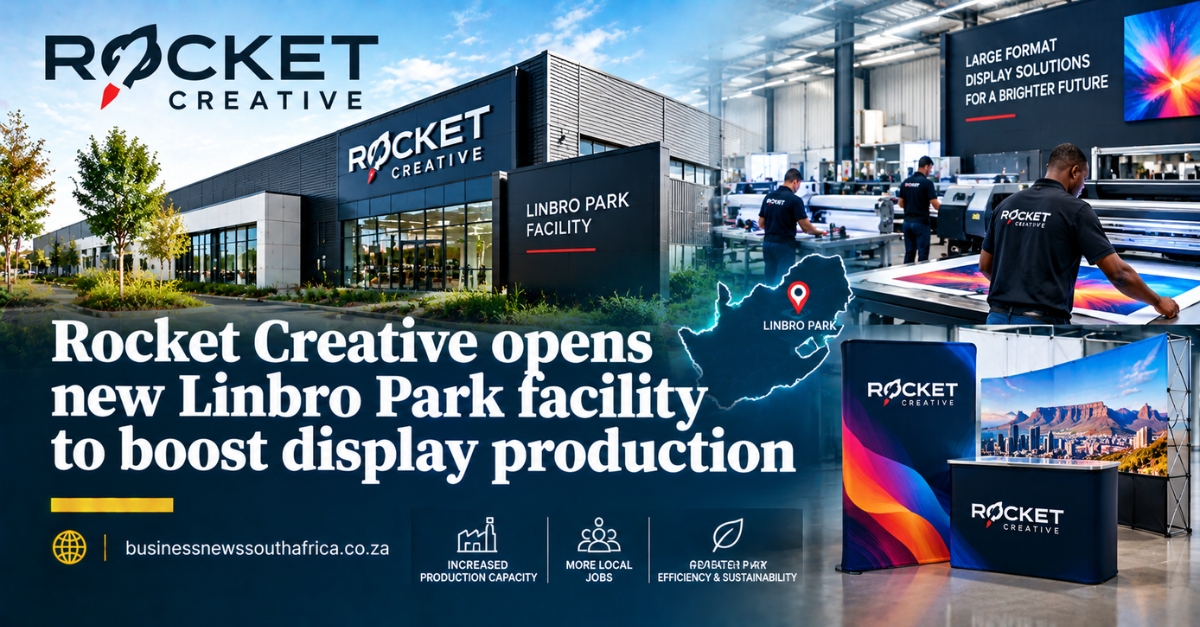
On a crisp evening in Sandton, Rocket Creative welcomed long-standing clients, manufacturing partners and industry stakeholders to the ribbon-cutting of its new premises at Units 3 and 4, HUB 24 Industrial Park, Linbro Park. The celebration, compered by print specialist Darryl Braithwaite, gave guests a first look at the expanded creative offices, workshop floors and prototyping bays.
Founder and CEO Rich Nilson told the assembled crowd that “Rocket 2.0 marks an exciting new chapter in our journey”. He explained that the new site was built from the ground up to reflect the future of display engineering, delivering sharper efficiencies, increased capacity and top-tier execution for the brands they serve.
The upgraded facility integrates dedicated creative studios with an expansive fabrication floor. In plain terms, the studios are where designers develop concepts and digital mock-ups, while the fabrication floor is the space where those concepts are turned into physical retail point-of-sale (POS) architecture, the in-store displays where customers make purchases. The company also highlighted its focus on turnkey retail displays (complete, ready-to-use installations), experiential brand activation structures and bespoke promotional hardware (custom-made pieces).
South Africa’s retail and events sector has been leaning heavily into experiential marketing, as brands seek to attract shoppers with immersive in-store experiences. This trend creates a steady stream of work for firms that can design and produce large-scale displays quickly. At the same time, the industry wrestles with load-shedding and a shortage of skilled fabricators, which can slow production. By adding more studio space and a larger floor for fabrication, Rocket Creative aims to offset those bottlenecks and offer faster turnaround times, a benefit that could ripple through advertising agencies and activation firms that serve small and medium enterprises.
Implications for the market
With the new “Rocket 2.0” site now fully operational, the company is positioned to take on bigger, more technically ambitious projects across the retail and events landscape. For SMEs that rely on third-party agencies for point-of-sale displays, the upgrade could mean shorter lead times and more innovative solutions, potentially lowering the cost of entry into high-impact brand activations.
South Africa’s experiential and display marketing industry has grown alongside brands’ shift toward in-person activations and pop-up retail formats, particularly as digital advertising costs have risen and marketers look for ways to stand out at physical events. The Interactive Advertising Bureau South Africa’s own industry research carries further detail. For related coverage, see this site’s SME and Entrepreneurship coverage.
Agencies that invest in their own fabrication capacity also tend to become more attractive partners for national and multinational brands running South African campaigns, since an in-house build reduces the number of subcontractors involved and gives the client a single point of accountability for quality and deadlines.
South Africa’s events and activations calendar has also become busier in the post-pandemic years, as brands that paused large in-person spending during that period have returned to physical marketing with bigger budgets, giving agencies with their own production capacity a wider window of paid work across the year rather than a handful of peak seasons.
South Africa’s broader creative and production sector has also benefited from a weaker rand making local fabrication more cost competitive against importing pre-built displays and set pieces from Europe or Asia, a shift that has encouraged some agencies to bring capabilities in-house that they previously outsourced offshore. That trend has, in turn, supported local employment in trades such as metalwork, carpentry and specialist printing that feed directly into building physical brand activations.
Clients commissioning a large activation typically build in a site visit to a fabricator’s own workshop before signing off on a build, a step that becomes easier to offer once an agency has expanded floor space of its own.