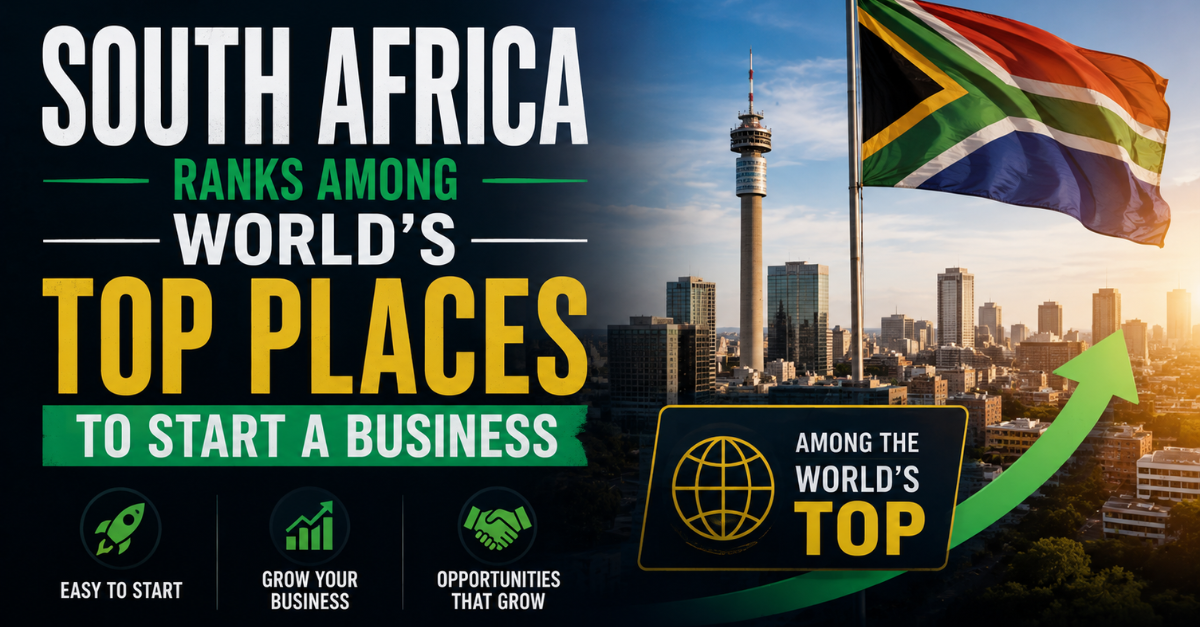
Good Things Guy announced that South Africa has been placed among the world’s top locations for starting a business. The statement is a claim by the outlet and has not been independently verified by other sources.
For owners of small and medium enterprises, the headline suggests that the regulatory environment may be more supportive than in many other countries. In practical terms, a favourable ranking usually reflects lower costs and shorter times to register a new company, easier access to credit, and fewer bureaucratic steps.
What the ranking measures
The most widely used international benchmark for business start-up conditions is the World Bank’s Doing Business index. The index looks at factors such as the number of procedures required to start a company, the time it takes to complete those procedures, the cost of registration as a share of per-capita income, and the ease of obtaining construction permits. While the Good Things Guy article does not give the exact position, the claim that South Africa is among the top places implies a relatively strong performance on these metrics.
In South Africa, the Companies and Intellectual Property Commission (CIPC) offers an online portal where entrepreneurs can reserve a company name, submit incorporation documents and pay the registration fee. The fee for a private company is roughly R175, and the process can be completed in as little as five working days if all documents are in order. This is faster and cheaper than many neighbouring economies, where registration can take weeks and cost several thousand rand.
Beyond registration, the ranking also reflects the overall business climate. South Africa has a relatively well-developed banking sector, with several banks offering start-up loans and government-backed financing schemes such as the Small Enterprise Finance Agency (SEFA). The presence of a large domestic market, a network of suppliers and a relatively stable legal framework are additional factors that can help new businesses grow.
However, the optimism of the ranking must be balanced against persistent challenges. Load-shedding, scheduled power cuts, continues to affect manufacturing and retail operations, raising operating costs for many SMEs. Labour regulations, while protective of workers, can also add complexity for small firms that lack dedicated HR resources. These issues are not captured in a single ranking but remain part of the day-to-day reality for entrepreneurs.
What the news means for an SME owner is simple: the environment for starting a new venture is recognised as relatively favourable on the global stage. This could translate into greater confidence from investors, both local and foreign, who often look to such rankings when deciding where to allocate capital. It may also encourage local banks to extend more credit to start-ups, knowing that the regulatory backdrop is supportive.
At the same time, owners should not assume that the ranking eliminates all obstacles. Practical steps such as preparing a solid business plan, securing reliable power solutions and staying compliant with tax and labour laws remain essential. The ranking can be used as a marketing point, for example, a new café could advertise that it is opening in a country rated as one of the world’s best for start-ups, but it does not replace the need for sound management.
In summary, the Good Things Guy report highlights a positive signal for South African entrepreneurs. While the claim has not been cross-checked, the country’s existing registration procedures, access to finance and market size support the notion that starting a business here is comparatively straightforward. SME owners can view the ranking as an endorsement of the current framework, but they should continue to plan for the known challenges that still affect the local economy.