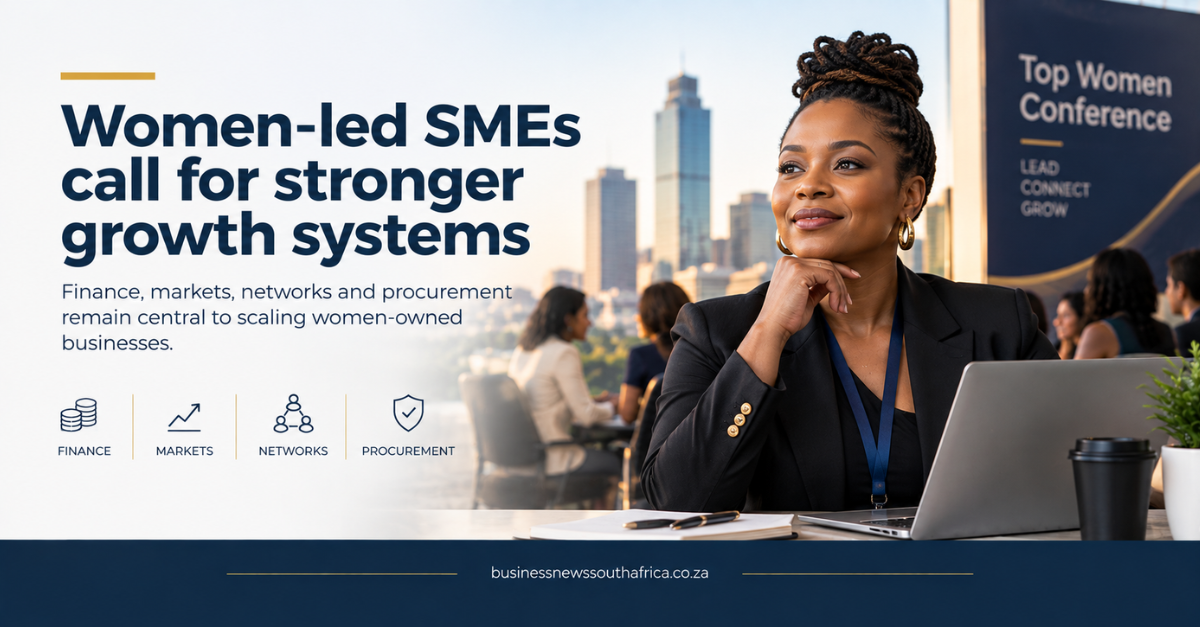
Hon. Dr Nomusa Dube-Ncube, Deputy Minister for Higher Education and Training, opened the Standard Bank Top Women Conference by warning that the cost of inaction on gender parity is measurable in lost GDP and jobs. According to the Deputy Minister, Africa could add US$316 billion to its gross domestic product by matching the continent’s best-performing nation on gender parity, with a further US$287 billion and 23 million jobs on the table by 2030, based on McKinsey and Mastercard Foundation research.
For owners of small and medium enterprises, the stakes are clear: without systemic support, women-led businesses miss out on contracts, mentorship and the talent pipeline that can drive growth. Dube-Ncube urged private-sector partners to move beyond one-off sponsorships and adopt multi-year commitments that tie bursaries to work-integrated learning, a model where students combine study with on-the-job training, and turn mentorship into sponsorship that leads to real procurement opportunities.
Day one of the two-day event featured a keynote from Dr Naledi Pandor, Chairperson of the Nelson Mandela Foundation, who argued that ambition and wellbeing need not be at odds. Sessions covered how to turn professional networks into business value, the use of digital tools as a growth lever, and a candid panel hosted by Vouch SA that highlighted the hidden costs of scaling a startup. The day closed with a retrospective conversation among past Top Women Entrepreneur award winners, offering practical lessons on what follows public recognition.
Day two shifted focus from representation to systems change. UNAIDS Regional Director Anne Githuku-Shongwe drew parallels with the global HIV response, emphasizing that lasting impact depends on coalitions rather than individual heroes. Panels examined the future of entry-level work under AI and automation, workplace cultures that enable harassment, and how innovation funding, inclusive leadership and trust-based cultures translate into economic participation. Representatives from MultiChoice, Harmony Gold Mining Company Limited and Sanofi led discussions on turning funding into measurable outcomes.
The conference also delivered concrete matchmaking opportunities. Business Matchmaking pre-arranged introductions between women-led businesses, corporates and decision-makers. PitchPower Networking offered two-minute lightning pitches, and the Pitching Den crowned the three regional EmpowHER winners, Lesego Seloane (Ronewa Creations), Kiki Sepuru (Afrique360 Solutions) and Refilwe Moreno Barahona (Tsogomath), who competed for the Top Women EmpowHER Entrepreneur of the Year Award.
While the statistics cited by the Deputy Minister are research-based estimates, they underline a real gap: women’s share of Africa’s GDP fell from 18 % in 2000 to 11 % in 2022. For SME owners, tapping the untapped potential of women entrepreneurs could capture a portion of the projected $600 billion economic boost. The conference’s call for structured pathways, from education to procurement, is a roadmap that can be adapted by any small business seeking growth.
SME owners interested in aligning with the conference’s recommendations can explore multi-year sponsorship models, link bursaries to on-the-job training and seek inclusion in corporate procurement pipelines. The Business News South Africa Commercial Funding Suite offers templates to structure such partnerships.
The conversation will continue on 3 December 2026 when the Top Women Awards recognise the businesses, leaders and entrepreneurs driving women-led growth across the continent. Seats can be booked at the event’s website.
What this means for your business
Women-owned SMEs that secure long-term corporate sponsorships and demonstrate measurable skills outcomes are more likely to win contracts with large firms such as Standard Bank, Telkom Group and bp Southern Africa, all of which are supporting the conference. Aligning your business with these expectations now could position you for future procurement opportunities.
Why the gender-parity gap widened, not narrowed
The drop in women’s share of Africa’s GDP from 18% in 2000 to 11% in 2022 is a genuinely counterintuitive trend given two decades of gender-focused development spending across the continent, and it points to a structural issue rather than a lack of individual effort: women-owned businesses have historically been concentrated in lower-margin, informal sectors that grew more slowly than the formal, capital-intensive sectors driving the continent’s overall GDP growth over the same period. That is part of why the conference’s emphasis on procurement access, not just funding access, matters: a business that can win a stable, recurring contract with a large corporate buyer moves into a fundamentally different growth trajectory than one relying on informal, one-off sales.