In a recent episode of Watts & Wheels with Wills, GridCars founder Winstone Jordaan told host William Kelly why the biggest obstacle to a national electric-vehicle (EV) charging network is not the charger itself but the software that runs behind it.
Jordaan explained that the physical hardware, the charging point, is relatively straightforward to install. The hard part, he said, is “working out where to put a charger and how much power to feed it” and, more importantly, building the billing and roaming systems that identify each driver, handle payments and alert users to faults.
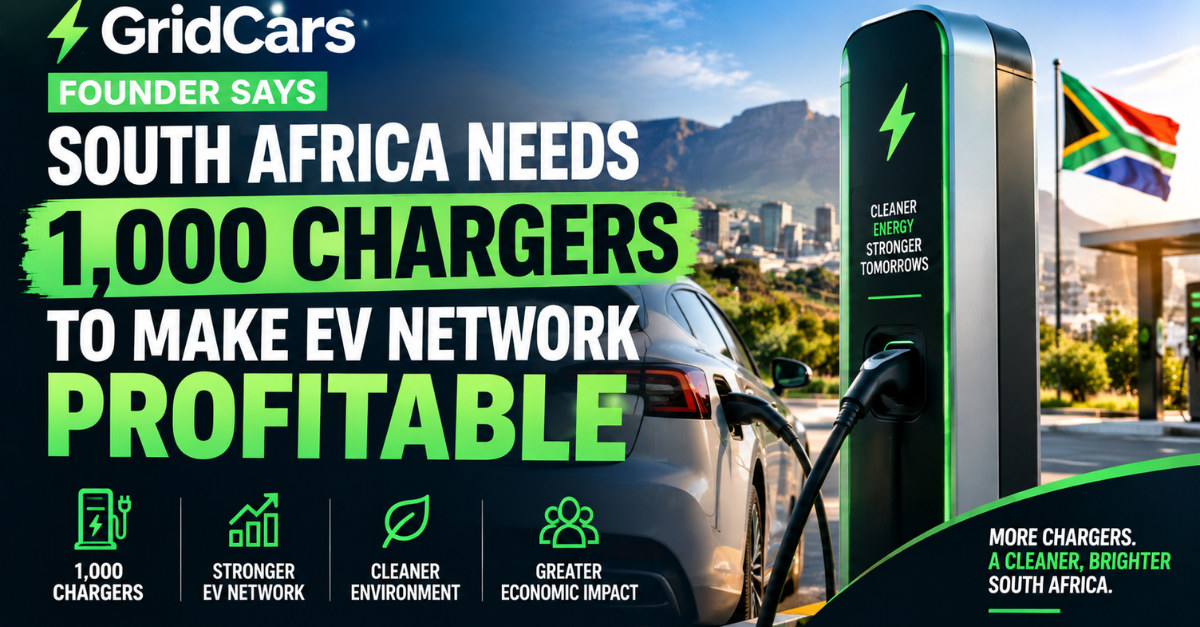
He noted that a charge point operator, a company that owns and runs public chargers, needs roughly a thousand charging points to break even. South Africa currently has about 650 public chargers, according to industry estimates, meaning the market is still below the scale required for profitability.
Jordaan also shared his long-term vision: for a fleet of 11 million EVs, South Africa would need around 500 000 chargers. That figure comes from a simple calculation, one charger for every 22 vehicles, which he says reflects the scale needed to support widespread adoption.
Beyond the numbers, Jordaan warned that the disruption will reach far beyond the motoring sector. He told an industry gathering that a third of the companies currently involved in charging infrastructure could be out of business within five years if they do not adapt to the emerging software-centric model.
For businesses considering entry into the EV charging space, the message is clear: the capital outlay for hardware is only part of the equation. Investing in robust billing platforms, customer-identification tools and a 24-hour call centre, which Jordaan says requires at least seven staff members, is essential to compete.
Jordaan’s comments come at a time when the South African government is pushing for greater EV uptake. The Department of Transport’s 2022 EV strategy targets one million electric vehicles on the road by 2030, a goal that will require a substantial expansion of charging infrastructure.
While load-shedding remains a concern for any electricity-intensive operation, Jordaan is confident that the grid can accommodate a larger charging network if the right software controls are in place. He dismissed the common excuse that there are not enough chargers, calling it “poorly informed”.
In practical terms, GridCars has been developing its backend platform since 2010, well before the first EVs arrived in South Africa in 2013. The company’s experience gives it a head start in tackling the software challenges that newer entrants will face.
For SME owners, fleet managers and investors, the takeaway is that profitability in the South African EV charging market hinges on reaching the critical mass of chargers and mastering the digital side of the business. Without a solid billing and roaming system, even a well-located charger can become a costly dead-end.
Why the software problem is harder than the hardware problem
The pattern Jordaan describes is not unique to South Africa. Globally, charge point operators have converged on a standard called OCPP (Open Charge Point Protocol), which lets a charger from one manufacturer talk to a billing and management system from another. Without that kind of interoperability, a network built one charger at a time becomes a collection of incompatible islands, each with its own app, its own payment method and its own fault-reporting process, which is exactly the fragmented experience that discourages everyday drivers from trusting public charging at all.
South Africa’s grid adds a second layer to the problem that most markets do not have to solve at the same time: unreliable base-load electricity. A charging network has to schedule when it draws power, how it responds to load-shedding stages, and how it prioritises paying customers over idle bays, all through the same software stack that also handles billing. That is why Jordaan frames the charger itself as the easy part. A badly run software layer cannot be fixed by installing more plugs; it has to be re-engineered from the ground up, which is a far more expensive and slower fix once a network is already live.
For South African investors weighing entry into this space, the implication is that capital raised for EV infrastructure should be weighted toward the platform, not just the concrete and copper. A charger with no reliable back-end is a stranded asset the moment a driver has a billing dispute or a fault goes unreported.