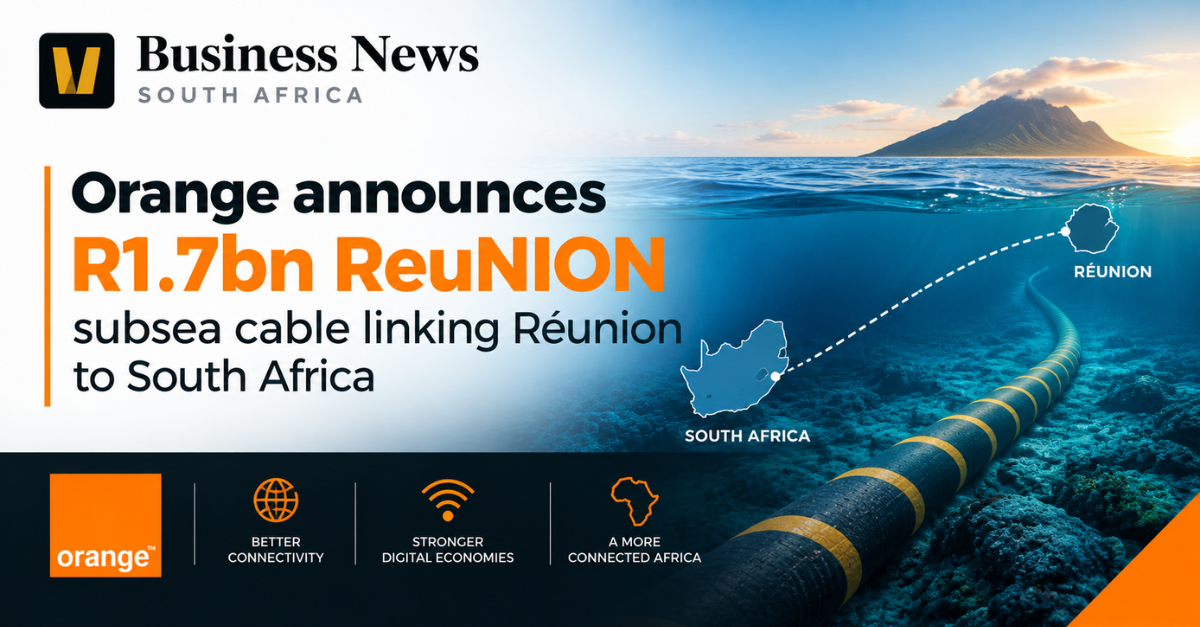
Orange has unveiled plans for a new submarine cable called ReuNION, a €93.1-million (R1.7 billion) project that will run from the French island of La Réunion to the South African coast. The announcement comes as the existing Safe cable, in service since 2002, approaches the end of its useful life.
According to the company, ReuNION will contain 16 fibre pairs, each capable of carrying about 20 Tbit/s. That gives the system a design capacity of roughly 320 Tbit/s, enough to handle a large share of the region’s internet traffic. Funding comes from four sources: €30 million from the European Regional Development Fund, €20 million from the EU’s Connecting Europe Facility, €36.6 million from the three operators in the consortium, and €6.5 million from the French state.
The consortium behind the cable includes the public body La Réunion Connectée, which will own most of the fibre pairs for commercial use, and the operators Orange, Réunicable and Telco OI (trading locally as Free). Orange Marine will be responsible for laying the cable, while Alcatel Submarine Networks will design and manufacture it. Orange will act as the landing party on the island, but has not yet confirmed the exact South African landing point. Industry reports suggest the cable will be engineered to feed the Durban and Johannesburg metros.
Next steps involve marine surveys and permit applications, followed by manufacturing and cable laying. The cable is slated to be ready for service in 2028.
What the cable means for South African businesses
For South African enterprises, especially small and medium-size firms that rely on cloud services, the extra capacity and redundancy could translate into lower latency and more reliable connections. When a single cable fails, traffic is forced onto alternative routes, which can increase costs and slow down data transfer. ReuNION will provide an additional pathway, reducing the risk of a bottleneck when the Safe cable retires in 2027.
At present, the Safe cable runs 13 500 km from Melkbosstrand and Mtunzini through Réunion, Mauritius and India to Malaysia. If it is decommissioned without a replacement, the Metiss cable, live since 2021 and landing at Amanzimtoti south of Durban, would become the island’s only direct long-haul international link. The Lion system, which connects to Mauritius and Madagascar, would still operate but does not provide the same capacity as a dedicated long-haul cable. ReuNION therefore restores a critical layer of resilience for data traffic between South Africa and the wider Indian Ocean region.
ReuNION joins a crowded pipeline of under-sea projects that already touch South Africa. Google is planning the Eastern Cape as the southern anchor of its Umoja route to Australia, Seacom is designing a 25 000 km, 2 000 Tbit/s successor to its original system, and Meta’s 2Africa and Project Waterworth cables also land in the country. The cumulative effect is a competitive market that could drive down wholesale bandwidth prices, a benefit that will filter down to end-users and businesses.
Companies that depend on high-speed internet should watch the permitting process and the cable-laying schedule. If the project stays on track, the extra capacity should be available by 2028, giving businesses a few years to plan upgrades or negotiate better service terms with providers.
Why South Africa keeps attracting new subsea cables
The country’s position at the southern tip of Africa makes it a natural landing point for cables connecting Europe, the Middle East and Asia to markets further down the continent’s east and west coasts, which is why South Africa now sits at the intersection of several competing subsea projects rather than depending on any single system. That competitive density is itself valuable for South African businesses: a market served by one dominant cable has limited negotiating leverage on wholesale bandwidth pricing, while a market served by several competing systems, as ReuNION will help create alongside Metiss, 2Africa and the planned Umoja route, gives network operators real alternatives to route around a fault or negotiate better terms, benefits that flow through to the retail broadband and cloud-service prices businesses actually pay.