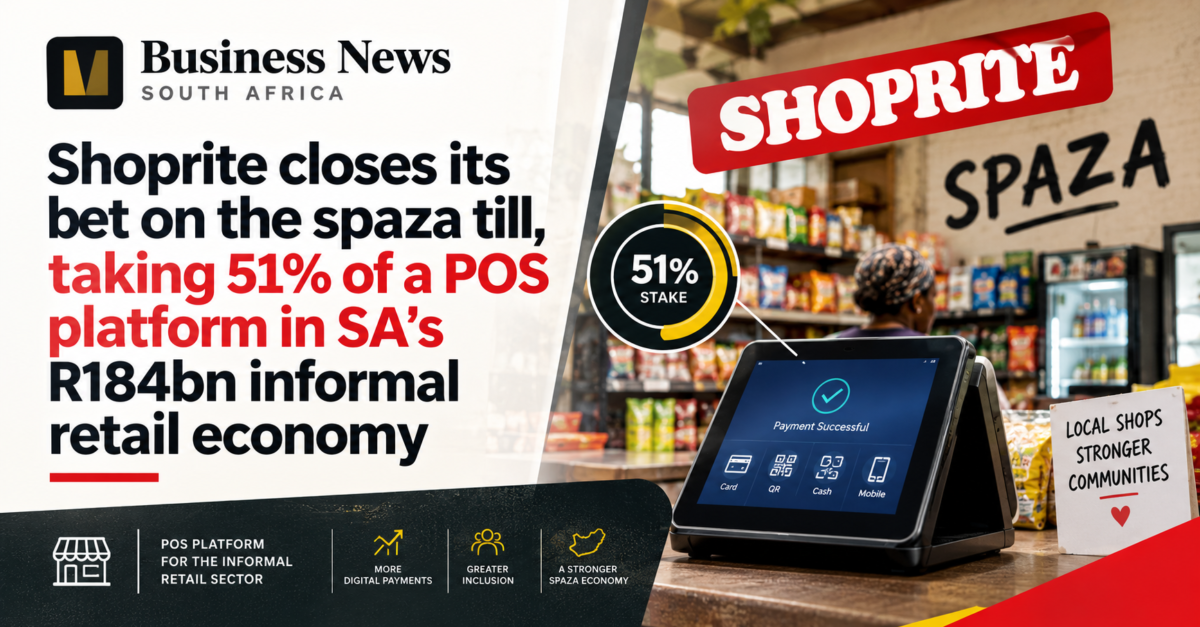
Shoprite has closed its acquisition of a 51% stake in R&A Cellular, effective 14 August 2026, giving South Africa’s largest grocery retailer direct ownership of a point-of-sale platform already embedded in the country’s spaza shops and informal retail sector. This site previously reported on Shoprite’s stated move into fintech based on a bare company announcement; the R&A Cellular deal is the specific transaction that announcement was describing, now closed with real detail attached to it.
What R&A Cellular actually does
R&A Cellular supplies point-of-sale devices, branded DesertPOS, to spaza shops and other informal retailers. The devices accept card, tap and digital wallet payments, and also sell prepaid airtime, mobile data, electricity tokens, gaming products and lottery tickets, critically with offline transaction capability built in, a genuinely necessary feature in areas where connectivity cannot be assumed to be constant. For a spaza shop owner, a device like this collapses what would otherwise be several separate relationships, a bank card machine, a prepaid airtime terminal, an electricity voucher outlet, into a single piece of hardware behind the till.
Why Shoprite wants a stake, not just a supply deal
Shoprite has not disclosed the deal’s value, describing it only as “relatively small” relative to the group’s own scale, and the group’s own financial reporting has not yet allocated the purchase consideration in its accounts. What is clear from chief executive Pieter Engelbrecht‘s own framing is the intent behind taking equity rather than simply remaining a customer or supplier: Shoprite wants to expand R&A Cellular’s device footprint nationally, broaden the value-added services those devices carry, and embed Shoprite’s own Money Market financial services, prepaid accounts and money transfers among them, directly inside the R&A Cellular ecosystem, reaching customers who may never set foot inside one of Shoprite’s 2,839 supermarkets.
That last point is the strategic core of the deal. Shoprite’s existing Money Market counter service already makes it one of South Africa’s largest processors of money transfers and bill payments, built on foot traffic through its own stores. A 51% stake in the informal retail sector’s own point-of-sale infrastructure extends that same financial-services reach into a channel Shoprite’s supermarkets structurally cannot replace: the spaza shop that sits inside a residential neighbourhood a taxi ride, not a shopping trip, away.
The size of the market Shoprite is buying into
Industry estimates put South Africa’s informal FMCG retail sector at R184 billion to R197 billion a year, spread across somewhere between 100,000 and 150,000 individual outlets, a market roughly the same order of magnitude as several of the country’s largest formal retail chains combined, but fragmented across outlets too small individually to interest a conventional banking relationship manager or a formal supply-chain contract. That fragmentation is precisely why the sector has historically been so hard for large, formal players to reach directly: a supermarket group can sign one supply agreement with a major distributor, but reaching 100,000 individually owned spaza shops one at a time is not commercially viable through a conventional sales channel.
A payments device already installed at the till, by contrast, is a distribution channel that scales differently: once DesertPOS terminals are in place processing daily transactions, adding a new financial product, a loan offer, a savings product, a new prepaid category, is a software and partnership decision rather than a fresh round of physical distribution. That is the underlying logic connecting this deal to the Competition Commission’s own recent finding that only 1 in 10 township firms currently sell online at all: the barrier for South Africa’s informal retailers has never really been demand, it has been the cost and complexity of getting basic digital payment and inventory infrastructure into a small, cash-based business in the first place.
What it means for the small businesses on both sides of this deal
For the spaza shop owners already running DesertPOS devices, the practical change is less about who owns 51% of the company behind their till and more about what gets added to it: a wider menu of financial products layered onto hardware they already use daily, potentially including access to short-term credit or savings products spaza owners currently cannot easily get from a mainstream bank given the informal, often undocumented nature of their trading income. For competing township-focused fintechs and payment providers, Shoprite’s move signals that the largest formal retailers now see direct ownership of informal-sector payment infrastructure, not just a supply relationship with it, as the more defensible long-term position, which is likely to accelerate similar acquisition interest from other large retail and banking groups eyeing the same underserved market.
The Competition Commission’s own merger review process is the regulatory gate a transaction of this kind has to clear before it can close.