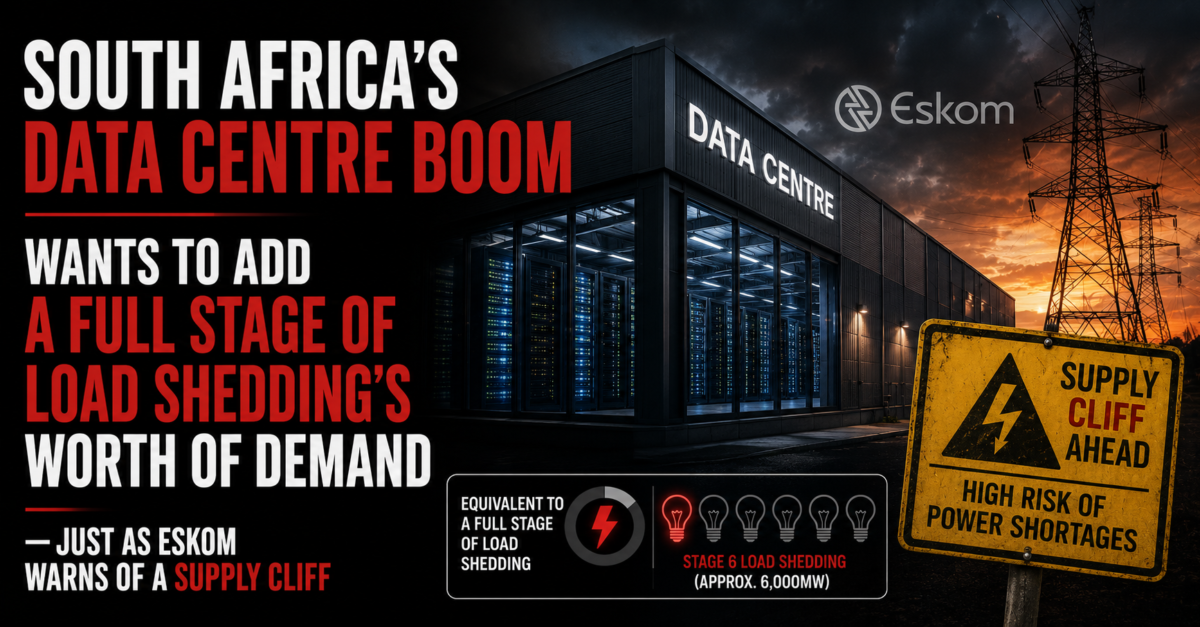
South Africa’s data centre operators are collectively planning to more than double the country’s existing capacity, and the number attached to that expansion is worth sitting with: roughly 1,000 megawatts of new electricity demand, according to reporting by the Daily Maverick. That is, by coincidence of scale rather than any formal equivalence, roughly the size of a single stage of the load shedding that defined the country’s power crisis for most of the last decade.
Who is building what
Teraco, the country’s dominant data centre operator, currently runs 190MW of capacity and is targeting 500MW, with 290MW of new capacity planned for Johannesburg and 60MW for Cape Town. A newer entrant, Cavaleros, operating as Cosmas Data City, has proposed a 360MW campus in Cape Town and a 200MW campus in Samrand, north of Johannesburg. Vantage Data Centres is adding another 100MW across two Johannesburg campuses. Layered on top of the local operators, Microsoft has already put R20.4 billion into South African data centre infrastructure over the past three years and has committed a further R5.4 billion, with reporting suggesting an unconfirmed link between Microsoft’s cloud ambitions and the Cosmas project specifically.
This is not speculative land-banking. Every major hyperscale cloud provider, Microsoft, AWS and their peers, is racing to secure African compute capacity for AI workloads, and South Africa’s existing fibre and power infrastructure, imperfect as it is, remains the most developed on the continent for that purpose. The country is a genuine beneficiary of that race. It is also, on the numbers here, about to test exactly how much slack its electricity system actually has.
Why the timing is the real story
Energy analyst Chris Yelland, quoted in the same reporting, called the scale of the expansion “not insignificant” given existing electricity supply constraints — a notably measured way of flagging a real problem. Eskom’s own risk analysis points to constrained supply becoming likely again by 2029 unless substantial new generation capacity is added rapidly, driven by what the reporting describes as a “looming base supply cliff”: a wave of coal station retirements arriving at roughly the same time as power imports from Mozambique’s Cahora Bassa hydroelectric scheme are due to expire.
That timeline matters enormously for how this expansion should be read. Eskom has just reported, as covered elsewhere in this publication, a profit of R30.3 billion for the year to March, helped substantially by an end to load shedding rather than by a fundamental change in generation capacity. The utility’s own numbers show 13 days of outages in the year, against hundreds in the worst years of the crisis, but sales still fell 6.2%, and the company’s own audited statements carry a material uncertainty note about its ability to continue as a going concern without further tariff and structural intervention. A grid that has stabilised because industrial demand fell and diesel spend was cut is not the same thing as a grid with headroom to absorb 1,000MW of new, always-on, technically demanding load on top of an eventual industrial recovery.
What this means beyond the data centre operators themselves
Data centres are an unusually demanding customer for a power grid: unlike a factory that can shed load or shift a production run, a data centre’s power demand is close to constant, 24 hours a day, and any interruption risks the kind of outage that ends contracts with the hyperscale clients the whole investment case depends on. That makes data centre operators some of the most motivated customers in the country for reliable, dedicated supply arrangements, private wheeling agreements, direct renewable power purchase deals, on-site generation, exactly the kind of arrangements Eskom has already been signing with large industrial users like ferrochrome smelters to keep them on the grid.
For South African businesses outside the data centre sector, the practical question this raises is one of sequencing and priority. If new base-load generation does not arrive fast enough to meet both a recovering industrial economy and a doubling of data centre demand, the country’s utility and its regulator will face a real allocation decision about whose demand gets served first, and on what commercial terms. The answer to that question, still years away, will matter more to an ordinary manufacturer or retailer’s electricity costs and reliability than almost anything else on South Africa’s infrastructure horizon, and it is being shaped right now by contracts being signed between hyperscalers and grid planners largely out of public view.