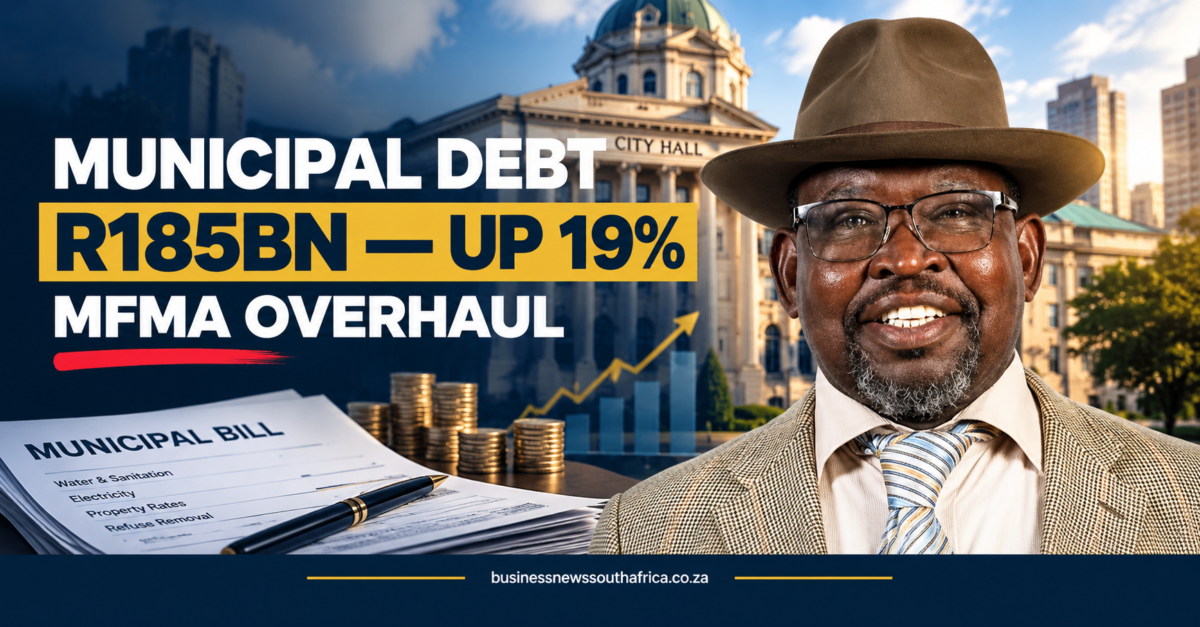
National Treasury has put municipal finances at the centre of the 2026 Medium-Term Budget Policy Statement, pairing a warning about rising local government debt with a draft law that would rewrite the rules councils work under. According to Bloomberg, as carried by BusinessTech, debt owed by municipalities to creditors rose 19% to R185.2bn in the year to June. The Treasury is also proposing the first comprehensive modernisation of the Municipal Finance Management Act (MFMA) in 23 years, and it has published the draft for public comment.
Finance Minister Enoch Godongwana tabled the statement in Parliament on Wednesday 21 October. In his speech as published by government, he said the financial and operational performance of many municipalities “remains weak” and called that “untenable”. He added that it affects basic services, undermines economic activity and erodes public confidence. Local government elections are on 4 November.
What the MFMA bill is meant to change
Godongwana said the changes focus on funded budgets, improved revenue management, clearer accountability and earlier intervention when municipalities fall into financial distress. The bill requires municipalities to demonstrate that their budgets are genuinely funded. It also introduces stronger mechanisms to investigate financial misconduct and recover losses, along with a clearer framework for financial recovery and intervention in distressed municipalities.
The Treasury’s summary of the proposals, as reported by The Citizen, goes further. It says the MFMA changes would expand the Treasury’s investigative, oversight and enforcement powers, require municipalities to submit bank account details to the Treasury, and provide for control of municipal accounts and withdrawals during a national or provincial intervention. The Treasury also says the changes would allow early interventions under section 139 of the Constitution and make officials, political office-bearers and board directors personally liable for unauthorised, irregular, fruitless and wasteful expenditure. Councils would be deterred from adopting unfunded budgets.
The reform also touches who runs municipal finance departments. Treasury Director-General Duncan Pieterse said the current MFMA proposal is for the Treasury to play a role in the appointment of chief financial officers only. According to EWN, he said: “If that changes through the public comment process that’s something else.” Some early reports described the plan as the Treasury taking over CFO appointments outright, so the final shape of that provision is still open.
Several details reported in the first wave of coverage could not be confirmed in the speech or the other sources we checked, including a requirement that municipal salary increases get the Finance Minister’s concurrence. We have left those out until the draft text is read.
Why the debt figure matters to business
The R185.2bn figure comes from Bloomberg’s reading of the statement, and we have not seen the same number in the speech text itself. The report also said the Treasury flagged weakening local and provincial finances as a key fiscal risk, and warned that distress across the public sector could spill onto the national balance sheet because Eskom and other entities may need further funding and guarantees.
The Eskom link is direct. Bloomberg reported that overdue municipal debt to the utility reached R122.5bn by 31 August, citing Electricity Minister Kgosientsho Ramokgopa, and that Eskom has warned the figure could grow to R300bn within five years if nothing changes. It added that Eskom has already received R220bn of the R230bn debt-relief package announced in 2023. Our earlier coverage looked at why Eskom’s municipal debt plan has stalled.
For companies, the practical risk is service reliability. Firms that depend on municipal water and electricity feel the effects when councils cannot pay bulk suppliers, and the minister himself linked weak municipal performance to economic activity. A council that cannot fund its operations from honest revenue estimates is also a harder counterparty for contractors and suppliers.
Money on offer, and conditions attached
The Treasury is pairing the tougher rules with more money. Godongwana said local government will receive 10% of available non-interest spending over the medium term, against 47.4% for national departments and 42.6% for provinces. He announced an additional R21.8bn for the local government equitable share to cover higher bulk costs of free basic water, sanitation, electricity and refuse removal, and an extra R13.4bn from the general fuel levy to restore the metros’ share to 23%.
On revenue collection, he said R3.5bn is being added over the medium-term expenditure framework for a wider smart meter rollout, on top of R2bn already allocated. One IOL report quoted the figure as R3bn, but the published speech and Inside Metros both say R3.5bn. Business Day reported that the programme has so far installed 247,206 meters in 28 municipalities.
Enforcement is already under way. Godongwana said that in June he suspended the next equitable share transfer to 69 municipalities that persistently failed to pay all creditors. He said 37 of them had concluded council-approved repayment plans by the end of July and R4.2bn had been paid to creditors. Business Day reported the number of municipalities with repayment plans as 38, so the two accounts differ by one. He also said grant conditions will be enforced, with funds withheld or reallocated where municipalities do not comply.
What is still unknown
The bill is a draft out for comment, not law. IOL reported that the related fiscal anchor legislation is expected to be tabled in Parliament next year, but we have not seen a tabling date for the MFMA bill. The comment period, the final wording on personal liability and the CFO appointment role will all be decided after submissions. Business Day noted that the Treasury had earlier relented on some withheld transfers, releasing a balance of R7.1bn, which shows how enforcement has been applied in practice.
For wider context, see our coverage of the medium-term budget and the fiscal anchor, and the COGTA warning on wasteful municipal spending, or browse Regulatory & Policy.