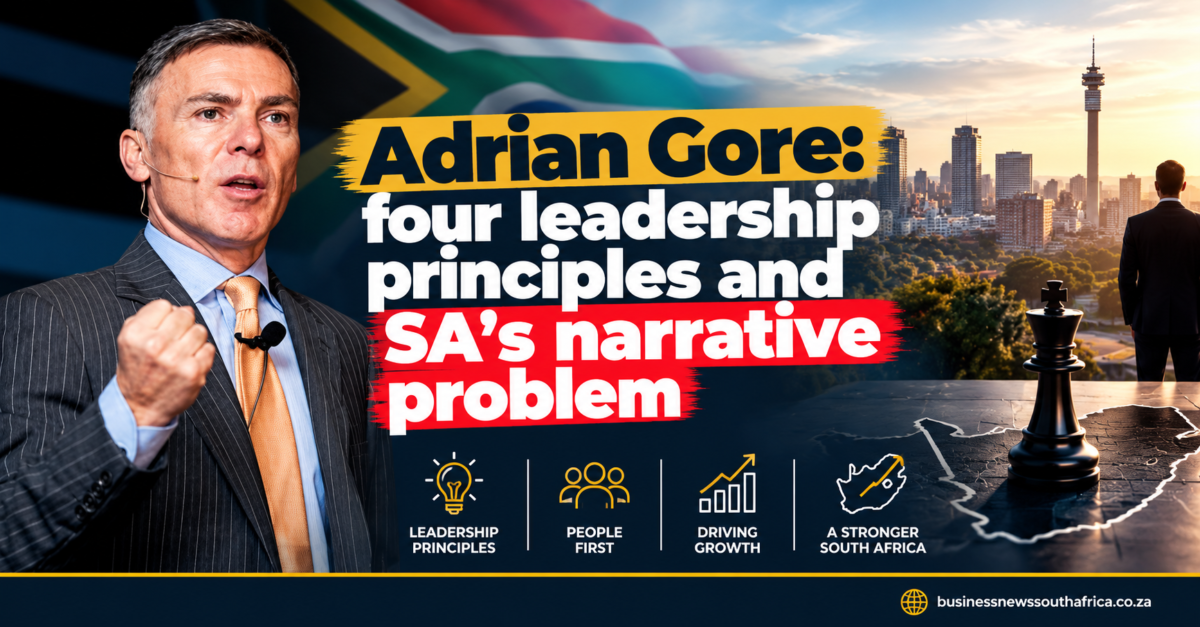
Speaking to MTN Group chief executive Ralph Mupita on the MTN Group’s “Yello Chair” series, Discovery founder Adrian Gore set out four principles for leaders from his new book, and argued that South Africa’s biggest handicap is how the country is talked about, not what is happening inside it. Gore, who also chairs Business Leadership South Africa (BLSA), speaks mostly from his own experience and opinion in the conversation, and the interview was recorded at MTN’s headquarters and published on MTN’s own channel.
What this means for your business: the most practical ideas are small. Put opportunities on the agenda next to risks, set a goal that could embarrass you if you miss it, run innovation on a fixed annual date instead of reacting to events, and recruit the best person for every role. The macro argument, that South Africa should talk itself up while fixing a few things well, is Gore’s opinion, and you should weigh it against your own numbers.
Disciplined optimism is not positive thinking
Gore’s book, The Four Principles: Multiply Your Impact in Life and Leadership, was reviewed by Daily Maverick, which called it a textbook, a workbook and a personal development manual, and he discussed it at Wits University on 15 October, the university said. In the MTN conversation he starts with disciplined optimism. “Disciplined optimism is not positive thinking,” he said. His point is that people are wired to look for threats, so leaders should put the opportunities on the table beside the risks. “I’ve never seen a board who doesn’t know the risks in some way,” he said, adding that boards rarely do the same for opportunities.
He applies it to management, too. He told Mupita he dislikes performance appraisals built around weaknesses, because strengths and weaknesses depend on context, and said people need several positive messages before they absorb a negative one. Both are his beliefs, not findings we have checked.
Set goals you can lose
Gore says loss aversion, the finding by Nobel laureate Daniel Kahneman that losses weigh more heavily than equal gains, is a tool, not just a bias. “When you set a goal you suddenly have got something to lose,” he said, which he argues pushes people to try harder. He is critical of corporate goal-setting: executive scores, he said, scatter around 100% of target, which suggests the goals were never real stretches because pay is attached to them. He offered his own failed attempt at a five-minute mile as an example of a declared goal that changed him even though he missed it.
On time, he describes the principle of focused urgency as being about focus, not haste, and says a company should align the urgency of its people with its own. Discovery’s approach, he said, is an annual innovation launch with a fixed date, so that businesses innovate on a cadence instead of waiting for a regulatory change or a rival’s move. We covered the book’s argument on time in an earlier article.
Hire the best for every job
The fourth principle is what Gore calls the Pareto tail: in any connected system, a few decisions or people account for most of the impact. His conclusion for hiring is the opposite of picking a few stars. Because a tail forms whoever you hire, he said, you should “hire absolutely the best people for every single job,” from the tea lady to the board, so that the tail is as strong as possible. He added that the tail is contextual and will shift as conditions change, for example with AI.
AI at Discovery, and the fear that comes with it
Gore said AI is the most disruptive thing to happen to the company and that he is both optimistic and scared: “it’s got scary aspects.” He said Discovery is using data and AI to tell members what to do about their health based on their risk factors, which it calls Vitality AI, in a joint venture with Google. He said he checks his own thinking against AI before meetings and is excited by agent tools that can run tasks, and he wondered how people’s brains will cope with things they no longer have to work through. We could not independently confirm the Google joint venture, which is Gore’s description.
The narrative problem
As chair of BLSA, Gore described the 3% growth target as a declared goal, and said “the 3% is the level at which unemployment stays the same.” He argued that growth above it creates jobs, and below it joblessness rises. His boldest claim is about perception: “Our narrative is so much worse than the reality,” and “this country is dramatically better and bigger than people think it is.” He said the narrative matters most to emerging market investors and opinion makers abroad, and that the country has a lot to lose if it is talked down.
The record is more mixed than the interview. In January, BusinessTech reported that GDP growth in 2026 was expected to average about 1.5%, with estimates of reaching 3.0% by 2030, and that the last decade had been described as a lost one. Gore also said the business-government partnership is fixing Johannesburg’s potholes, claiming about 400,000 fixed for around R15 million; we have not verified that figure.
On small business, he said smaller firms create the jobs and that South Africa does not have enough venture capital: “we don’t have a sufficient venture capital market.” He said pension and institutional funds still find it hard to back venture capital. Our report on the private capital survey shows what fundraising looked like in 2025, and our coverage of BLSA’s call on the transmission tender shows the partnership at work.
What we could not confirm
We could not independently confirm Gore’s statistics in the interview, such as his estimates of child mortality in early human history and his calculation of how people perceive time, which are his own. The 400,000 potholes, the R15 million cost, the Vitality AI partnership with Google and his statements about GDP resilience are his claims. We have not interviewed Gore or Mupita, and the conversation was published by MTN, whose chief executive, Mupita, was the interviewer.