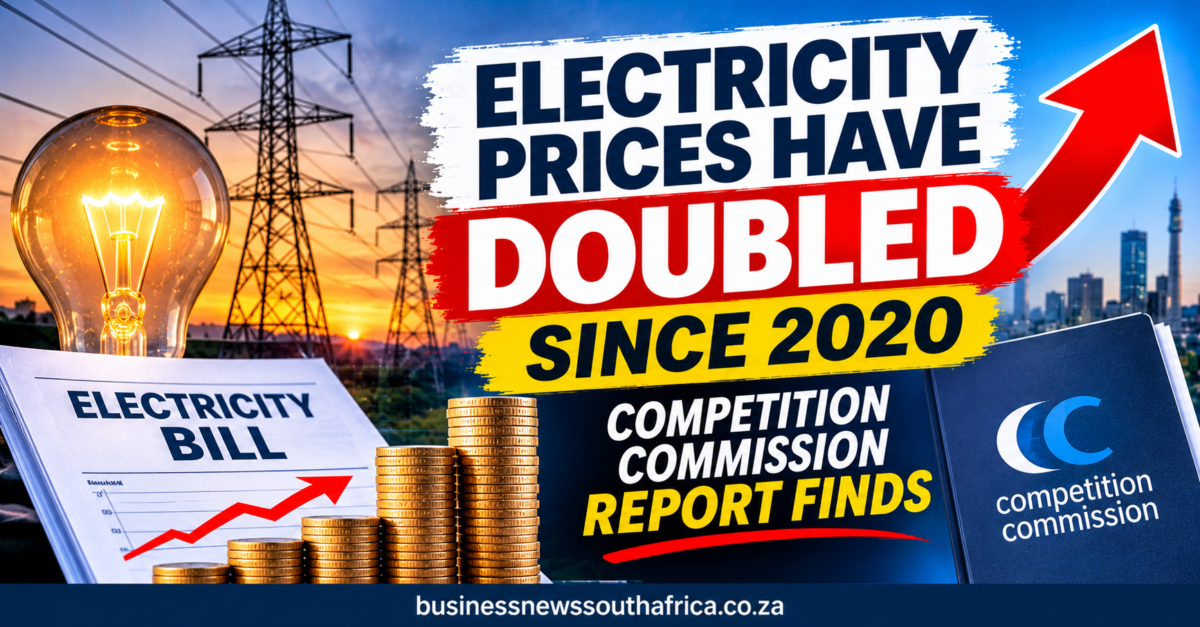
Electricity prices in South Africa have roughly doubled since the start of 2020, and they have risen nearly three times as fast as consumer prices in general. According to the Competition Commission’s August 2026 Cost of Living Report, cumulative electricity inflation reached around 100.5% by July 2026, against headline consumer price inflation of approximately 36% over the same period.
The “101%” figure that circulated in early November rounds that number up. It is a cumulative measure, not a one-year price rise, and it should not be read as electricity costing 101% more than a year ago.
What the 100.5% actually measures
The Commission, the competition regulator, says its analysis uses data from Statistics South Africa. Its long-term chart tracks cumulative inflation in electricity and water supply prices between January 2020 and July 2026. The report is the third edition of the Commission’s cost of living series and focuses on the items that weigh most on low-income households.
The report says tariffs rise each year in July. After the adjustments of July 2025 and July 2026, cumulative electricity inflation moved from approximately 85% to around 100.5%. The same method puts cumulative water inflation at approximately 85% by July 2026, against the same headline figure of roughly 36%.
The one-year picture is more modest. Between July 2025 and July 2026, the Commission reports that electricity inflation was 8.1%, water inflation was 10.1% and headline CPI was 4.3%. In the report’s words, “Electricity inflation is double headline inflation” over that period, while water is more than double.
Where reports differ on the numbers
The Commission’s report gives the headline CPI comparison as approximately 36%. BusinessTech, which published the story on 2 November, wrote that consumer prices had risen 35% since 2020 and described the electricity figure as 101%. The Commission’s own text says 100.5% and 36%, and those are the figures used here. BusinessTech and the report agree on the one-year numbers of 8.1%, 10.1% and 4.3%.
Why electricity weighs so heavily on poorer households
The Commission built its analysis around the lowest income decile. Using Stats SA expenditure data, it found that these households spend 40.71% of their budgets on food and non-alcoholic beverages and 26.1% on housing and utilities. Within housing and utilities, owners’ equivalent rent makes up 14.96% of spending and electricity 5.5%, while water supply accounts for about 0.9%.
That is why a tariff rise that looks small against a whole basket can still bite. The Commission describes electricity and water as essential services with few practical substitutes, so increases have what it calls an immediate and unavoidable effect on household spending. It adds that the widening gap between administered prices and general inflation falls hardest on households that devote a larger share of income to basic services. For businesses, the same logic applies to anything that runs on grid power, though the report itself is focused on households.
Government’s response so far
The report notes that on 29 July 2026 Cabinet approved a revised electricity pricing policy for public consultation. According to the Commission, the Minister of Electricity, Kgosientsho Ramokgopa, said the policy would group customers by income level and usage, with large industrial users as one example, and aims to show customers the true cost of electricity. The policy also seeks to lift the free basic electricity allocation for qualifying households from 50kWh to between 200kWh and 300kWh. The Commission calls that welcome, while noting suggestions that the minimum needed to cover essentials is 350kWh. It stresses that consultations are ongoing and that the pricing mechanisms behind tariffs still need to be addressed.
Our earlier coverage of the electricity pricing overhaul and of the proposed 8.8% tariff rise sets out how that process has unfolded.
Eskom’s profit and its pricing ambitions
Eskom’s own results add context. On 31 August the utility reported a group profit after tax of R30.3bn for the year to 31 March 2026, up from a restated R14.0bn a year earlier, according to SAnews. Group chief executive Dan Marokane said sustained profitability lets Eskom continue discussing affordability with its shareholder “as we aspire to remain within single-digit price increases”. Chairperson Mteto Nyati said the profit allows reinvestment in Eskom Green, distribution, the coal fleet and grid expansion.
BusinessTech’s report on the results noted that a 12.74% tariff increase was partly offset by a 6.2% decline in sales for the year, and that Eskom itself said this path is unsustainable, with future revenue growth depending on demand retention and diversification. Higher prices and falling volumes together are a warning for any business weighing its own power supply options.
What is still unclear
The Commission’s figure is a measure of what electricity prices have done, not a forecast. It does not say how much of the increase came from Eskom’s direct tariffs and how much from municipal mark-ups, and the report does not set out a projection for the coming years. Reports that Eskom expects average increases of 8.8% in 2027 and about 6% a year from 2029 to 2050 come from BusinessTech’s article and were not confirmed against a primary document for this report.
The Commission’s data also covers July 2026 only, so it does not yet capture any later changes in tariffs. Readers who budget for electricity costs should treat 100.5% as the measured backward-looking gap between power prices and general inflation, and watch the outcome of the pricing policy consultation for what comes next. Wider coverage of the cost pressure is in the Sowetan’s summary of the report, and more on tariffs and power policy is in our Energy & Infrastructure section.