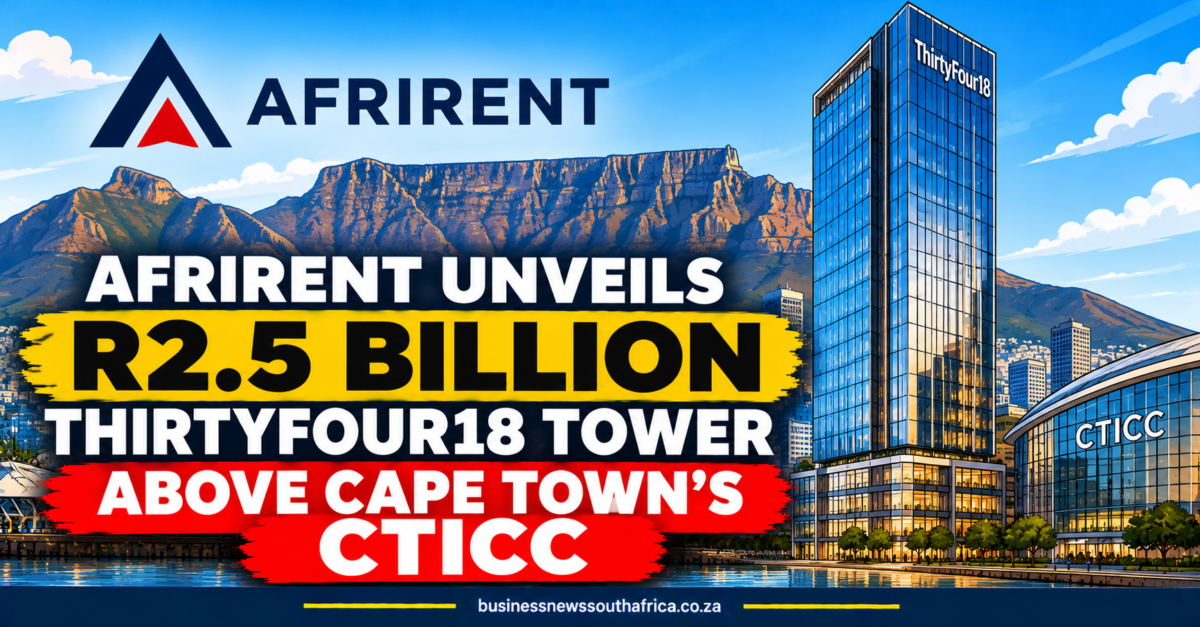
Afrirent Holdings has unveiled plans for a R2.5 billion mixed-use tower built directly above the Cape Town International Convention Centre’s second building, in one of the largest private developments announced for the city’s Foreshore precinct in recent years. The project, named ThirtyFour18 after the site’s global coordinates, was revealed to property investors at CTICC 2 by Afrirent founder and executive chairman Senzo Tsabedze, with the City of Cape Town confirming it will formally launch the project to the market on 1 December.
What is being built
The development is designed as a 35-storey tower comprising 101 luxury residential apartments and penthouses, five-star hotel accommodation, dedicated commercial office floors, and amenities including a gym and spa, a rooftop restaurant and bar, and co-working and meeting facilities. It sits on the open space in front of CTICC 2 on Heerengracht Street in central Cape Town, with views over the V&A Waterfront, the harbour and Table Mountain. The architecture is being led by Messaris Wapenaar Cole Architects, with partner Andre Wapenaar overseeing design.
Engineering for the site is significant given its location above an existing convention centre structure: the project calls for roughly 90 piles, each around 90 feet deep, to support the tower. Construction is scheduled to begin on 22 April 2027, subject to the necessary approvals, with completion earmarked for April 2031.
Who is behind it
Afrirent Holdings, a black-owned fleet management and logistics group that has been expanding into hospitality and property since 2021 through its Indalo Hotels and Leisure Group subsidiary, is the project’s co-developer. Tsabedze described the site as carrying real responsibility given its prominence. “This is an iconic site, and we have a responsibility to make the most of the opportunity it presents,” he said, according to Bizcommunity’s coverage of the concept reveal.
The project emerged from a City of Cape Town lease auction process for the Foreshore site. We could not independently confirm the value attached to Afrirent’s original winning bid or when the lease was secured, so readers should treat the R2.5 billion figure as the current, publicly announced scheme value rather than a like-for-like comparison with any earlier proposal for the same site.
Why the city is backing it
James Vos, the City of Cape Town’s mayoral committee member for economic growth, used the CTICC reveal to position the project as a signal to international investors. “We want Cape Town and the world to know we are open for business,” he said. The city’s involvement follows a broader push to unlock private investment on municipally-owned Foreshore land, an area that has sat underdeveloped relative to its central location for years, as reported by Business Day.
Jobs and the construction pipeline
Afrirent and the city say the development will create around 2,500 construction jobs during the build phase and about 400 permanent positions once the tower is operational, spanning hotel operations, retail, facilities management and office tenancies. The development team says it has already appointed Cape Town-based professionals to lead design and project work, a detail both the city and Afrirent have emphasised as part of the project’s local economic case.
ThirtyFour18 adds to a visibly changing Cape Town skyline, following a wave of commercial and residential tower proposals in the city over the past two years. Other large towers under construction or recently completed in the city include One on Bree, regarded as Cape Town’s second-tallest building, and the Portside Tower, the city’s tallest at 139 metres.
What businesses should watch
For Cape Town’s hospitality, property and construction sectors, ThirtyFour18 is significant both for its scale and for its timeline: a near five-year build process that, if it proceeds on schedule, would deliver fresh five-star hotel capacity and premium office space into the Foreshore market just as the city’s convention and tourism sectors continue to recover. Suppliers, subcontractors and professional services firms serving Cape Town’s built environment sector have a multi-year pipeline of work to track as the project moves from concept to construction, starting with the City of Cape Town’s formal market launch in December and the approvals process that must be cleared before building can begin in 2027.