With South Africa’s 2026 municipal election results now finalised by the Electoral Commission, enough time has passed to look past the politics of the campaign and examine it as a piece of marketing. Stripped of party colours, the Democratic Alliance’s (DA) run-up to 4 November offers a case study that any business running a product launch, rebrand or sales campaign can learn from, regardless of where that business or its customers sit politically.
This is not a comment on policy or an endorsement of any party. It is an analysis of campaign mechanics: timing, branding consistency, tone and messaging, set against the actual, verified results.
Starting early, consistently
The clearest lesson is timing. In a Daily Maverick interview, the DA’s federal council chair and elections head, Ashor Sarupen, said the party deliberately moved first on launch, messaging and posters, describing groundwork and logistics planning that began roughly a year and a half before polling day, with the broader strategy dated back to October 2024. Business Report recorded the party’s formal campaign launch and voter registration push as early as May 2026, months ahead of the 4 November vote, building name and message recognition before rival parties had meaningfully entered the field.
For a business, the parallel is straightforward: a product or campaign that builds familiarity over months, through repeated, low-pressure exposure, typically converts better than one that tries to manufacture urgency in a compressed window immediately before a launch date.
Humour and a recognisable cast cutting through the noise
The campaign also leaned on humour and visual distinctiveness to stand out in a crowded field of competing posters and billboards. The clearest example was a billboard depicting Gauteng premier Panyaza Lesufi showering in a shirt and tie, tied to the slogan referencing water supply problems; The Media Online reported on the billboard and the public reaction it drew, including a direct response from Lesufi himself, which extended the story’s reach into ordinary news coverage well beyond the DA’s own advertising spend. The exchange was covered widely because it was memorable and visually distinctive, not merely because of its political content.
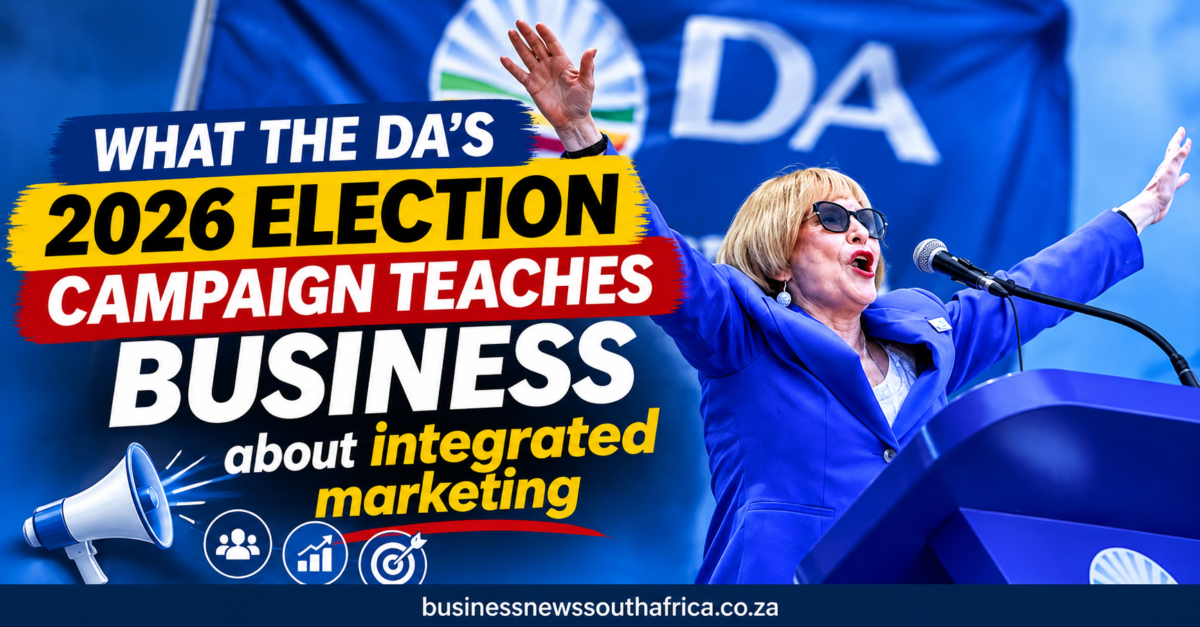
Beyond humour, consistent, recognisable figures reappeared across the party’s channels throughout the campaign, including in Johannesburg-specific messaging centred on former party leader Helen Zille, who stood as the DA’s Johannesburg mayoral candidate. Having a consistent, identifiable face attached to a local campaign, repeated across posters, radio and public appearances, is a basic but frequently neglected marketing discipline: audiences remember people and symbols more reliably than slogans.
It is worth noting, without relitigating any single commentator’s view, that the campaign’s integrated use of humour, recognisable figures and early timing has drawn attention from marketing commentators more broadly as a case study in cutting through a cluttered field, independent of the politics involved.
Addressing a tension people already felt
The campaign’s substantive messaging also centred on problems that were already live grievances for many urban voters: water supply interruptions, billing disputes and concerns about tender-linked corruption, often labelled in DA messaging as a “coalition of chaos” risk. Rather than introducing a new issue, the campaign amplified frustrations that target audiences were already experiencing, which is a far easier sell than trying to create a new need from scratch.
A single, clear value proposition
Across its channels, the party’s core proposition stayed simple: stable, single-party administration delivers more reliably than unstable multi-party coalitions. Whatever one makes of the claim politically, as a piece of positioning it was consistent and repeated without dilution across the campaign’s duration, which is itself a marketing discipline many commercial campaigns fail to maintain.
A mixed result, honestly read
Judged purely against the final, IEC-declared results, the outcome for the DA was a real but partial win. Nationally, the party’s vote share rose by just under 3 percentage points, from 21.66 percent in 2021 to 24.64 percent in 2026, according to the final results reported by BusinessTech. In the metros where the party campaigned hardest, it led in five of eight, retaining its outright majority in Cape Town and topping the poll in Johannesburg, Tshwane, Ekurhuleni and Nelson Mandela Bay, though without an outright majority in any of those four. It did not win eThekwini, where MK topped the poll, or Buffalo City and Mangaung, where the ANC led. Much of the ANC’s national decline, from 45.59 percent to 30.76 percent, appears to reflect the entry of MK as a new competitor for its traditional base at least as much as any single rival party’s own campaign gains.
The honest marketing lesson, then, is not that a well-run campaign guarantees victory. It is that disciplined timing, consistent branding, humour and a clear, repeated value proposition reliably improve a campaign’s reach and recall, even where the final result is shaped by many other factors outside any one campaign’s control.
What we could not confirm
- Any specific, publicly disclosed advertising spend figures for the DA’s 2026 campaign; none of the sources consulted published a verified total spend.
- The exact origin or author of the “coalition of chaos” phrasing in party messaging, beyond its use in coverage of the campaign’s final push.
- Any causal, as opposed to correlational, link between specific marketing tactics and vote-share movements in individual metros.