South Africa’s garlic growers are weighing a move from a voluntary to a statutory industry levy, after two years of rising imports, some reportedly smuggled through neighbouring countries, cut into local producers’ share of the market. The proposal emerged from the South African Garlic Growers Association’s (SAGGA) 2026 national biennial conference, held in Pretoria on 15 October, where outgoing chairperson Corrie Bezuidenhout described the pressure on local growers as feeling “much worse than in the past”, even as he noted that earlier generations of growers overcame their own hard obstacles. The conference and the growers’ concerns about imports were also reported by FreshPlaza and Agribook.
Imports have nearly doubled their market share
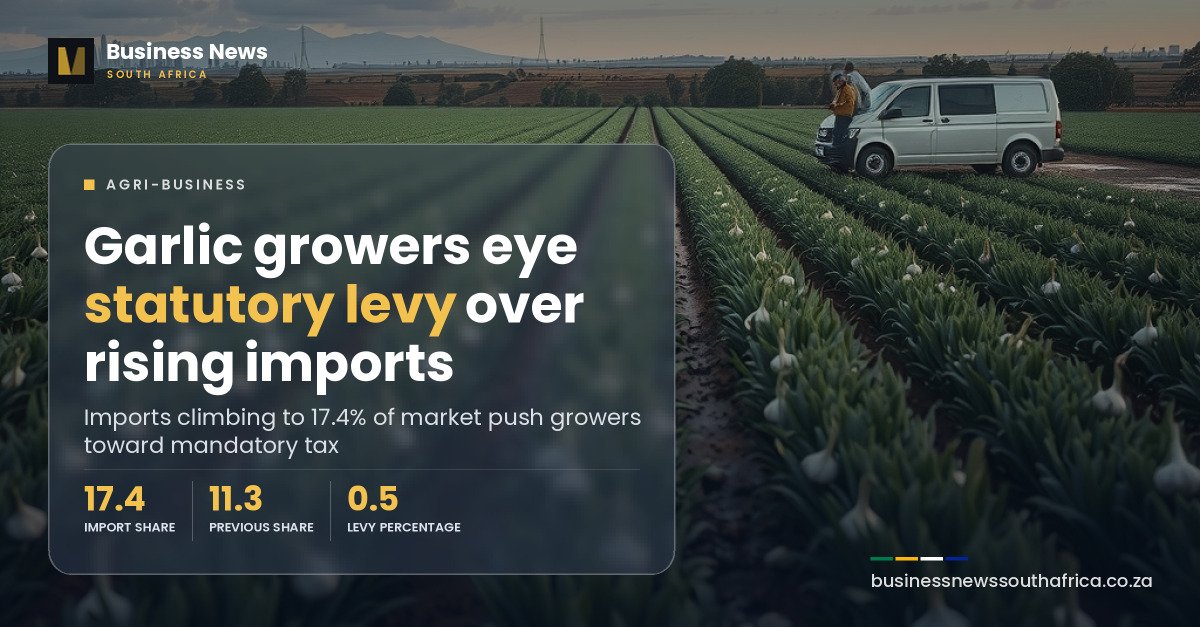
According to market researcher Moira Burger’s presentation to the conference, imported garlic’s share of domestic volume rose from 11.3 per cent in 2023 to 17.4 per cent in 2025. Growers say the problem goes beyond legitimate trade: some imported garlic is allegedly being rerouted through neighbouring countries to dodge antidumping duties, with falsified country-of-origin documents used to disguise its true source. Smuggled product sold at lower prices undercuts both local growers and importers who are complying with the rules, SAGGA says. Our guide to importing goods into South Africa explains the duty, VAT and permit rules that apply to imports of this kind.
Those antidumping duties are themselves at risk. A duty on Chinese garlic is due to expire in February 2027, and SAGGA has decided not to pursue a renewal application to the International Trade Administration Commission of South Africa (ITAC) for now. Trade specialist Frans Dubbelman told the conference the association could not compile a sufficiently comprehensive case, citing difficulty obtaining verifiable financial data from local producers and depressed international garlic prices. He said any future application would need broader grower cooperation, wider product coverage including rehydrated garlic and garlic flakes, and investigation of additional countries of origin beyond the current scope.
A funding model built for a different market
SAGGA currently funds its operations through a voluntary levy of 0.5 per cent on garlic sold through South Africa’s national fresh produce markets, which handled 4.56 million kilograms of garlic worth R262 million between 2023 and 2025, according to National Agricultural Marketing Council (NAMC) figures presented at the conference. Johannesburg accounted for roughly 60 per cent of that volume and 55 per cent of the revenue. But a growing share of the crop now moves directly to supermarket groups rather than through fresh produce markets, meaning the levy captures a shrinking slice of total trade.
Members at the conference backed exploring a statutory levy that would also apply to importers and processors, which would require sign-off through the NAMC’s formal levy process. SAGGA says it would follow NAMC guidelines on administration costs, with an estimated 70 per cent of any levy income earmarked for industry support such as research and market development, but stressed that it still needs to consult growers and other stakeholders before taking a formal proposal forward.
Research effort to rebuild local varieties
Alongside the trade and funding questions, SAGGA is working with the Agricultural Research Council’s Roodeplaat campus and the Western Cape Department of Agriculture to revive virus-free garlic planting material, an effort led by ARC research team manager Professor Michael Bairu. The association has also spent two years testing imported varieties in partnership with private input and technology firms, part of a broader push to find varieties that are commercially competitive under South African growing conditions, where climate differences make some import-origin cultivars difficult to replicate profitably.
Why it matters for business
For South African vegetable producers and retailers, the outcome will shape input costs, shelf pricing and the competitiveness of local garlic against cheaper imported and allegedly smuggled product. A statutory levy would widen the funding base for anti-dumping applications and research, but it would also raise costs across the value chain, including for importers who currently operate outside the voluntary levy system. Bezuidenhout is due to step down as SAGGA chairperson at the end of 2026, meaning the association’s new leadership will likely have to carry the levy proposal and any renewed ITAC application forward. Our look at how little state support South African farmers receive compared with their global peers adds context to the pressure growers face.
What we could not confirm
- SAGGA’s own website or a direct SAGGA statement on the levy proposal was not independently accessible; this account relies on Farmer’s Weekly’s reporting of the conference.
- The scale of smuggled or misdeclared garlic imports, and the specific neighbouring countries used as transshipment routes, was not independently quantified.
- Whether the NAMC has received a formal application to convert the levy to a statutory one could not be confirmed.