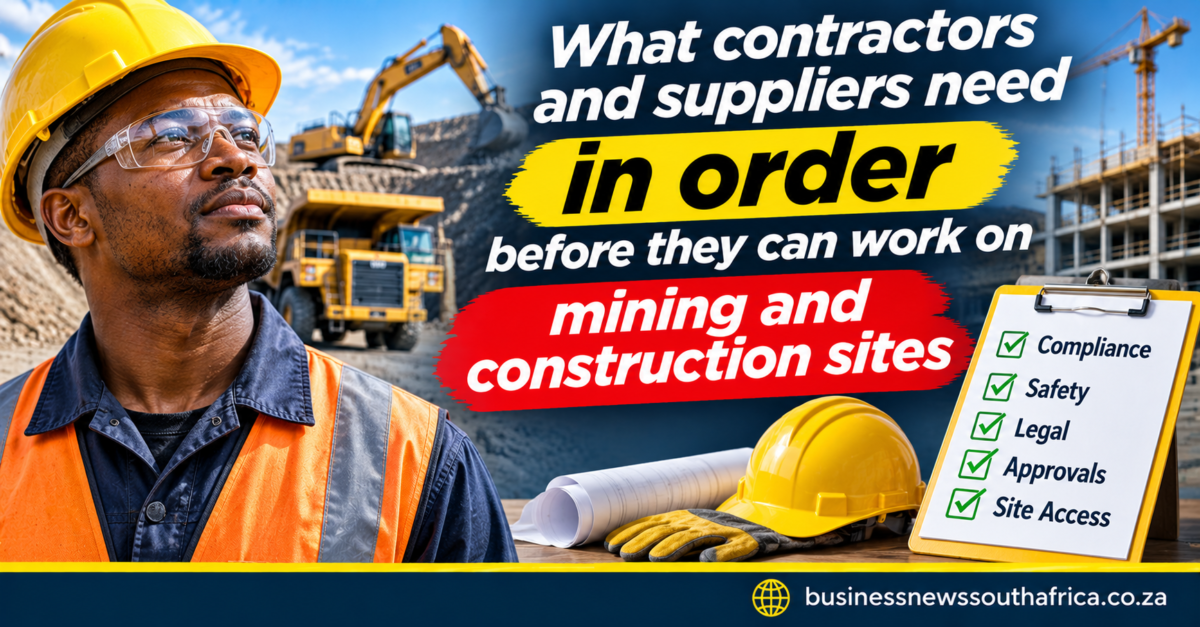
Any contractor or supplier hoping to work on mining and construction sites has a compliance checklist to clear before the first day on site. A summit in Rustenburg later this month has brought that checklist back into focus. This explainer sets out what the published rules require. If you are also hunting for work, our Tender Finder lists open government tenders, and our guide to winning government tenders covers registration, scoring and getting paid.
The news hook
Brandscapers Africa says it is hosting INNOVEX 2026 on 26 and 27 November at Ben Marais Hall in Rustenburg, described in a promoted article on TechCentral as a free summit helping entrepreneurs reach markets, funding, technology and networks. The same article lists the Industrial Development Corporation and ProNet Business Solutions among its confirmed partners. ProNet has been described to us, in material sent by the organisers’ agency, as an occupational health and safety training and compliance company. That is the company’s own account, based on company statements, and we have not been able to check it independently.
Mines: the employer carries the duty
The Mine Health and Safety Act places the main duties on the mine’s employer, and those duties reach beyond its own payroll. According to a published copy of Chapter II of the Act, the main provisions are these:
- Section 5(2): the employer must, as far as reasonably practicable, assess risks for people who are not employees but may be directly affected by mine activities, and ensure they are not exposed to hazards to their health and safety.
- Section 10: people must be trained in the hazards, risks, controls, work procedures and emergency procedures that apply to them, before they first start work, at set intervals and before significant changes. Employees cannot be charged for this training.
- Section 11: hazards must be identified, risks assessed and significant findings recorded.
- Section 13: where a regulation or the risk assessment requires it, employees exposed to health hazards must be covered by medical surveillance, including an initial medical examination and periodic ones.
Expect the mine to add its own entry requirements, and ask for them before pricing.
Construction: client and contractor each have tasks
On construction sites, the Construction Regulations, 2014 made under the Occupational Health and Safety Act apply. Regulation 5, as published on Acts Online, requires the client to prepare a baseline risk assessment and a site-specific health and safety specification, and to include that specification in the tender documents. The client must also ensure that tenderers have budgeted for health and safety measures, and that the principal contractor has the competencies and resources to do the work safely. Before work starts, the client must confirm the principal contractor is registered with the compensation fund or a licensed insurer, appoint it in writing and approve its health and safety plan.
Regulation 7, also on Acts Online, then sets out what the principal contractor and contractors must do:
- Provide a site-specific health and safety plan based on the client’s specification, and keep it updated.
- Keep a health and safety file on site, available on request to an inspector or the client.
- Check that any contractor it appoints is competent and registered with the compensation fund, appoint it in writing and approve its plan.
- Ensure that employees hold a valid medical certificate of fitness issued by an occupational health practitioner.
- Ensure nobody enters the site without site-specific induction training, with visitors inducted too and records kept on site.
A contractor must give the principal contractor its own documented health and safety plan before starting, and keep its own file on site.
Registration for public work
Public sector construction work adds a registration step. The Construction Industry Development Board says contractors must apply for grading to be listed on its Register of Contractors, which gives access to tender for government projects. It also notes that 75 contractors have been removed for submitting false information and that an audit is under way, so applications need to be accurate and documented. The wider economics of this kind of work, including the pressure some contractors face on site, are discussed in our conversation with Thobani Ndlovu on the construction mafia, tenders and the 30% rule, and our guide to starting a construction business covers the basics of getting set up.
A practical checklist
- Get the client’s health and safety specification and the site’s entry requirements before you price.
- Prepare a site-specific health and safety plan and a health and safety file.
- Keep proof of compensation fund or licensed insurer registration current.
- Arrange medical certificates of fitness and induction records for every person who will be on site.
- Confirm your CIDB grading if the work is public.
What we could not confirm
- Whether the Industrial Development Corporation has a partnership with INNOVEX 2026: it appears only in the organiser’s promoted article, and we found no statement from the Corporation itself.
- What ProNet Business Solutions is: we found no independent record, website, company registration or accreditation evidence. Its description is a self-description.
- The legal texts: government websites were unreachable, so the rules above were read from copies hosted by Acts Online and the University of Cape Town. Check them against the official gazette, and check whether newer amendments or draft regulations have been finalised.
- Accredited training and SETA requirements, which differ by site and client: we did not cover them, so ask the client what it will accept.