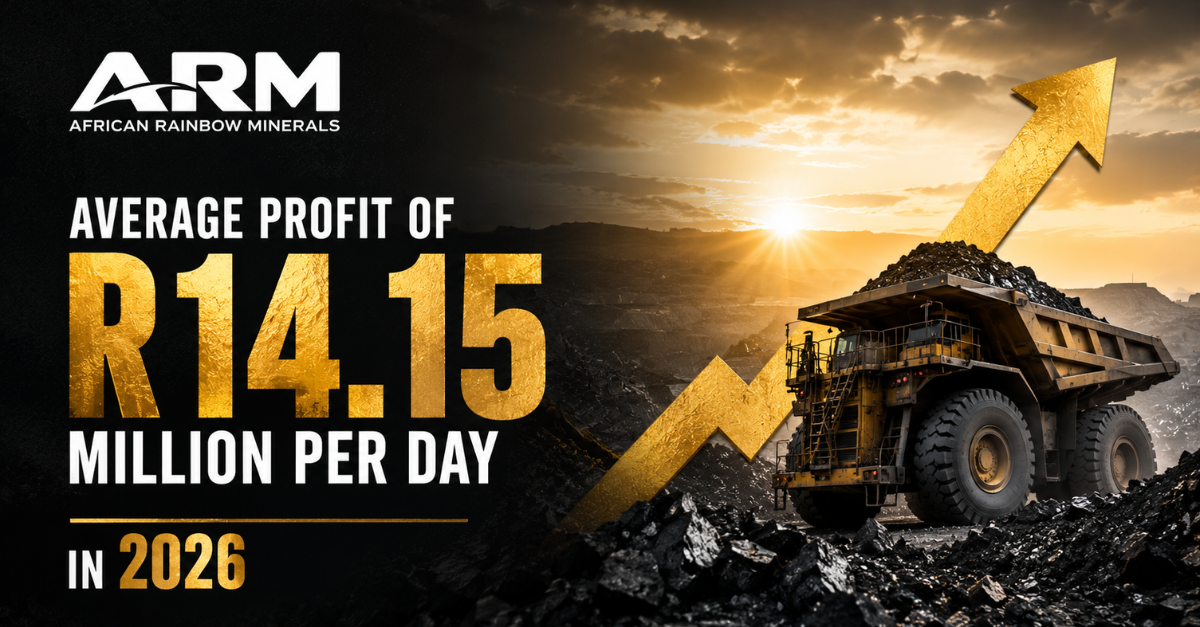
When the finance team at African Rainbow Minerals (ARM) crunched the numbers for the year ended 30 June 2026, the headline was simple: the group earned more than R14 million every day on average. That translates to a total profit of R5.165 billion for the financial year, according to the company’s own release.
Headline earnings, the profit figure that excludes one-off items such as asset sales, rose 19% to R3.201 billion, or R16.60 per share, from R2.695 billion (R13.79 per share) a year earlier. Basic earnings, profit after accounting for those one-off gains, jumped even further, from R330 million in the previous year to R3.998 billion in 2026.
What drove the turnaround?
The company attributes most of the improvement to higher prices for the platinum group metals (PGM) basket, measured in US dollars. A stronger PGM price helped offset weaker results in ARM’s ferrous metals and coal divisions. The PGM uplift was bolstered by a one-off R241 million profit from selling its joint-venture interest in Sakura and a R462 million re-measurement gain on its 50 % stake in Nkomati Mine.
Another relief came from the absence of a R2.209 billion impairment loss that had hit the Bokoni Mine in the prior year. Without that loss, the group’s earnings were able to climb sharply.
Within the mining portfolio, ARM Platinum was the standout, posting headline earnings of R1.345 billion, a swing from a R1.288 billion loss the year before. Two Rivers Mine contributed R1.202 billion, up from R202 million, while Modikwa Mine generated R683 million after a R43 million loss in 2025. Bokoni Mine, which had recorded a R1.392 billion loss the year before, improved to a R579 million loss, narrowing the gap considerably.
Not every segment shared the upside. ARM Ferrous saw headline earnings fall 42% to R2.028 billion, mainly because a stronger rand reduced the benefit of dollar-denominated commodity prices and lower iron ore sales from Beeshoek Mine, which has been on care and maintenance since October 2025. ARM Coal slipped into a R428 million loss after earning R47 million the previous year, reflecting weaker realised coal prices and exchange-rate pressure.
Cash, dividends and future projects
ARM’s balance sheet also strengthened. Net cash rose by R3.562 billion to R10.171 billion at the end of June 2026. The company said this cash “gives ARM the flexibility to pursue value-enhancing growth prospects”.
Shareholders received a higher dividend, with a final payout of R7.00 per share declared, bringing the total dividend for the year to R12.00 per share, up from R10.50 the year before.
Looking ahead, ARM is focusing on the development of Bokoni and the planned restart of Nkomati Mine’s open-pit nickel operations, which could restore South Africa’s only primary nickel producer. The Bokoni development plan is described as “materially de-risking execution” and aims to place the mine below the 50th percentile of the global PGM cost curve.
Safety milestone and broader implications
The group recorded zero fatalities in 2026, a notable safety milestone after three deaths in 2025 and the last fatality-free year being 2017. ARM framed this as evidence of improved operational discipline.
For suppliers, local service providers and communities that depend on mining activity, the stronger cash position and dividend signal a healthier partner. However, the mixed performance across divisions also underscores the sensitivity of South African miners to exchange-rate swings and commodity price volatility, a reality that smaller mining contractors and downstream processors must navigate.
In short, ARM’s daily profit figure is a headline that reflects a rebound in PGM prices, strategic asset sales and a cleaner balance sheet, while also highlighting the uneven terrain that still challenges parts of the group’s portfolio.