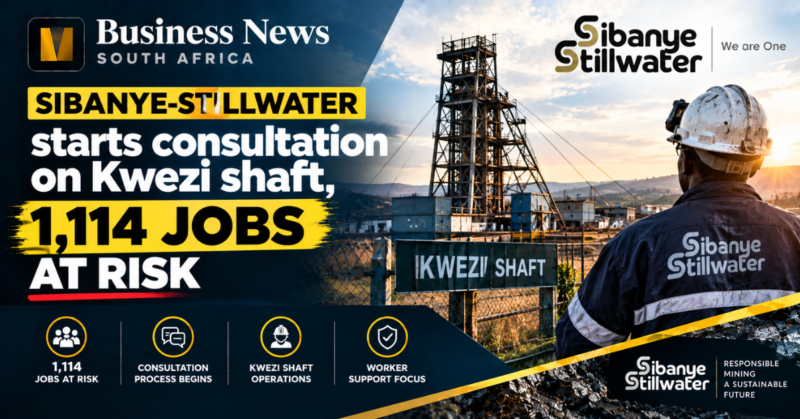
In the early light of a remote mining camp, a convoy of heavy trucks rolls into a dusty clearing, a scene that has become rarer in South Africa as gold output has slipped for more than a decade. According to news24.com, Sibanye Stillwater, the country’s largest gold producer, has signalled its intention to open a new gold mine on home soil.
Sibanye’s statement, released on its website, frames the project as a long-term investment in the country’s mineral base. The company did not disclose the exact location, expected start-up date or capital cost, but it described the venture as a “strategic expansion” that will create jobs and add to the national gold supply.
For a sector that has been shedding capacity, the announcement is noteworthy. South Africa’s gold production fell from roughly one thousand tonnes in the early 2000s to about five hundred tonnes today, a decline driven by ageing mines, power cuts and labour disputes. The country’s mining code, tightened after a series of safety incidents, also adds compliance costs that smaller operators find hard to absorb.
In that context, Sibanye’s move could have several knock-on effects. First, the project may revive demand for local contractors, equipment suppliers and service firms that have seen orders dwindle as mines close. Second, the presence of a new mine could encourage the government to prioritise infrastructure upgrades, such as more reliable electricity, in the surrounding region, benefitting nearby businesses. Finally, the plan may signal to other large miners that South Africa still offers viable gold projects, potentially prompting a modest wave of new licences.
However, the plan is not without risk. The mining sector continues to grapple with load-shedding, where scheduled power outages can halt production for hours at a time. Labour unions remain vigilant, and any strike could delay construction or increase operating costs. Moreover, the global gold price, while currently above US$1,800 per ounce, is volatile and could affect the project’s profitability if it falls sharply.
Industry observers note that Sibanye’s decision contrasts with the trend of miners pulling back from South Africa in favour of operations in West Africa or South America, where regulatory environments are perceived as more predictable. Whether the new mine will prove a successful outlier depends on how well Sibanye can manage the local challenges that have forced many peers to exit.
For small- and medium-sized enterprises that supply the mining value chain, from transport firms to catering services, the announcement offers a potential new customer. Yet the timing is crucial: contracts are typically awarded during the construction phase, and any delay could postpone the expected boost to local economies.
In short, Sibanye Stillwater’s plan adds a rare note of optimism to a sector that has been in retreat. The real test will be whether the project can navigate South Africa’s operational hurdles and deliver the promised jobs and economic activity.
South Africa’s gold mining history means any new project of this kind is being built in a country with among the deepest and most technically demanding underground mines in the world, which raises both the capital cost of a new operation and the safety-compliance burden relative to the shallower, often open-pit operations that have drawn investment to West African gold jurisdictions instead. That cost gap is precisely why many miners have shifted capital elsewhere over the past decade, and why a large domestic producer choosing to invest in a new South African mine rather than expanding abroad is treated as a meaningful vote of confidence by industry watchers rather than a routine capital-allocation decision.
Job creation from a new mine is also rarely immediate. A gold project of this scale typically spends one to several years in construction, shaft development and ramp-up before reaching full production employment, meaning the local contractors and suppliers Sibanye’s announcement points toward are more likely to see a gradual build-up of work than an immediate hiring wave, a timeline worth factoring into any small business weighing whether to gear up in anticipation.