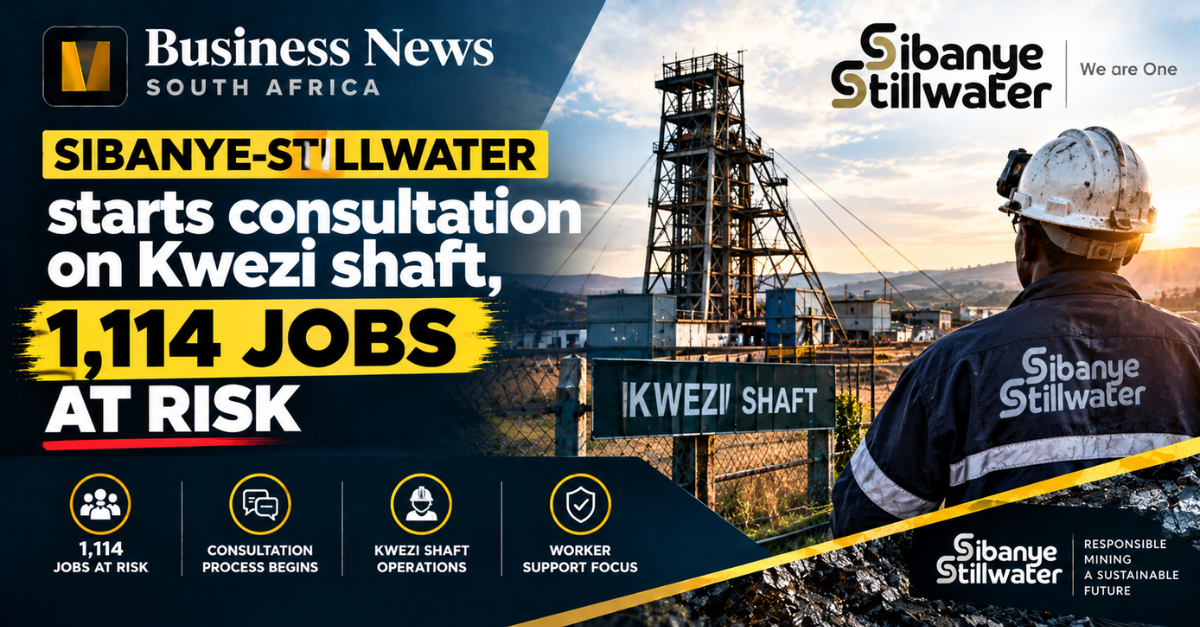
In the dim tunnels of the Kwezi shaft, the hum of drills has faded as workers await a meeting that could decide the future of their jobs. Sibanye-Stillwater has launched a formal consultation process that may lead to the closure or restructuring of the shaft, a move that could affect 1,114 employees.
The company said it will consult under Section 189A of the Labour Relations Act (a legal process that requires employers to discuss possible retrenchments with employee representatives before any layoffs are finalised). The talks will involve organised labour and non-unionised staff alike.
Kwezi is a 24-year-old underground operation that extracts platinum group metals (PGM, a family of metals that includes platinum and palladium). Over the years the mine’s economically mineable reserves have been depleted and production has slipped, pushing the shaft towards the end of its economic life.
Financial pressure
According to the company, Kwezi posted losses of roughly R208 million in 2024 and R91 million in 2025. A brief rebound in the first half of 2026, helped by higher PGM prices, lifted the shaft back into profit, but the improvement is not expected to last. The operation now contributes less than 3 % of Sibanye-Stillwater’s total South African PGM output, producing 20,658 4E ounces in the first half of 2026.
Management said it has spent several years trying to extend the shaft’s life through reserve optimisation and a proposed Kwezi Shallows project, but stakeholder objections and delays in approvals stopped the plan.
While no final decision has been made, the company stressed that the consultation will explore ways to avoid or reduce job losses and to mitigate the impact on affected workers.
South Africa’s mining sector is confronting similar challenges: many underground mines are seeing reserves dwindle and face pressure from fluctuating global metal prices. For owners, the choice often comes down to whether to invest further in extensions or to cut losses and redeploy resources.
For the 781 permanent staff and 333 contractors on the Kwezi shaft, the outcome of the Section 189A process will shape their employment prospects and the economic health of the Rustenburg community that depends on mining jobs.
Why a shaft can swing from loss to profit and still close
Kwezi’s own numbers illustrate a distinction that matters for how seriously to read the consultation: a shaft returning to profit in one half-year on the back of higher PGM prices is not the same as a shaft with a viable long-term future, since a commodity price recovery can mask, temporarily, the underlying reserve depletion that determines whether a mine has anything left worth extracting years from now. Sibanye-Stillwater’s own framing, that economically mineable reserves have been run down over 24 years of operation, describes a geological constraint no price cycle can reverse, which is precisely why a single profitable half-year has not been enough to keep the shaft off the retrenchment agenda.
For the Rustenburg economy specifically, a shaft contributing less than 3% of the group’s total PGM output but employing over 1,100 people is a reminder of how concentrated the local employment impact of a mine closure can be relative to its weight in a mining group’s own results: a rounding error on Sibanye-Stillwater’s production statement is, for the town built around that shaft, a major local employer’s fate being decided.
Section 189A consultations of this scale rarely conclude quickly: the Labour Relations Act requires a genuine consultation process, not a formality, meaning organised labour can raise alternatives, propose different retrenchment numbers, or negotiate extended notice and severance terms before any final headcount is confirmed, a process that has historically taken Sibanye-Stillwater and other major PGM producers several months to work through on shafts of comparable size.