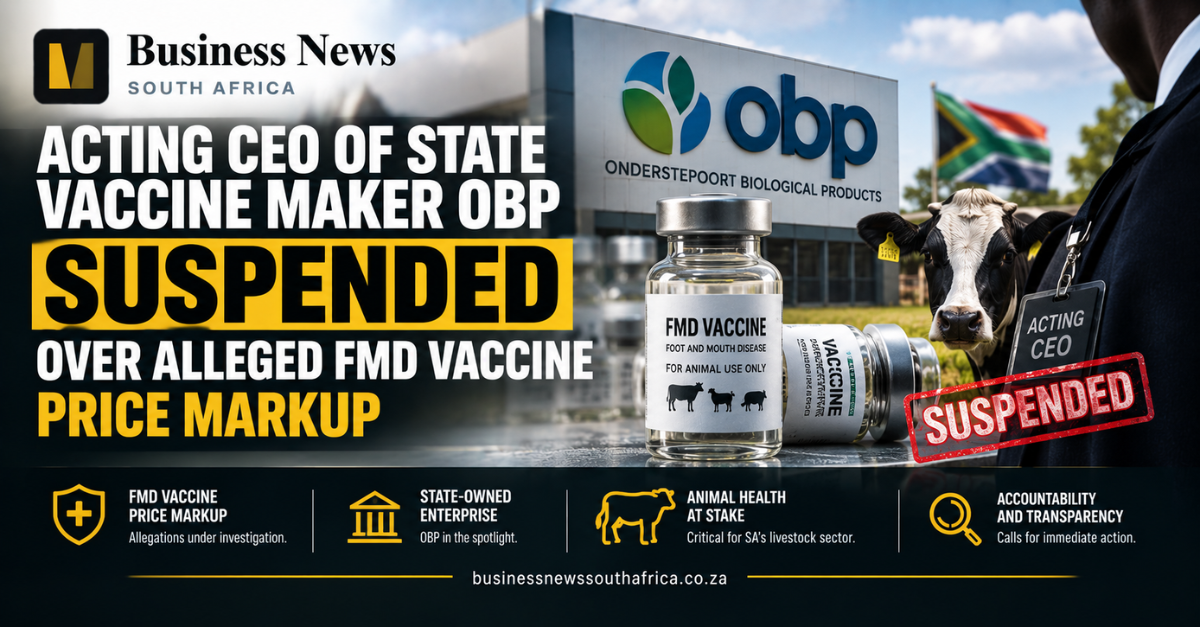
Minister of Agriculture Willie Aucamp confirmed on Saturday that the board of Onderstepoort Biological Products (OBP) has suspended its acting chief executive, Dr Jacob Modumo. The suspension follows an urgent board meeting where the minister presented allegations of serious misconduct relating to the pricing of foot-and-mouth disease (FMD) vaccines.
According to the minister’s statement, the board gave Modumo five days to explain why he should not be suspended. If the board finds his response insufficient, the suspension will remain in place while an independent investigation is carried out.
Why the price of a vaccine matters to farmers
OBP is a state-owned institution tasked with importing and selling animal vaccines. By law it is not supposed to make a profit on those sales. South Africa is currently battling the largest FMD outbreak in its history, a disease that can cripple cattle herds and threaten the livelihoods of millions of farmers. The outbreak has forced the government to ensure that vaccines are supplied at the lowest possible cost.
GroundUp reports that the allegation against OBP is that it bought FMD vaccines from Argentine supplier Biogénesis Bagó for about R45 per dose and then sold them for between R70 and R130. If true, that would represent a markup that the minister says is unacceptable, especially when farmers are already bearing heavy financial losses from the disease.
The minister stressed that the suspension is precautionary and that no finding of wrongdoing has been made against the acting CEO. He added that the government expects OBP to act in the public interest and avoid “exorbitant” mark-ups on a product that is essential for the country’s livestock sector.
Farmers have been fighting for the right to purchase vaccines directly. In May, the Gauteng High Court in Pretoria issued an interim ruling that allowed farms to buy vaccines via veterinarians, provided they report usage to the Department of Agriculture. That court case was a factor in former agriculture minister John Steenhuisen losing his portfolio.
OBP’s troubled track record provides further context. The organisation manufactured FMD vaccines until about 2005 before losing its production capacity through mismanagement. In 2013 it received a R500 million grant to rebuild that capacity, but an audit later found a large portion of the money unaccounted for. To date, OBP still does not manufacture FMD vaccines; it relies on imports from Biogénesis Bagó in Argentina and Dollvet in Turkey.
The Agricultural Research Council’s (ARC) Onderstepoort campus, a separate state entity, does produce a small number of vaccines each year, only tens or hundreds of thousands so far in 2026. By contrast, South Africa’s cattle population of roughly 12 to 14 million requires about 25 million doses annually, assuming each animal is vaccinated twice a year. Those volumes can be supplied by the two importers, which is why the pricing issue has drawn sharp scrutiny.
For livestock-dependent SMEs, the outcome of the investigation could affect input costs and cash-flow planning. If the board confirms that OBP was overcharging, the government may tighten controls on vaccine pricing or shift more procurement to the private sector, altering the cost structure for small-scale producers.
The next steps are clear: Modumo must submit his response within five days, after which the board will decide whether to keep the suspension in place. An independent probe will then examine the pricing allegations, the procurement process, and any potential breach of the profit-prohibition rule that governs state-owned vaccine distributors.
Why a state monopoly’s pricing is scrutinised differently
OBP occupies an unusual position in South Africa’s animal-health supply chain: as a state-owned entity explicitly barred by law from profiting on vaccine sales, any markup above its actual procurement and distribution cost is not simply a commercial pricing decision open to market forces, it is a potential breach of the statutory basis on which the organisation is allowed to operate at all. That distinction is why this allegation carries more institutional weight than a similar complaint against a private supplier would: a private company charging what the market will bear is operating within its legal rights even if farmers consider the price high, whereas a state entity created specifically to keep essential vaccines affordable during a national disease outbreak has a much narrower legal justification for charging above cost, which is exactly the gap this investigation is testing.