On a hot afternoon in Johannesburg, a line of trucks waits outside a water tank while residents protest broken taps and overflowing bins. The scene is a reminder that who runs the city matters to anyone who keeps a shop open, a workshop humming, or a delivery van on the road.
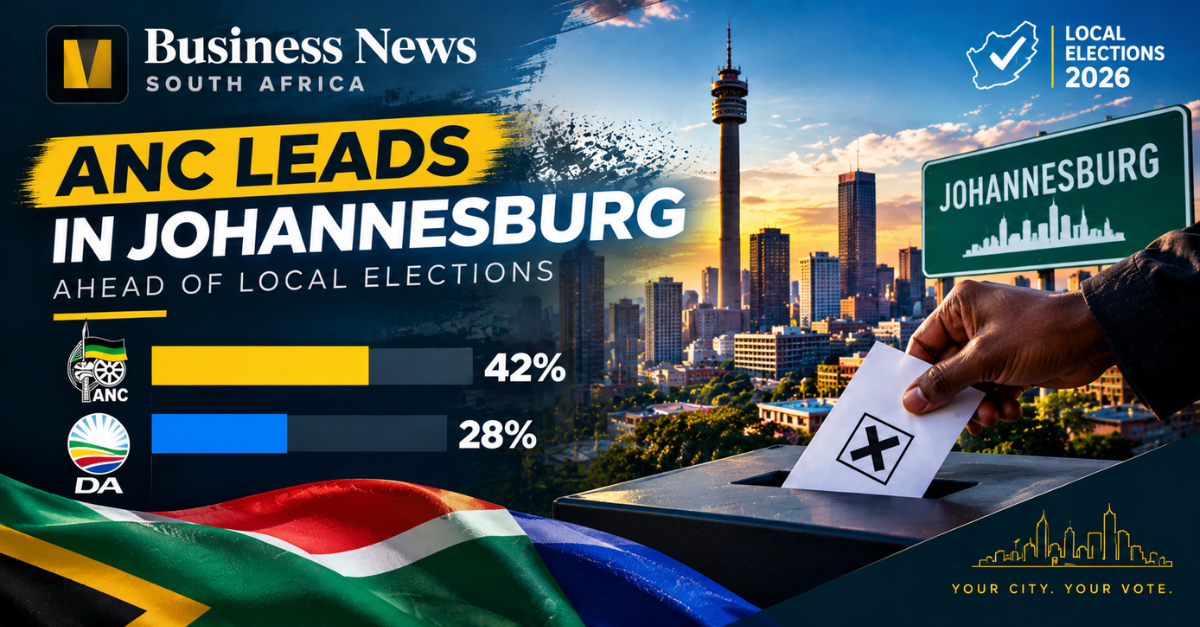
According to a survey posted on Ipsos’ website, the African National Congress (ANC) holds 31% backing in the city, while the Democratic Alliance (DA) is close behind at 28%. The poll was conducted among 3 600 South Africans in June and July and weighted to represent eligible voters. Ipsos cautioned that the figures are not a prediction of the final outcome and that support may shift during the remaining two months of campaigning.
The numbers contrast sharply with a poll released last month by a research firm that listed former DA officials among its senior staff. That earlier poll suggested the ANC had only 18% support and the DA 42%. Ipsos said the discrepancy highlights how volatile voter sentiment can be in a city where service delivery has faltered.
Johannesburg’s service crisis is more than a political talking point. A collapse of basic services such as water supply and garbage collection has sparked protests, and the National Treasury has temporarily paused funding to the municipality because of mismanagement of municipal finances. For small business owners, delayed water and waste removal can mean lost sales, higher operating costs, and the risk of fines.
The DA has nominated Helen Zille, former mayor of Cape Town, as its candidate to take over Johannesburg. The ANC has not yet confirmed its nominee. In Cape Town, the Ipsos survey shows the DA at 46% and the ANC at 26%, well below the 50%+ needed for an outright majority. The city has a R40 billion three-year basic infrastructure investment programme aimed at improving roads, water and electricity, a plan that directly affects the cost of doing business.
In eThekwini, which includes the port city of Durban, former President Jacob Zuma’s MK party is polling at 55%, ahead of the DA at 17% and the ANC at 10%. MK is the only party showing a dominant position in a metropolitan municipality, according to Ipsos.
Ipsos gives a maximum margin of error of 5.57 percentage points for Johannesburg, 6.12 for Cape Town and 6.86 for eThekwini. The margin of error is the range within which the true level of support is likely to fall, based on the sample size and weighting.
What this means for local businesses
Municipal elections decide who controls the budgets that fund water, electricity, waste collection and road maintenance. A change in leadership could bring new contracts for private service providers, alter rates for utilities and shift the focus of economic development programmes. For an SME that relies on reliable water for a laundry service, or on steady waste collection for a restaurant, the outcome of the vote could affect daily operating costs.
Business owners should watch the candidate announcements, the final allocation of Treasury funding, and any promises around infrastructure investment. Even if the race remains close, the uncertainty itself can make lenders and suppliers more cautious, which may tighten credit conditions for small firms.
With the election scheduled for 4 November, the next two months will see intensified campaigning, more opinion polls and likely a flurry of promises around service delivery. SMEs that stay informed about the evolving political landscape will be better positioned to adapt their budgets and contingency plans.
Why two polls on the same city can disagree this much
The gap between Ipsos’s Johannesburg numbers and the earlier poll showing the DA at 42% is a useful reminder that not all political polling is built the same way: methodology, sample size, weighting assumptions and, in this case, the polling firm’s own staffing history all shape a result before a single number is published. A poll conducted by a firm with former officials from one of the contesting parties on staff does not automatically produce a biased result, but it is exactly the kind of detail that makes independent replication, multiple pollsters reaching similar conclusions through different methods, the more reliable signal than any single survey, however professionally conducted.
For a small business owner trying to plan around the outcome rather than simply follow the horse race, the more durable signal in this data is not which party leads by a few points, it is the sheer fragmentation on display: an ANC at 31%, a DA at 28%, and enough undecided or minor-party support to leave neither anywhere near a majority, points toward a coalition government in Johannesburg regardless of which party finishes first, the same fragile, negotiation-dependent arrangement that has repeatedly slowed decision-making and service delivery in the city’s recent coalition administrations.