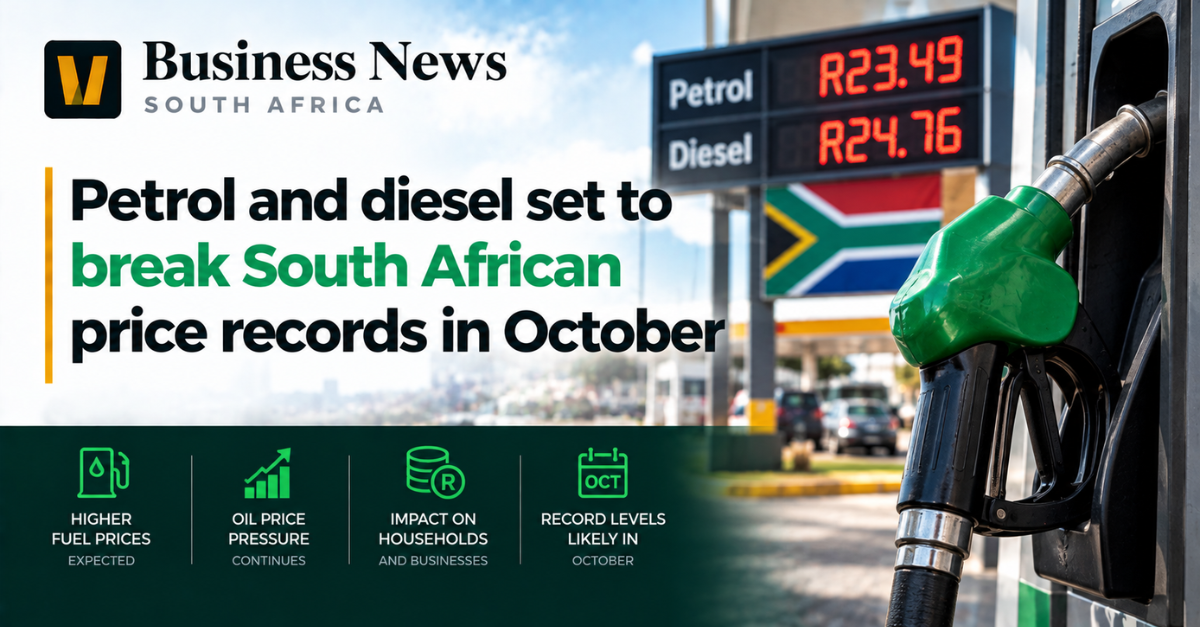
South African motorists are staring at a bill that could eclipse every price seen since the country began tracking fuel costs. Data released by the Central Energy Fund (CEF) for the first week of September shows that, if current market conditions hold, October could bring the highest ever pump price for both petrol and diesel.
What the CEF calls an “under-recovery” is the gap between the wholesale price of fuel and the price that retailers are allowed to charge. In plain terms, an under-recovery of R1.81 per litre for 93 octane petrol means that the cost of buying the fuel from the market is R1.81 higher than the price set by the regulator. When that gap widens, retailers must raise the pump price to stay in business.
For petrol, the under-recovery sits at R1.81 for 93 octane and R1.93 for 95 octane. At those levels, the CEF projects a retail price of about R28.83 per litre, a figure that would top the previous record of R28.06 set in June 2026 when the Iran-US conflict first sent global oil prices soaring.
Diesel is not far behind. The wholesale price of 0.005% sulphur diesel is already R30.05 per litre, and the under-recovery of R2.03 pushes the projected retail price to roughly R32.08 per litre. That would break the May 2026 record of R31.88 and dwarf the pre-2026 high of R25.53 recorded in July 2022.
The main driver behind these widening gaps is the ongoing war between the United States and Iran. After a brief lull in July, peace talks collapsed and both sides have escalated military posturing. The Strait of Hormuz, a narrow waterway that carries about a third of the world’s oil, remains a chokepoint, and any threat to its flow pushes crude prices higher. Crude oil has already climbed past $99 a barrel and is edging toward the psychological $100 mark.
Compounding the Middle-East tension are the wars in Russia and Ukraine, which continue to tighten global supply. Analysts at Goldman Sachs Group note that markets are pricing in a prolonged Middle-East conflict and are raising oil-price forecasts on the assumption that shipping disruptions will last into 2027. They describe the upside risk as “significant”.
Even a relatively strong rand, trading around R16 to the dollar, only softens the impact by about 15 cents per litre. The currency’s resilience cannot offset the scale of the under-recoveries, which are driven by raw oil prices rather than exchange-rate movements.
For small business owners who rely on transport, the outlook is bleak. Higher fuel costs translate directly into higher logistics expenses, which in turn squeeze margins on everything from fresh produce to retail goods. Unless the under-recovery narrows to around R1.13 per litre, an improvement of 80 cents, the record-high prices are likely to stay in place through October.
How the pump price is actually assembled
The South African fuel price is regulated rather than set by competition at the forecourt, and it is adjusted once a month, on the first Wednesday. Knowing how it is built makes the monthly announcement considerably less mysterious and, for a business with vehicles, a good deal more predictable.
The foundation is the Basic Fuel Price, which is an estimate of what it would cost to buy the refined product on international markets and land it in South Africa. The key point, and the one most commonly misunderstood, is that this is based on the international price of refined petrol and diesel rather than the price of crude oil. The two move together but not identically, because refining capacity has its own supply and demand. A refinery outage somewhere in the world can widen the gap between crude and product prices, which is why the pump price sometimes moves in ways a crude oil headline does not explain. To that landed cost are added shipping, insurance, wharfage and storage.
On top of the Basic Fuel Price sit the elements set domestically: the general fuel levy and the Road Accident Fund levy, which are fixed amounts per litre rather than percentages, plus a customs and excise component, a slate levy, and regulated margins for wholesalers and retailers along with transport costs to the region where the fuel is sold. Because the levies are fixed in rand per litre, they do not rise when oil rises. They do mean the pump price never falls below a floor set by tax and margin no matter how far the oil price drops.
Why over and under recovery exist
The regulated price is fixed for a month while the underlying costs move every day. The daily difference between what fuel actually cost and what retailers were permitted to charge accumulates over the month into a running total, and the average of those daily gaps is what determines the next adjustment. An under recovery means the market price ran above the regulated price and the next change is likely to be upward. An over recovery means the opposite.
Two variables drive it, and only two: the international product price and the rand dollar exchange rate. Because fuel is bought in dollars, a weakening rand raises the pump price even when the oil price has not moved at all, and a strengthening rand cushions an oil price rise. The two frequently move in opposite directions, which is why a mid month projection is an indication rather than a commitment. A late swing in either variable in the last days of a month can change the final figure.
For a business running vehicles, the practical value of the mid month figures is timing rather than prediction. They arrive early enough to bring forward a bulk purchase, delay one, or give customers advance notice of a surcharge, which is usually easier to explain before an increase than after it.