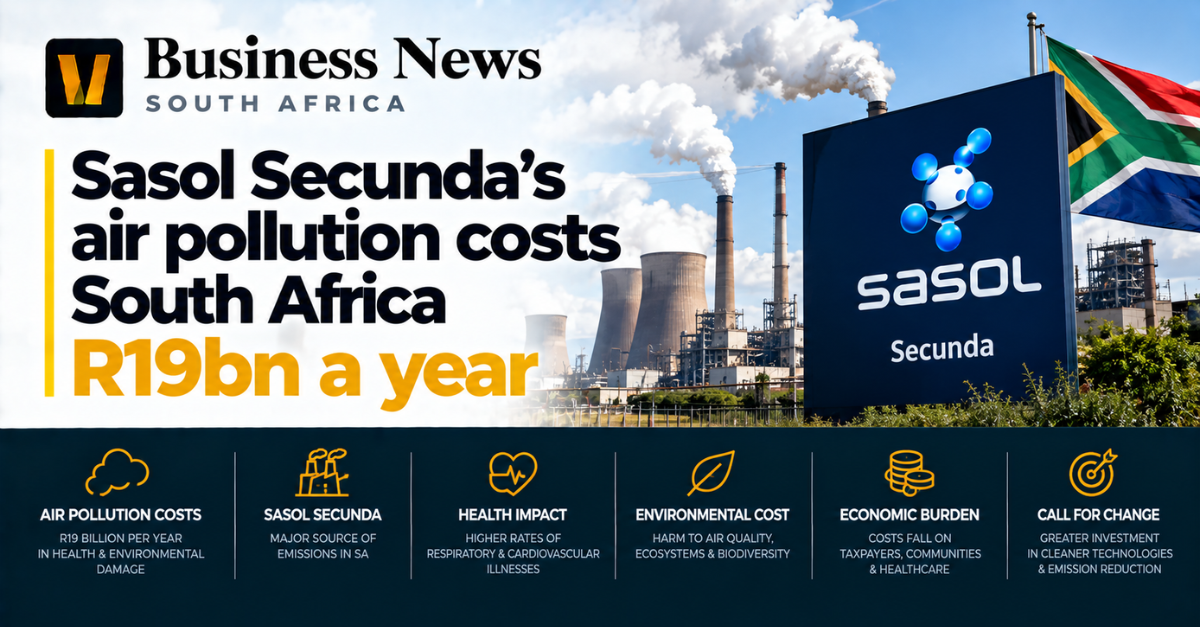
On a typical morning in the Highveld, a faint rotten-egg smell drifts over the town of Secunda, a reminder that the coal-to-liquids complex nearby is still running at full tilt.
According to a report by the Centre for Research on Energy and Clean Air (CREA) published on BusinessTech, the emissions from that complex impose a public-health burden that translates into an economic cost of roughly US$1.0 billion, or R19 billion, each year.
Health and economic toll
The study quantifies the impact of several pollutants. Sulphur dioxide (SO₂), a gas that irritates the lungs and can aggravate asthma, was emitted at 112 kilotonnes in 2024, well above South Africa’s Minimum Emission Standards. Nitrogen dioxide (NO₂) and particulate matter (PM₂.5), tiny particles that can penetrate deep into the lungs, also featured heavily in the emissions profile.
CREA links these pollutants to a range of health outcomes: about 1,000 premature deaths, 23,800 lost years of life, roughly 1,100 pre-term births, and an extra 2,000 asthma-related emergency-room visits in the same year. Almost half of those emergency visits involved children under 18.
When health outcomes are converted into economic terms, using standard estimates for lost productivity, medical costs and the value of statistical life, the total burden reaches the R19 billion figure cited above. The report notes that the cost includes not only direct medical expenses but also lost work days and reduced future earnings.
Why it matters to small businesses
For the many small and medium-size enterprises that operate in the Highveld Priority Area, the region designated for special air-quality management, the hidden cost appears in higher absenteeism, increased health insurance premiums and lower worker productivity. While the report does not break down the impact by company size, the cited productivity losses suggest that local manufacturers, retailers and service providers will feel the pinch through a less healthy workforce.
In addition, the reputation risk of operating near a facility labelled the world’s largest single-site emitter of climate-warming gases can affect customer perception and supply-chain decisions, especially for firms that market themselves as environmentally responsible.
Company response and regulatory outlook
Sasol, the owner of the Secunda plant, says it complies with the requirements of its Atmospheric Emission Licences (AELs) and that it has submitted an Emission Reduction and Management Plan for the Highveld Priority Area in September 2025. The company is awaiting feedback from the licensing authority.
The statement from Sasol is a claim by the company; independent verification of the plan’s effectiveness has not yet been made public.
CREA’s recommendations call for the environmental minister to tighten the alternative SO₂ limits that currently allow the plant to emit more than the standard minimum. The centre also urges binding annual reductions for SO₂, nitrogen oxides (NOₓ), PM₂.5 and hydrogen sulfide (H₂S), greater transparency in emissions reporting and independent monitoring data made publicly accessible.
At present, the government’s response timeline is unclear. The report stresses that without stricter, enforceable limits, the health and economic burden will continue to grow, and the communities, including the workers and small businesses that depend on them, will bear the cost.
In short, the Secunda complex delivers jobs and tax revenue, but the hidden price of its emissions is already being paid by South Africa’s health system, its economy and the people who live and work in the shadow of the plant.
How a health cost estimate like this is built
Numbers of this kind are modelled rather than counted, and it is worth understanding the chain that produces them, because that is where most of the argument between industry and researchers actually takes place. The first link is an emissions inventory, either reported by the operator or estimated from fuel use and process data. The second is atmospheric dispersion modelling, which takes those emissions and estimates the resulting concentration of each pollutant across the surrounding area, using terrain and weather data. The third is a concentration response function drawn from epidemiological literature, which translates a given exposure into an expected change in mortality, hospital admissions or births. Only at the fourth step does money enter, when those health outcomes are valued using standard economic conventions.
Each link carries uncertainty, and the uncertainty compounds. That is why studies of the same facility can arrive at different totals, and why a company disputing a figure will usually attack the modelling assumptions rather than the underlying science. It is also why researchers publishing this work tend to present ranges alongside a central estimate.
The convention that draws the most objection is the value of a statistical life. It is not a price on any individual person. It is derived from what populations are collectively observed to pay to reduce small risks, in wage premiums for dangerous work or in spending on safety equipment, and then scaled up. Economists use it because the alternative, treating avoided deaths as worth nothing in a cost comparison, is plainly worse. It remains a contested tool, and where a study has adapted a value derived in wealthier countries to a South African context, the adjustment method matters a great deal to the headline.
None of that makes the estimate unreliable. It makes it a modelled estimate with a stated method, which is a different thing from a measurement, and it is the reason these reports are usually accompanied by a call for independent monitoring data rather than a call to simply accept the number.
The regulatory mechanism underneath the dispute
Air quality regulation in South Africa works through licences issued to individual facilities, setting limits for named pollutants, and through minimum emission standards that apply across a category of plant. The tension that recurs in cases like this comes from the gap between the two. A facility can hold a valid licence, comply with every condition in it, and still emit more than the general standard, because the licence has been written with an alternative limit specific to that plant.
That is a legal outcome, not a loophole in the ordinary sense, and it exists because regulators have to weigh the cost and feasibility of retrofitting existing plant against the health benefit of a tighter limit. It does mean that compliance and acceptability are separate questions, and that a company can accurately state the first while the argument continues about the second.