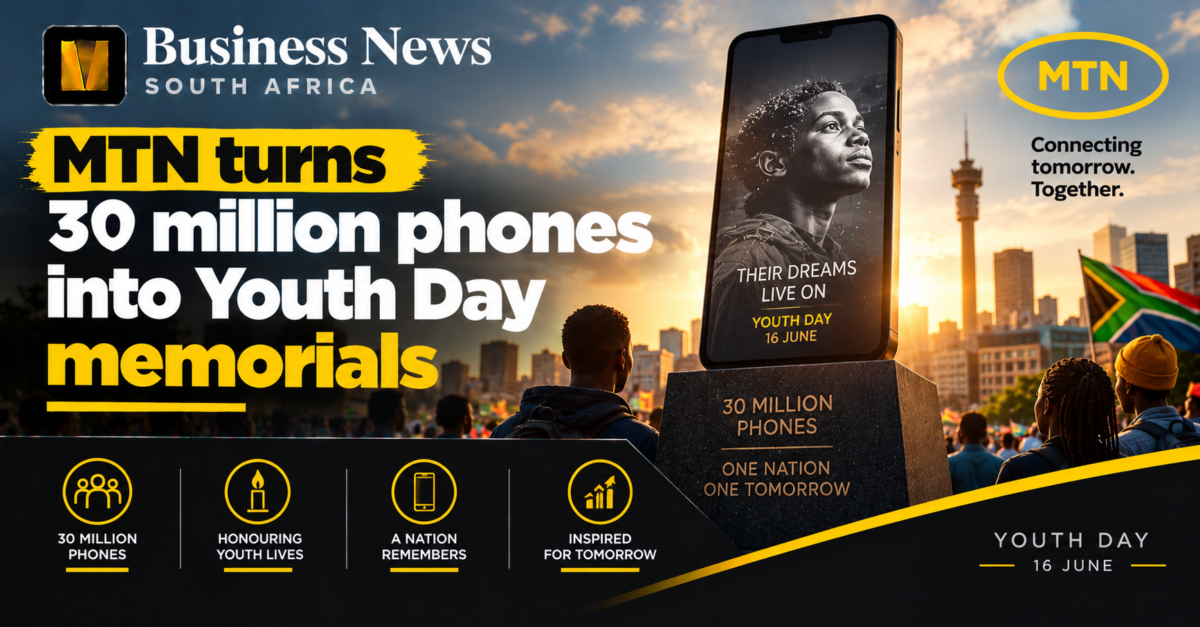
On 11 June, MTN replaced the network name that appears on the status bar of its South African customers’ phones with a tribute to the heroes of the 1976 Soweto uprising. The change was visible to anyone who looked at their handset, turning a routine piece of technology into a reminder of a pivotal moment in the country’s history.
The initiative, called CarryThemForward, was run in partnership with the June16 Foundation, an organisation that preserves the memory of the Youth Day protests. According to the campaign brief, the goal was to honour the young people who changed South Africa’s future and to keep their story alive for a new generation.
MTN’s carrier display name, the short text that tells a phone which network it is connected to, was swapped for the name of Hector Pieterson, the iconic student whose photograph became a symbol of the uprising. The company also encouraged users to change their lock screen, the image that greets a phone when it is unlocked, to a picture of a chosen hero. M+C Saatchi Abel managing director Masego Motsogi said the campaign aimed to turn up to 30 million smartphones into a national tribute.
“This campaign was MTN’s tribute to the young people who helped shape where our country is now,” said Kholofelo Magagane, MTN SA acting brand and marketing general manager. “MTN believes in South Africa. We recognise that, while the country is shaped by the past, it does not necessarily define the future. We acknowledge that, for us to move forward as a country, we must know where we come from. Today’s youth have different needs. They want an inter-connected ecosystem and society, and that is what we strive to provide them with. Connectivity enables them to be heard.”
Motsogi added that the idea was to position MTN as a youth brand that makes the unseen visible and the untold heard. “We believed in a simple, unique idea that authentically reflected the core ethos of Youth Day,” she said. “The single-minded message CarryThemForward encouraged people to choose a hero, create a picture, carry them forward, sending a powerful message that MTN stands with all South Africans in honour of our shared heritage.”
Youth Day marks the 50th anniversary of the Soweto uprising, a protest sparked by a school-pass law that forced black students to carry passbooks. The death of Hector Pieterson and the subsequent crackdown ignited a nationwide movement that eventually contributed to the end of apartheid. For many South Africans, the day is a reminder of both sacrifice and the power of collective action.
For small and medium-size enterprises, the campaign offers a case study in cause-related marketing. By using a piece of brand space that is normally static, the carrier name, MTN turned a functional element into a storytelling platform. The approach shows how a business can align its brand with a national narrative without a direct sales pitch, potentially building goodwill and deeper customer engagement. SMEs with limited advertising budgets might consider similar low-cost tactics, such as overlaying social messages on existing digital assets or partnering with community organisations to amplify a shared cause.
The numbers cited, up to 30 million phones, come from the agency’s statement and have not been independently verified. The impact on brand perception or sales remains to be measured, but the campaign has already generated a noticeable conversation on social media and in the press.
The narrow ground a commemorative campaign stands on
Marketing that attaches a brand to a national memory operates with very little margin for error, and the reason is that the memory does not belong to the brand. An audience will accept a company participating in a commemoration and will react sharply to one appearing to use it, and the line between the two is drawn by the audience rather than by the marketer.
The factors that usually decide which side a campaign lands on are reasonably consistent. Whether the brand has any legitimate connection to the subject, or is borrowing significance it has not earned. Whether the execution asks the audience to do something meaningful or simply to look at the brand. Whether a product is being sold in the same breath. And whether the commitment extends past the day itself, because a gesture that appears on the anniversary and disappears the following morning invites the obvious question about what the rest of the year is for.
Partnership with an organisation that holds the subject matter is the most common structural safeguard, and it works when the partner has genuine standing and an actual role rather than a logo placement. It does not substitute for the other three.
The asset nobody counts as media
The transferable idea for a smaller business has nothing to do with the scale involved. It is that most companies own communication surfaces they have never thought of as media, and those surfaces are already paid for.
An invoice is read by somebody in every single customer organisation, usually carefully. A delivery vehicle sits in traffic for hours. A packing slip is handled by hand. An order confirmation email is opened at a rate almost no marketing email achieves. A receipt, a job card, an out of office reply and a hold message are all read by people who chose to deal with the business. None of them appear in a marketing budget, and none of them cost anything additional to use.
The constraint is the same one that governs the larger version. These surfaces work for a message that is genuinely relevant to the business and its customers, and they irritate when they carry something borrowed. A functional space turned into a statement earns attention precisely because it is unexpected, which is also why it does not survive being used carelessly or often.
Measurement, honestly
Campaigns of this kind are difficult to evaluate, and the number most readily available is the least meaningful. Reach counts how many people could have seen something, not how many noticed it, and certainly not how many thought better of the brand afterwards.
The measures that carry information are harder and slower to collect: brand tracking studies that ask the same questions of comparable samples before and after, sentiment analysed rather than counted, and eventually consideration and preference. That is why companies running this kind of work rarely make a sales claim afterwards. In most cases there is no defensible one to make, and the honest position is that the effect is real, gradual, and not separable from everything else the brand did that year.