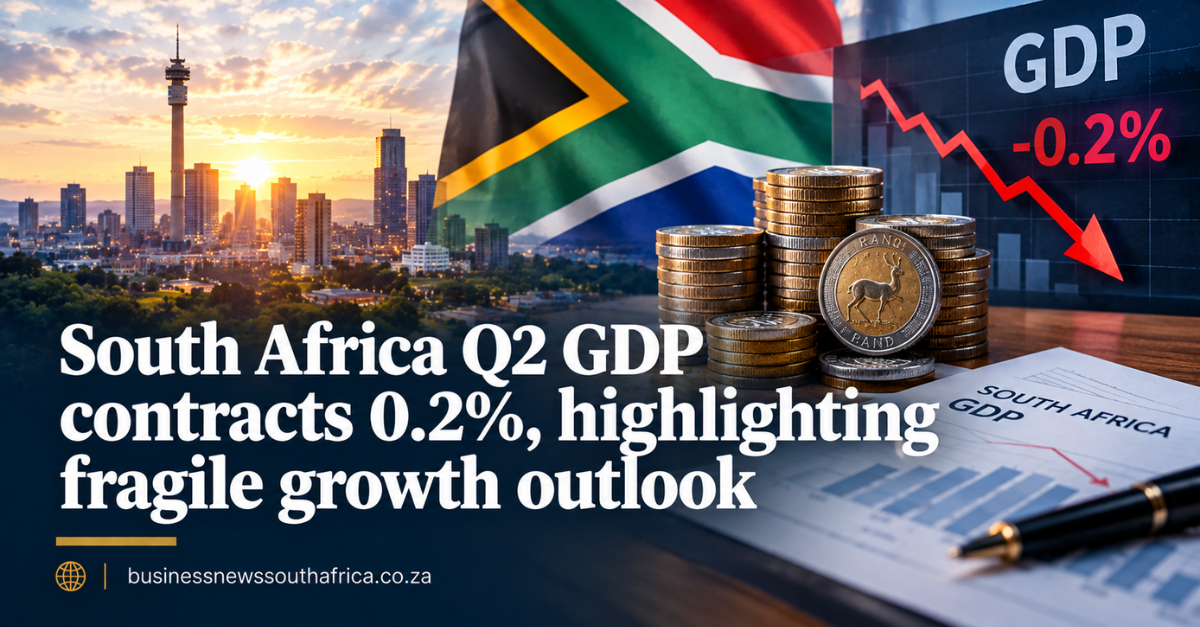
According to the latest quarterly gross domestic product (GDP) release, South Africa’s economy shrank by 0.2% in the second quarter of 2024, ending a six-quarter stretch of growth. The figure comes from Statistics South Africa and marks the first contraction since the end of 2022. A decline in overall output signals that the aggregate value of goods and services produced in the country fell compared with the previous three-month period, and it raises concerns among policymakers, investors and business owners who rely on a growing economy to sustain employment and revenue streams.
How GDP is measured and why the change matters
GDP is calculated by adding together consumption, investment, government spending and net exports. When any of these components weakens, the total can slip, as happened in this quarter. The contraction is not merely a statistical footnote; it reflects reduced demand for products, lower sales volumes and a slowdown in the flow of capital through the economy. For a business owner, a shrinking GDP often translates into fewer customers, tighter credit conditions and heightened competition for limited market share.
Sectoral performance drives the headline number
GDP, the total value of all goods and services produced, fell because three of the biggest sectors, trade, manufacturing and mining, all recorded declines. These sectors together account for a large share of employment and export earnings, so weakness in each amplifies the overall impact. Agriculture managed a modest increase, while the electricity and transport sectors provided a small upside that was not enough to offset the broader weakness. The mixed performance highlights the uneven nature of the economy, where some activities can grow while others contract, creating a patchwork of opportunities and challenges for firms operating across different industries.
Investment trends signal future growth potential
Investment, measured as gross fixed capital formation (the amount spent on buildings, machinery and equipment), slipped to 13.6% of GDP, 0.2 percentage points lower than the previous quarter. Private investment held relatively steady, but spending by state-owned enterprises and the government fell sharply. The drop reflects both the lingering uncertainty around reliable power and the still-slow rollout of logistics upgrades. When businesses postpone or cancel projects that involve new factories, warehouses or technology, the ripple effect can be felt in supply chains, employment and tax revenues.
Transnet’s turnaround offers a glimpse of resilience
One bright spot was Transnet, the state-owned rail, port and pipeline operator. It posted a profit of R4.6 billion, a turnaround from a R1.9 billion loss a year earlier. The improvement was driven by the concession of the Durban Gateway Terminal, which generated R12.5 billion in revenue. Transnet chief executive Michelle Phillips was praised for delivering a clean audit opinion for the second consecutive year, signalling stronger financial controls. A healthier Transnet can reduce bottlenecks at ports and rail hubs, lower freight costs and improve the reliability of moving raw materials and finished goods, which is vital for manufacturers and exporters.
Implications for small- and medium-sized enterprises
For small- and medium-sized enterprises, the contraction signals tighter demand and a tougher credit environment. Unreliable electricity supply and bottlenecks in transport have long been cited as barriers to growth; the latest data suggest those barriers are still influencing business confidence. Companies that depend on export markets or on moving raw material through ports may see margins squeezed if logistics do not improve further. In addition, reduced consumer spending can limit sales for retailers and service providers, forcing owners to reconsider staffing levels, inventory policies and pricing strategies.
Policy reforms under the Business-Leadership South Africa partnership
The Business-Leadership South Africa (BLSA) partnership is now moving into Phase 3, which shifts the focus from fixing basic infrastructure to actively driving growth. The plan calls for completing the unbundling of the independent transmission system operator, launching the South African Wholesale Electricity Market and establishing a Transport Economic Regulator. If those reforms deliver a more predictable supply of power and smoother freight flows, SMEs could see a more stable environment for investment and hiring. The reforms aim to create a level playing field where competition is based on efficiency rather than on the ability to absorb higher operating costs.
Why electricity market reforms matter to business owners
The electricity sector in South Africa has traditionally been dominated by a single utility that has struggled with capacity constraints and financial challenges. Unbundling the transmission system separates the management of the grid from generation and retail, which can encourage new entrants, improve transparency and reduce the risk of price volatility. A wholesale market allows generators to sell electricity based on market prices, fostering competition that can drive down costs over time. For a business owner, lower and more reliable electricity bills translate directly into lower operating expenses and fewer production interruptions.
Transport regulation and its impact on logistics
Establishing a Transport Economic Regulator is intended to oversee rail, road and port services, set performance standards and resolve disputes. Effective regulation can reduce delays, improve safety and ensure that tariffs reflect the true cost of service provision. When freight moves more quickly and predictably, companies can adopt just-in-time inventory practices, reduce warehousing costs and improve customer satisfaction. For exporters, smoother transport links can enhance competitiveness in international markets by shortening delivery times.
How state-owned enterprise spending influences the broader economy
Spending by state-owned enterprises often acts as a catalyst for private sector activity because these entities contract for construction, maintenance and services. When their investment falls, the ripple effect can be felt in the construction industry, in suppliers of raw materials and in professional services such as engineering and consulting. The recent decline in government and state-owned enterprise spending therefore compounds the challenges faced by private investors, who may encounter fewer opportunities for partnership or subcontracting.
Financing conditions and the credit environment
A contraction in GDP typically leads banks and other lenders to tighten credit standards as they reassess risk. For small businesses that rely on loans to fund working capital, equipment purchases or expansion, tighter credit can mean higher interest rates, longer approval times or reduced loan amounts. This environment can force owners to seek alternative financing, such as equity investment or supplier credit, which may come with different costs and governance implications.
Outlook and strategic considerations for the coming quarters
While the current data point to a modest contraction, the underlying structural reforms outlined by the BLSA partnership offer a pathway to renewed growth. Business owners should monitor the progress of electricity market liberalisation and transport regulation, as these areas are likely to produce measurable improvements in cost structures and reliability. Diversifying supply chains, investing in energy-efficient technologies and strengthening relationships with logistics providers can also mitigate some of the risks associated with the present downturn. By aligning strategic decisions with the anticipated policy environment, firms can position themselves to benefit from the next phase of economic expansion.