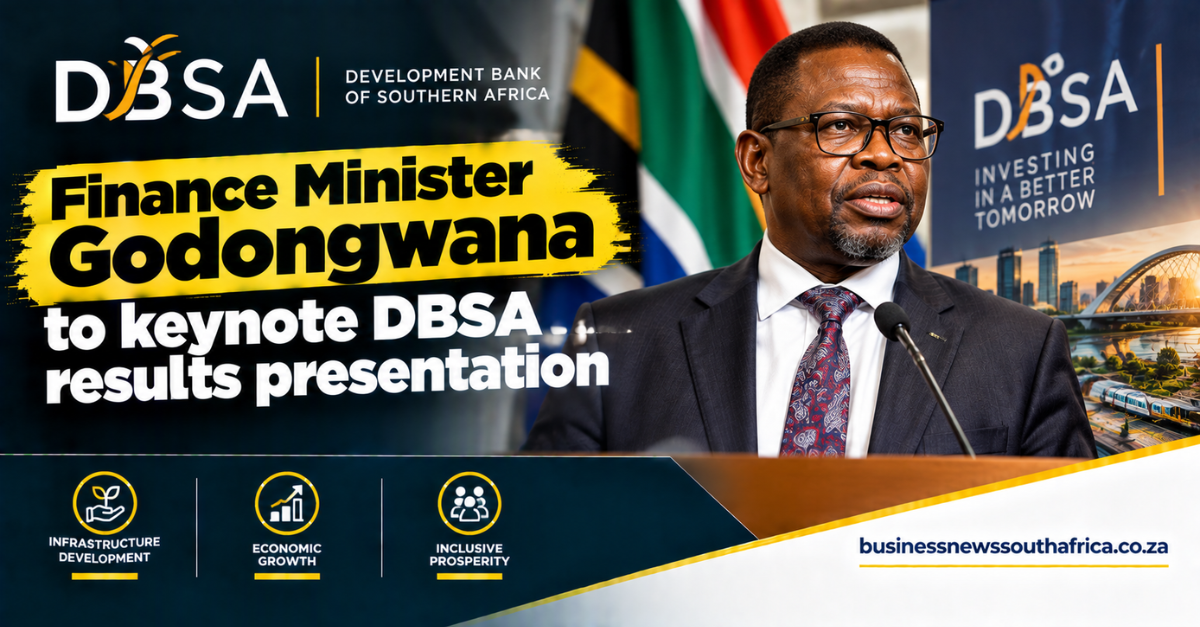
According to Central News South Africa, Finance Minister Enoch Godongwana will deliver the keynote address at the Development Bank of Southern Africa (DBSA) results presentation. The appearance places the minister at the centre of a forum that reviews the bank’s performance and outlines its future priorities.
The DBSA is a development finance institution, a bank that provides long-term loans and technical support for projects that boost economic growth, such as water infrastructure, renewable energy and transport links. Its loan book sits in the tens of billions of rand and is largely funded by the South African government, multilateral partners and private investors.
Why should a small-to-medium enterprise (SME) owner care? Development banks often act as a conduit for financing that would otherwise be unavailable to smaller firms. When the DBSA funds a large power-plant or a water-treatment project, subcontractors, suppliers and service providers, many of which are SMEs, can win contracts and gain cash flow. A ministerial keynote can signal whether the government intends to keep that pipeline flowing, expand it, or tighten the criteria.
In recent years the DBSA has increased its focus on green projects, aligning with South Africa’s commitment to reduce carbon emissions. The bank’s annual results usually include data on the number of jobs created, the amount of private capital leveraged and the sectors receiving the most support. If the minister highlights these figures, it may reinforce the policy narrative that development finance is a lever for job creation and economic diversification, topics that sit at the heart of many SME owners’ concerns.
What the keynote could mean for the broader economy
While the exact content of Godongwana’s speech is not yet public, past appearances have covered topics such as fiscal sustainability, the role of development finance in closing the infrastructure gap, and the need for private-sector participation. A clear message of continued backing could encourage banks and investors to partner with the DBSA, potentially widening the pool of funds that eventually trickle down to smaller businesses.
Conversely, if the speech hints at tighter fiscal constraints, SMEs might see a slowdown in the flow of large-scale project financing, which could reduce the number of subcontracting opportunities. For owners who rely on government-linked projects, the tone of the address will be a useful barometer of the investment climate in the months ahead.
In short, the finance minister’s presence at the DBSA results presentation is more than ceremonial. It offers a glimpse into how the government views development finance as a tool for economic growth, and that view will shape the environment in which SMEs operate.
The DBSA is one of the country’s key development finance institutions, funding infrastructure projects in energy, water, transport and social infrastructure across the region. The Development Bank of Southern Africa’s own annual disclosures carries further detail. For related coverage, see this site’s Markets and Finance coverage.
Development finance institutions like the DBSA occupy a different niche to commercial banks, typically taking on longer-dated infrastructure risk that private lenders are reluctant to carry alone, and often blending their own balance sheet with concessional funding from multilateral partners to bring down the overall cost of a project.
Results presentations of this kind are also an opportunity for a development finance institution to signal its lending appetite for the year ahead, information that construction firms, engineering consultancies and equipment suppliers in the infrastructure sector often use to plan their own pipelines.
The DBSA’s own funding mix has shifted over the years toward a heavier weighting of renewable energy, water and municipal infrastructure projects, areas where private capital has been more willing to co-invest alongside the bank than in some of the harder infrastructure categories state utilities still dominate. A results presentation therefore also gives analysts a sense of which of those categories is actually attracting bankable projects, rather than just sitting on a strategy document.