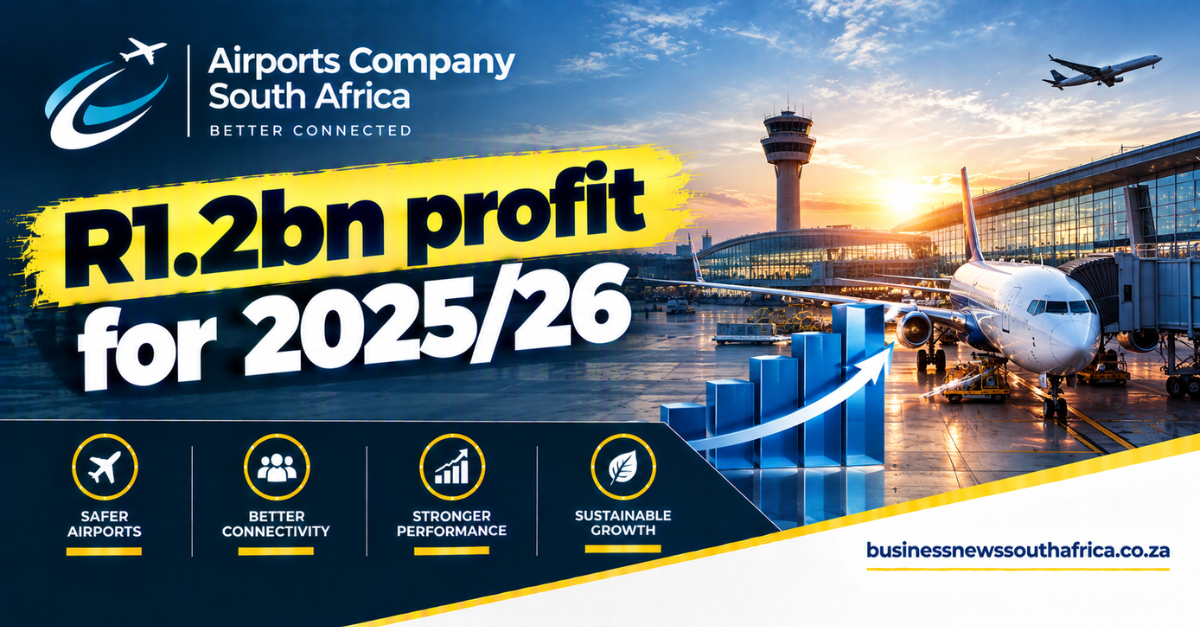
For airlines, cargo firms and retailers that rely on airport traffic, the latest numbers from Airports Company South Africa (ACSA) matter more than any headline. The state-owned operator said it earned a profit after tax (net profit after taxes) of R1.2 billion for the 2025/26 financial year and generated revenue of R8.8 billion, an 11.6% increase on the previous year. Those figures show that passenger and cargo activity is moving back toward pre-pandemic levels, giving businesses that serve travellers a clearer picture of demand.
Charles Shilowa, acting chief executive of ACSA, described the operating environment as one of “renewed momentum, shifting demand patterns, and continued complexity”. In plain terms, more people are flying again, but the network still faces bottlenecks such as runway capacity and ageing terminals. Shilowa said the company managed to grow despite those pressures by sticking to disciplined execution and investing in its airport network.
What the numbers mean for businesses
The rise in revenue came largely from higher passenger fees, retail concessions and cargo handling charges. For small retailers that lease space in terminals, a stronger passenger flow can translate into more sales per square metre. Cargo operators, many of whom are SMEs, may also benefit from the company’s stated focus on “exploiting growth in cargo volumes” as part of its capex (capital expenditure) programme that runs to the 2029/30 financial year.
ACSA’s three-pronged strategy, Innovate, Grow and Sustain, is already being funded through that capex plan. The company says the programme will upgrade infrastructure, boost capacity and secure new revenue sources. In practice, that could mean larger terminal expansions at busy hubs, more parking bays for aircraft and improved digital services for passengers. Such upgrades tend to create short-term construction contracts for local firms and longer-term opportunities for technology suppliers.
Recognition of airport performance also supports the business case. Cape Town International Airport won its 11th consecutive Skytrax Best Airport in Africa award, plus accolades for staff and cleanliness. The airport is estimated to contribute R2.7 billion to regional gross domestic product (GDP). O.R. Tambo International Airport, the country’s main gateway, earned the Skytrax Best Airport Hotel award and is linked to R5.9 billion of regional GDP. King Shaka International Airport and other regional airports also collected Skytrax awards and improved health and carbon accreditations, signalling a broader push toward sustainability.
For SMEs that operate retail outlets, food services or ground handling at these airports, the awards matter because they attract more travellers and airlines. Higher passenger satisfaction often leads to longer dwell times, which can boost sales for shops and restaurants. Likewise, a cleaner, more energy-efficient airport can lower operating costs for tenants that pay utility fees based on consumption.
Shilowa warned that the sector still faces “persistent infrastructure, capacity and operational pressures”. While the capex programme aims to address those issues, the timeline extends to 2029/30, meaning that some constraints will remain in the near term. Businesses should therefore monitor the rollout of specific projects, such as runway extensions at O.R. Tambo or terminal upgrades at King Shaka, to gauge when capacity bottlenecks may ease.
Despite “economic volatility and geopolitical uncertainty”, Shilowa said the medium-term outlook for aviation remains constructive. That optimism rests on the expectation that passenger numbers will keep rising and that cargo volumes will grow as global supply chains adjust. For entrepreneurs eyeing airport-related ventures, the message is clear: demand is returning, but success will depend on aligning with ACSA’s investment schedule and meeting the higher standards set by recent awards.
Airports Company South Africa operates the country’s busiest airports, including OR Tambo, Cape Town International and King Shaka, and its results are typically read as a proxy for the broader recovery in air travel and tourism since the pandemic-era slump in passenger numbers. As a state-owned enterprise, ACSA’s profitability also matters beyond its own balance sheet, since a financially healthy ACSA is better placed to fund the runway, terminal and security upgrades airlines and cargo operators rely on without needing government support. ACSA’s own investor and results disclosures carry the full detail behind this year’s numbers. For related coverage, see this site’s Energy and Infrastructure coverage.