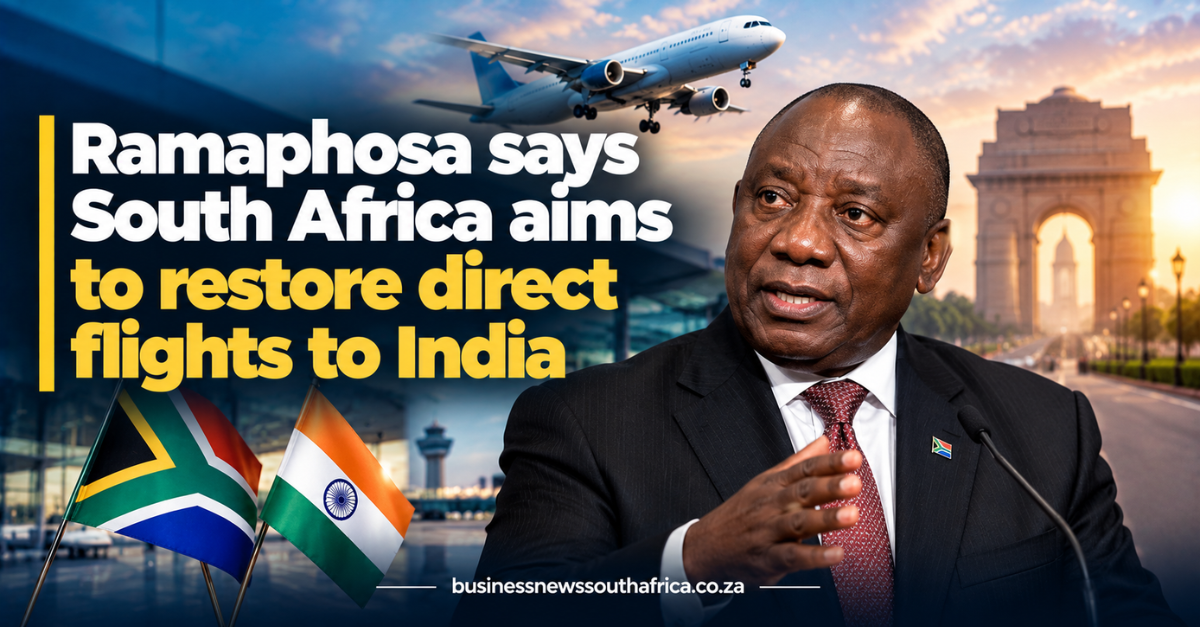
President Cyril Ramaphova told a business roundtable in New Delhi that South Africa is working to bring back direct flights to India. The aim is to turn the existing trade and tourism potential into real economic activity.
For South African exporters and importers, a direct route would cut out the long layovers that currently force cargo and passengers through the Middle East or Europe. That could lower shipping costs for goods such as pharmaceuticals, health-technology equipment and critical minerals, sectors that both countries have highlighted as growth areas.
Ramaphova said India’s strength in pharmaceuticals and health technology can help South Africa expand local production of medicines and vaccines. He also pointed to India’s capabilities in information technology, financial technology and digital public infrastructure as support for modernising South African systems and services.
What the plan entails
Airports Company South Africa (ACSA) announced in September 2025 that it intends to connect the country’s three main international airports with India. The first route on the agenda is a direct flight between Mumbai and Johannesburg, which carries 58% of passenger traffic between the two nations. ACSA also plans links from Mumbai to Cape Town and Durban, and a direct service from Delhi to Johannesburg.
South African Airways (SAA) is aiming to resume operations to India in 2026 after a hiatus of more than ten years caused by aircraft shortages. However, no nonstop flights have launched yet.
Tourism Minister Patricia de Lille has led delegations to meet Indian carriers such as Air India, IndiGo and SpiceJet. The goal is to secure airline commitments that will increase the flow of the roughly 126,000 travellers who move between the two countries each year.
Mpho Rambau, acting group manager for traffic development at ACSA, said the agency has presented a business case to several carriers and is in advanced stages of dialogue with selected partners. He explained that ACSA has completed market studies, traffic-flow analysis and passenger-demand modelling to prove the commercial viability of the routes.
The bilateral agreement allows for 28 weekly flights in each direction, which Rambau believes is sufficient for the current demand of over 126,000 annual passengers. India ranks as the seventh-largest source of visitors to South Africa, delivering more than 42,600 arrivals between January and July 2025.
For South African small and medium-sized enterprises, the prospect of direct flights could mean easier access to Indian markets for both raw materials and finished products. Travel agencies, tour operators and logistics firms stand to benefit from higher passenger volumes and reduced transit times.
While the statements from the president and ACSA are clear, the exact timetable for airline commitments remains unconfirmed. The next steps will depend on negotiations with carriers and the ability of SAA to secure suitable aircraft.
India is already one of South Africa’s largest trading partners in Asia, spanning pharmaceuticals, mining equipment and vehicle components, and a restored direct air link would cut travel times that currently require a stopover in the Gulf. The Department of Trade, Industry and Competition’s own trade disclosures carries further detail. For related coverage, see this site’s Regulatory and Policy coverage.
The current absence of a direct route follows years in which South African Airways scaled back its long-haul route network amid its own financial difficulties, leaving fewer nonstop options between South Africa and several major Asian markets. Reinstating routes of this kind typically depends on securing enough business and premium leisure traffic to justify wide-body aircraft, since a route running mostly on price-sensitive economy demand is harder to sustain profitably over the long term.
Airlines typically review a route like this against fuel costs, aircraft availability and reciprocal landing rights agreed between the two countries’ aviation authorities before committing to a fixed schedule.